

UNISON. Scotland's biggest and liveliest trade union, representing members delivering public and related services.
Showing posts with label Child Poverty. Show all posts
Showing posts with label Child Poverty. Show all posts
Sunday, 3 May 2015
May Scotland in UNISON now online


Saturday, 2 May 2015
Make work fair for parents and give children decent childhoods, say UNISON and Child Poverty Action Group
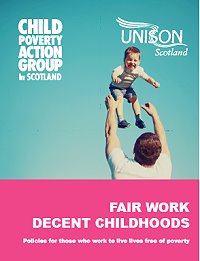
The call comes as the two organisations release their report Fair Work and Decent Childhoods – policies for those who work to live lives free of poverty. They call for investment in the social security system and say we must not allow a race to the bottom on skills, pay and insecure work.
John Dickie, Director of the Child Poverty Action Group in Scotland said ‘“The new UK government will inherit a child poverty crisis with a shocking 59% of poor children in Scotland living in working families. For the future of our children and our economy we need urgent action to make work fair for parents and allow them to give their children the decent childhoods they deserve. That’s why as anti-poverty campaigners and trade unionists we have united in setting out three key priorities for the new government – decent pay, family friendly workplaces and investment in in-work benefits.”
Wednesday, 22 April 2015
End 1 in 5 children living in poverty in Scotland

Delegates called for a review of the benefit system to ensure that it acts as a genuine safety net against poverty; and a wider provision of good quality, affordable childcare to improve parents access to work and children's education outcomes.
Tackling poverty to tackle education inequalities

Monday, 13 October 2014
Working harder but getting poorer is conclusion of new report comparing wages and prices
Mon 13 October 2014
A new report from public services union UNISON - 'The Price of Everything and the Value of Wages' - paints a stark picture of the decline and fall in living standards for workers across public services.
Years of zero or below inflation pay rises have meant that the value of wages has failed to keep pace with rising prices. 'The Cost of Everything and the Value of Wages' tracks how prices have risen faster than wages and the way that inflation as it is experienced by the poorly paid is often significantly higher than headline figures would suggest.
The report details how the cost of food, fuel, childcare and rent amongst other essentials has increased faster than wages.
Dave Watson, Head of Bargaining and Campaigns with UNISON Scotland said:
“It’s no coincidence that we are bringing this report out at the start of Challenge Poverty week and the day of the Poverty Alliance Conference. Wage freezes are reducing people to poverty one fifth of the children in poverty in Scotland are in households where at least one adult is working.
"It’s no use politicians in Edinburgh and London trumpeting record employment figures if those in work aren’t getting enough to live on.
"Scotland needs a pay rise that’s the message we’ll be sending out loudly all this week and most especially on Saturday’s STUC demonstration for Decent Work and Dignified Lives.”
ENDS
Notes to editors:
The full UNISON Scotland report 'The Price of Everything and the Value of Wages' can be found herehttp://www.unison-scotland.org.uk/publicworks/
ThePriceof_UNISONScotlandReport_Oct2014.pdf
STUC Demonstration 18 October For A Just Scotland: Decent Work and Dignified Lives - Saturday 18 October 2014 in Glasgow. STUC links for more information
http://www.stuc.org.uk/
http://www.ajustscotland.org/events/4/18-october-march-and-rally
ThePriceof_UNISONScotlandReport_Oct2014.pdf
STUC Demonstration 18 October For A Just Scotland: Decent Work and Dignified Lives - Saturday 18 October 2014 in Glasgow. STUC links for more information
http://www.stuc.org.uk/
http://www.ajustscotland.org/events/4/18-october-march-and-rally
Tuesday, 7 January 2014
Announcement of free healthy school lunches for all P1 to P3 children is "a huge boost"
Child poverty campaigners and trade unions including UNISON
today welcomed news of free healthy school lunches for all P1 to P3 children.
It was described as “a
huge boost” for children and families by the coalition of children’s
charities, anti-poverty campaigners, churches and trade unions who have been
campaigning for the Scottish Government to deliver on its longstanding pledge
to do this.
Wednesday, 25 September 2013
Unions, churches and charities urge Scot Gov to deliver on free school meals
UNISON today joined the STUC, churches and
charities in urging the Scottish Government to deliver on its free school meals
policy.
The call follows Deputy Prime
Minister Nick Clegg's announcement last week of free school meals for children
in P1-P3 in England from September 2014.
UNISON Scotland has long
campaigned for universal free school meals and is disappointed that the
Scottish Government has not delivered on its commitment to provide a free
healthy lunch to all pupils in P1-P3.
At a time when child poverty is
predicted to increase significantly, food bank use is soaring and family
budgets are hit by falling incomes and rising food and energy bills, free
school meals are more important than ever.
Thursday, 27 June 2013
Scottish implications of UK Spending Review
The UK Spending Review confirms a real terms cut in the Scottish
Government’s budget of £333m between 2014/15 and 2015/16. The capital budget
will have been cut by 26% in real terms since 2010.
The ‘new’ money claim by
the Secretary of State, is actually largely borrowing powers that have to be
repaid from a reducing revenue budget. Instead of the promised growth, £3.2bn
is being taken from the Scottish economy.
Specific proposals
directly impacting on public service workers include:
Wednesday, 17 April 2013
Tackle poverty to help children's education
#stuc13 Congress condemned the inequalities in education, linked to poverty, which blight the life chances of many of Scotland’s children, and prevent them from taking up places in colleges and universities - Susan Kennedy full story at http://www.unison-scotland.org.uk/stuc2013/12.html
Women and work – STUC demands good quality jobs, not zero hours and less pay
#stuc13 17 April 2013
UNISON's Equalities Officer Eileen Dinning, highlighted the pressures on women in the workforce in her speech to STUC Congress today.
Eileen, in her role as chair of the STUC Women's Committee, said: "Women are struggling under the Coalition Government’s austerity programme.
"Tackling child poverty means tackling women’s poverty. The STUC Women’s Committee will continue to argue for secure well paid employment for all.
"Women are present in increasing numbers in our conferences and in the trade union movement. We will speak up for them, and give them hope for the future.”
Her full speech is below.
CONFERENCE, THANKS FOR THE OPPORTUNITY TO ADDRESS YOU ON BEHALF OF THE STUC WOMEN’S COMMITTEE.
I AM NOT SURE HOW MUCH HAS BEEN SAID TODAY ABOUT THATCHER.
BUT THERE WAS A SIGNIFICANT AMOUNT OF DROSS SPOKEN LAST WEEK ABOUT HER.
THE NOTION SHE WAS A ROLE MODEL FOR WOMEN WAS DELUSIONAL.
SUCH A SUGGESTION IS DELUSIONAL.
SHE CREATED NO POSITIVE CHANGE FOR WOMEN.
SHE HAD THE ACCIDENT OF BEING BORN FEMALE – NOTHING MORE.
AS BEA CAMPBELL STATED.... "SHE HAS NOT FEMINISED POLITICS BUT HAS OFFERED FEMININE ENDORSEMENT FOR PATRIARCHAL POWER."
AND THOSE PATRIARCHS ARE CARRYING ON HER WORK WITH OBSCENE ENTHUSIASM.
IF SHE DID ANYTHING POSITIVE IT’S TO BE A CONSTANT REMINDER OF HOW IMPORTANT THE TU MOVEMENT IS TO WOMEN.
SCOTTISH TUC REPRESENTS OVER 300,000 TRADE UNION WOMEN IN SCOTLAND.
INCREASINGLY, WOMEN ARE THE MAJORITY IN MANY OF OUR AFFILIATES. IN SOME CASES 60 – 70%.
MAJORITY ARE LOW PAID.
MANY ARE STRUGGLING UNDER THIS GOVERNENT’S AUSTERITY PROGRAMME.
OR LET’S CALL IT WHAT IT REALLY IS – A DIRECT ATTACK ON THE POOR, A PROTECTION RACKET FOR THE RICH AND OUTRIGHT CONTEMPT FOR WORKING PEOPLE.
AND IF THE SCOTTISH GOVERNMENT WANT TO HELP MITIGATE THE WORST ASPECTS OF THE BEDROOM TAX, THEN MAKE THE CHANGES TO LEGISLATION THAT WILL PREVENT UNNECESSARY EVICTIONS THAT WILL DISPROPORTIONATELY IMPACT ON WOMEN, CHILDREN AND THE DISABLED.
WITH THAT BEING THE BACKGROUND THE WOMEN’S COMMITTEE WORK PLAN FOR 2013 NEEDED TO REFLECT THESE CHALLENGES.
THE THEMES WITHIN WHICH THE COMMITTEE IS WORKING ARE:
- ECONOMY AND EMPLOYMENT
- INCREASING WOMEN’S REPRESENTATION AND PARTICIPATION
- EDUCATION AND LIFELONG LEARNING
- SOCIAL JUSTICE
- HEALTH
- COMBATING VIOLENCE AGAINST WOMEN AND CHILDREN
- INTERNATIONAL ISSUES.
OUR PRIORITIES FOCUS ON:
- ECONOMY AND EMPLOYMENT
- INCREASING WOMEN’S REPRESENTATION AND PARTICIPATION
THAT DOESN’T MEAN THAT THE OTHER ISSUES ARE ANY LESS IMPORTANT BUT WE NEED TO BE CLEAR THAT WOMEN’S EMPLOYMENT IS CRUCIAL AND THAT WOMEN’S REPRESENTATION CAN PLAY A BIG PART IN MAKING THAT A REALITY.
LAST YEAR, AND WORKING WITH THE SCOTTISH GOVERNMENT, WE PARTICIPATED IN A SUCCESSFUL WOMEN’S EMPLOYMENT SUMMIT.
SOME OF THE PRIORITIES TO BE PROGRESSED TOGETHER FOLLOWING THE SUMMIT ARE:
- STATE FUNDED CHILDCARE PROVISION, INCLUDING INVESTING IN THE WORKFORCE IN THE SECTOR;
- CHALLENGING THE INCREASED CASUALISATION OF THE LABOUR MARKET;
- EXPERIENCE AND CHALLENGES FOR WOMEN OVER 50 IN THE LABOUR MARKET;
- AND PROMOTING EMPLOYMENT OPPORTUNITIES FOR WOMEN IN ALL SECTORS.
ACCORDING TO 2011 WORKPLACE EMPLOYMENT RELATIONS STUDY, ZERO HOURS CONTRACT ARE ON THE RISE AND THIS FOLLOWS A SURGE IN THE NUMBER OF PUBLIC SECTOR SERVICES CONTRACTED OUT TO PRIVATE PROVIDERS.
FIGURES BY THE ONS FOUND THAT THE NUMBER OF WORKER IN JOBS WITHOUT ANY GUARANTEE OF REGULAR HOURS OR PAY REACHED 200,000 IN THE FINAL QUATER OF 2012 – 40,000 MORE THAN THE SAME QUARTER IN 2011.
A BREAKDOWN SHOWS 52% ARE WOMEN AND 48% ARE MEN.
THAT IS WHY IT IS ESSENTIAL THAT THE SCOTTISH GOVERNMENT ENSURES THAT THE PROCUREMENT REFORM BILL SHOULD BE USED TO PROMOTE :-
- LABOUR RIGHTS AND WORKFORCE PROTECTIONS
- A POSITIVE EMPLOYMENT AGENDA
- THE SCOTTISH LIVING WAGE - BOTH FOR DIRECTLY EMPLOYED STAFF AND FOR
EMPLOYEES WORKING FOR CONTRACTORS
IN RESPECT OF INCREASING WOMEN’S PARTICIPATION IN PUBLIC LIFE, WE ARE PUTTING THE 50/50 CAMPAIGN BACK ON THE AGENDA THROUGH BUILDING LINKS WITH PARLIAMENTARIANS, WOMEN’S ORGANISATIONS, AND SCOTTISH CIVIC SOCIETY, IN PARTICULAR CAMPAIGNING FOR INCLUSION OF COMMITMENTS ON WOMEN’S REPRESENTATION DURING THE DEBATE ON CONSTITUTIONAL CHANGE.
OUR OTHER PRIORITIES – WHICH ARE INEXTRICABLY LINKED TO WOMEN’S EMPLOYMENT AND PUBLIC LIFE – WE ARE PURSUING THE GOAL OF FREE SCHOOL MEALS; WORKING TO ENSURE THAT WOMEN IN RURAL AREAS FEEL SUPPORTED AND CONTINUING TO GIVE PRIORITY TO THE CAMPAIGN OF COMBATTING VIOLENCE AGAINST WOMEN.
LAST MONTH WE ATTENDED THE SCOTTISH WOMEN’S CONVENTION’S INTERNATIONAL WOMEN’S DAY EVENT IN THE SCOTTISH PARLIAMENT.
THE THEME WAS WOMEN OF INFLUENCE.
WE LISTENED TO WOMEN POLITICIANS FROM MOST POLITICAL PARTIES HIGHLIGHTING THE VERY ISSUES WE SPEAK ABOUT EVERY YEAR.
- CHILDCARE,
- LIVING WAGE,
- FLEXIBLE WORKING,
- EQUAL PAY.
WE MADE THE POINT THAT YOU CANNOT INFLUENCE IF YOU DON’T HAVE FINANCIAL CLOUT.
WE TOLD THEM – YOU WANT EQUAL PAY ?
TELL PUBLIC AUTHORITIES TO STOP FIGHTING CLAIMS AND TRYING TO DEFEND THE INDEFENSIBLE.
WE ALSO TOLD THEM – IF YOU DON’T DEAL WITH WOMEN’S POVERTY – YOU WON’T DEAL WITH CHILD POVERTY.
CONGRESS, WE ARE WITNESSING AN INCREASINGLY FEMALE TRADE UNION MOVEMENT.
WE NEED TO RESPOND TO THAT AND GIVE WOMEN HOPE AND RAISE THEIR EXPECTATIONS.
THAT IS THE RESPONSIBILITY OF THE WHOLE TRADE UNION MOVEMENT.
TWO YEARS AGO THE STUC WOMEN’S COMMITTEE MEMBERS, PAST AND PRESENT, EMBARKED ON A PROJECT TO CELEBRATE AND HIGHLIGHT THE ACHIEVEMENTS OF WOMEN IN THE TRADE UNION MOVEMENT.
THAT ACTIVITY AND THE CONTRIBUTION MADE BY THESE WOMEN HAS LED TO CHANGES IN THE WAY SCOTLAND IS GOVERNED.
IT WAS NEVER INTENDED TO BE A GLOSSY PUBLICATION THAT WOULD GATHER DUST.
RATHER, IT WILL BE A CAMPAIGNING AND EDUCATIONAL RESOURCE THAT WILL HOPEFULLY INSPIRE OTHER WOMEN TO RECORD THEIR OWN CONTRIBUTION.
I WANT TO THANK THE WOMEN WHO GAVE UP SO MUCH OF THEIR TIME TO MAKE THIS BOOK A REALITY.
SO I HOPE YOU’LL MAKE SURE YOU HAVE A COPY OF OUR BOOK ‘INSPIRING WOMEN’ BEFORE CONFERENCE FINISHES TOMORROW.
FINALLY, AS CHAIR OF THE WOMEN’S COMMITTEE, I WANT TO THANK ANN HENDERSON, OUR SECRETARY, AND THE STAFF AT THE STUC, WHO GO MORE THAN THE EXTRA MILE FOR US, AS WELL THE REST OF THE COMMITTEE FOR THEIR SUPPORT AND ADVICE.
CONFERENCE, I HOPE THE REMAINDER OF YOUR SESSIONS ARE SUCCESSFUL AND I LOOK FORWARD TO WORKING WITH YOU ALL THROUGHOUT THE YEAR.
THANK YOU.
.
Tuesday, 19 March 2013
INFLATION FIGURES HIGHLIGHT HEATING OR EATING DILEMMA
19 March 2013
Commenting on inflation figures out today Dave Prentis, General Secretary of UNISON, the UK’s largest union, said:
“The unprecedented, unrelenting squeeze on family budgets is yet another example of the Tory-led coalition’s ongoing failure to turn recession into recovery.
“A public sector pay freeze turned squeeze has hit families and high streets hard. The spiraling cost of energy means people face the misery of choosing between heating and eating.
"And as families suffer, its boom time for millionaires in Tory Britain who are in line for tax cuts in tomorrow’s budget.
“The government has to take radical action to turn our economy around. Tinkering at the edges will not work. The Chancellor could take an important step in the right direction by ending the pay squeeze and stopping the jobs carnage in the public sector.
ENDS
Notes to editors:
A recent survey by UNISON's Welfare Fund, There for you, found that more than half of applicants for a fuel grant (56.6%) had sacrificed food to keep warm, while 69% had cut back on clothing and 80% on leisure. The survey also revealed that 77.7% avoid putting the heating on, while 54.6% only heated the room they were in.
In the last year there was a massive 388% increase in demand for applications to the union‚s fund for fuel grant assistance.
The union's full plan to help the government turn recession into recovery is available on the UNISON UK website here:
www.unison.org.uk/asppresspack/pressrelease_view.asp?id=3002
.
Monday, 18 March 2013
HELP MILLIONAIRES OR GIVE 618,800 FAMILIES IN SCOTLAND INCREASED CHILD BENEFIT
18 March 2013
New analysis from UNISON reveals that instead of cutting taxes for millionaires in the budget, the government could end the child benefit freeze, giving up to 618,800 families in Scotland increased child benefit in line with inflation.
The decision would make a difference of up to £200 a year to 303,765 families in the Scotland with two children, and more than £100 a year for the 315,035 families with one child, helping to ease growing levels of child poverty.
New figures from the TUC last week showed that more than half a million children in the UK will slip into poverty by the 2015.
The u-turn would also have a huge knock on effect by stimulating local economies. Unlike millionaires, low paid families spend most of their money in local shops and businesses and they have precious little left over to save.
UNISON is calling on the government to make the right choice in the budget next week (20 March), with targeted help for hard-pressed families.
Scottish Regional Secretary Mike Kirby, said: "The true blue Tory-led coalition is a government of the rich for the rich. It is a disgrace that child poverty is growing in the UK because of benefit and welfare cuts, whilst millionaires are being handed tax cuts.
"Low paid families cannot afford to save. Restoring child benefit levels would lead to more spending in local shops and businesses, giving our beleaguered high streets the boost they need."
The government's decision to cut the 50p rate of tax would hand the 13,000 millionaires in the UK an average of £97,884.62 next year, at a cost to the Treasury of £1,272.5 million.
If this tax had been collected, it could have funded an increase to child benefit - in line with CPI inflation - for the first two children in every family, effectively helping 12,049,360 children and nearly 8 million families.
.A family with one child will get £114.50 a year less than they would have received if child benefit had been raised in line with CPI.
A family with two children will get £190.09 a year less, and a family with three children is £265.66 a year worse off.
.
New analysis from UNISON reveals that instead of cutting taxes for millionaires in the budget, the government could end the child benefit freeze, giving up to 618,800 families in Scotland increased child benefit in line with inflation.
The decision would make a difference of up to £200 a year to 303,765 families in the Scotland with two children, and more than £100 a year for the 315,035 families with one child, helping to ease growing levels of child poverty.
New figures from the TUC last week showed that more than half a million children in the UK will slip into poverty by the 2015.
The u-turn would also have a huge knock on effect by stimulating local economies. Unlike millionaires, low paid families spend most of their money in local shops and businesses and they have precious little left over to save.
UNISON is calling on the government to make the right choice in the budget next week (20 March), with targeted help for hard-pressed families.
Scottish Regional Secretary Mike Kirby, said: "The true blue Tory-led coalition is a government of the rich for the rich. It is a disgrace that child poverty is growing in the UK because of benefit and welfare cuts, whilst millionaires are being handed tax cuts.
"Low paid families cannot afford to save. Restoring child benefit levels would lead to more spending in local shops and businesses, giving our beleaguered high streets the boost they need."
The government's decision to cut the 50p rate of tax would hand the 13,000 millionaires in the UK an average of £97,884.62 next year, at a cost to the Treasury of £1,272.5 million.
If this tax had been collected, it could have funded an increase to child benefit - in line with CPI inflation - for the first two children in every family, effectively helping 12,049,360 children and nearly 8 million families.
.A family with one child will get £114.50 a year less than they would have received if child benefit had been raised in line with CPI.
A family with two children will get £190.09 a year less, and a family with three children is £265.66 a year worse off.
.
Friday, 15 March 2013
#sldconf STUC - Lib Dems claim to be fairer than Tories, so end Bedroom Tax
15 March 2013
Saturday 16 March 11.30am – 1.00pm West Park Conference Centre, Dundee
Amidst protests across the UK, Scottish Trades Union Congress (STUC) will lobby Scottish Liberal Democrats for a change of policy on the Bedroom Tax.
STUC General Secretary Grahame Smith said:
“I have today written an open letter to Scottish Liberal Democrats calling for action to reverse the Bedroom Tax.
The concessions announced this week go nowhere near far enough to mitigate this impending crisis.
The Liberal Democrats consistently claim to have a much greater of social justice and fairness than the Conservatives. It is time for them to show it.”
ENDS
Open Letter to Scottish Liberal Democrats
We are four days away from the fourth Coalition Government budget and by common consent the Liberal Democrats face a crisis, a drop in popular support matched only by the equal woes of the Conservative Party.
In Scotland for generations, the Liberal Democrats have held a particular place in the political landscape, electing a relatively large number of MPs to Westminster and sharing in Government for more than half of the years of existence of the Scottish Parliament, the creation of which your party played a proud role in. To the extent that a progressive consensus has existed in Scotland, the Liberal Democrats have been seen by electors as one, amongst a number of parties representing that tradition.
That position is now at enormous risk.
As the economic policies of the Chancellor unwind with no growth and the general failure of austerity economics, changes in welfare policy are hitting some of the most vulnerable in Scottish society.
The proposed cap on benefits is a cruel measure which will punish the less well-off whilst further reducing demand in the economy where it is needed most.
Meanwhile disabled people around the country are desperately worried about the impact of various reforms on their way of life and TUC figures published earlier this week show that despite changes to tax thresholds an increasing number of children are expected to fall below the Minimum Income Standard.
STUC is lobbying your conference on Saturday 16th March to highlight the enormous injustice of the Bedroom Tax. This measure - affecting those in and out of work and disproportionately impacting the lives of disabled people – is understood by most Scots to be wrong. The Oxfam Humankind index shows that no factor is more important in people’s welfare and happiness than their home and environment. We believe and trust that the Scottish people will not stand by while this injustice is delivered on their fellow citizens and that the very least that they will expect is that the Scottish Liberal Democrats will join them.
It is not too late to insist that the Bedroom Tax and other welfare reforms are reversed.
Friday, 8 March 2013
International School Meals Day - UNISON calls for free sustainable meals in all schools
Date: Fri 8 March 2013
A goal for International School Meals Day should be that all school children can have free healthy, fresh meals, prepared and sourced locally where possible, UNISON said today.
The public services union welcomed the first day to promote healthy school meals and awareness of hunger and poverty issues addressed through school meals.
But UNISON says recent scares around horse meat have highlighted that not enough is being done to ensure our children have quality meals.
Stephanie Herd, Chair of the Local Government Committee, called for UNISON’s Food for Good Charter to be adopted in all schools and across the public sector.
She said: “It is important to recognise the excellent work that goes on in schools across the country to provide nutritional meals that encourage young people to eat healthily.
“However, we believe that all children should receive free school meals and that our Food for Good Charter offers ways to deal with some of the issues that have arisen following recent food scares.
“It calls for sustainable food, locally sourced, using fair trade where possible, with consideration given to less meat-intensive diets and excellence in procurement and staff training and conditions.
“The Charter gives an excellent framework for providing healthy meals that can also be a major contributor to improving health and tackling childhood obesity.”
ENDS
Notes to Editors
1. UNISON is Scotland’s largest trade union representing 160,000 members working in public services in Scotland including school meals staff.
2. March 8 2013 is the first international school meals day www.internationalschoolmealsday.com/about/
3. UNISON Scotland’s Food for Good Charter is here www.unison-scotland.org.uk/foodforgood/FFGA4recr.pdf
4. The Charter states:
Food for Good Charter for the public sector
1. Sustainability: Food should be fresh, prepared locally and sourced locally where possible. Mains-fed water coolers should be provided, minimising the use of bottled water. Public bodies should produce annual reports giving clear 'global footprint' type information on all aspects of their food use, including e.g. % of fresh, local food, progress on waste minimisation and recycling etc.
2. Health: Universal free school meals should be recognised and adopted as a major contributor to improving health and tackling childhood obesity. The aim for all public sector catering should be to give a daily option of an organic/ethically produced main meal, ideally locally sourced. Vending machines on school/hospital premises should be used for healthy alternatives, not junk/fast food.
3. Social Justice: Fair trade food should be used where possible, with targets of 50% by 2010 where relevant fair trade products are available. Decisions about menu options should give consideration to providing less meat-intensive diets, with more fresh, seasonal fruit and vegetables and sustainable fish. Animal welfare must be prioritised, with an aim for animal produce of using only recognised farm assured schemes or organic schemes by 2015.
4. Excellence: All food must meet quality nutritional standards, monitored by relevant regulators. This involves excellence in procurement and in staff training and conditions. The top priority must be the contribution of food to health and wellbeing, with recognition of the folly of previous policies that pursued Compulsory Competitive Tendering, privatisation, PFI and outsourcing - cutting standards and employment conditions, increasing the use of cook-chill and cook-freeze food, and allowing 'fast' and junk food in schools and hospitals. The public must have access to clear relevant information about food, including via labelling and annual reports.
5. Skills: Quality training and proper pay and employment conditions for the sector, including training in environmental factors as part of 'green workplaces'. Lessons for young people in primary and secondary schools about the food chain, sustainability and preparation of healthy meals. Public awareness campaigns on healthy diets, tied in with support to local food co-operatives and similar initiatives to improve access to quality food for the most vulnerable.
.
A goal for International School Meals Day should be that all school children can have free healthy, fresh meals, prepared and sourced locally where possible, UNISON said today.
The public services union welcomed the first day to promote healthy school meals and awareness of hunger and poverty issues addressed through school meals.
But UNISON says recent scares around horse meat have highlighted that not enough is being done to ensure our children have quality meals.
Stephanie Herd, Chair of the Local Government Committee, called for UNISON’s Food for Good Charter to be adopted in all schools and across the public sector.
She said: “It is important to recognise the excellent work that goes on in schools across the country to provide nutritional meals that encourage young people to eat healthily.
“However, we believe that all children should receive free school meals and that our Food for Good Charter offers ways to deal with some of the issues that have arisen following recent food scares.
“It calls for sustainable food, locally sourced, using fair trade where possible, with consideration given to less meat-intensive diets and excellence in procurement and staff training and conditions.
“The Charter gives an excellent framework for providing healthy meals that can also be a major contributor to improving health and tackling childhood obesity.”
ENDS
Notes to Editors
1. UNISON is Scotland’s largest trade union representing 160,000 members working in public services in Scotland including school meals staff.
2. March 8 2013 is the first international school meals day www.internationalschoolmealsday.com/about/
3. UNISON Scotland’s Food for Good Charter is here www.unison-scotland.org.uk/foodforgood/FFGA4recr.pdf
4. The Charter states:
Food for Good Charter for the public sector
1. Sustainability: Food should be fresh, prepared locally and sourced locally where possible. Mains-fed water coolers should be provided, minimising the use of bottled water. Public bodies should produce annual reports giving clear 'global footprint' type information on all aspects of their food use, including e.g. % of fresh, local food, progress on waste minimisation and recycling etc.
2. Health: Universal free school meals should be recognised and adopted as a major contributor to improving health and tackling childhood obesity. The aim for all public sector catering should be to give a daily option of an organic/ethically produced main meal, ideally locally sourced. Vending machines on school/hospital premises should be used for healthy alternatives, not junk/fast food.
3. Social Justice: Fair trade food should be used where possible, with targets of 50% by 2010 where relevant fair trade products are available. Decisions about menu options should give consideration to providing less meat-intensive diets, with more fresh, seasonal fruit and vegetables and sustainable fish. Animal welfare must be prioritised, with an aim for animal produce of using only recognised farm assured schemes or organic schemes by 2015.
4. Excellence: All food must meet quality nutritional standards, monitored by relevant regulators. This involves excellence in procurement and in staff training and conditions. The top priority must be the contribution of food to health and wellbeing, with recognition of the folly of previous policies that pursued Compulsory Competitive Tendering, privatisation, PFI and outsourcing - cutting standards and employment conditions, increasing the use of cook-chill and cook-freeze food, and allowing 'fast' and junk food in schools and hospitals. The public must have access to clear relevant information about food, including via labelling and annual reports.
5. Skills: Quality training and proper pay and employment conditions for the sector, including training in environmental factors as part of 'green workplaces'. Lessons for young people in primary and secondary schools about the food chain, sustainability and preparation of healthy meals. Public awareness campaigns on healthy diets, tied in with support to local food co-operatives and similar initiatives to improve access to quality food for the most vulnerable.
.
Wednesday, 27 February 2013
Rise in fuel poverty linked to higher prices
27 Feb 2013
UNISON, the UK’s largest union, today accused the government of doing “precious little” to help the millions of people trapped by fuel poverty.
On the day that Centrica announced a rise in profits to £606m for its residential arm, the union is calling for urgent action to stem the flow of people falling into the despair of fuel poverty.
Dave Prentis, General Secretary of UNISON, said:
“The rise in fuel poverty is a blight on this country with hundreds and thousands of people joining the growing numbers now spending more than 10% of household income on energy costs. Without action we are sleepwalking into very cold and dark future.
“The high cost of fuel has made ‘heat or eat’ a dilemma for many families and it is a scandal that 1.6m million children are living in fuel poverty in the UK. Shareholders and directors should not be creaming profits from British Gas and adding to the numbers of consumers struggling with their bills.
“The Government is doing precious little to address this problem. They need to pursue positive and concrete policies to stem the flow of people falling into the despair of fuel poverty. We want a nationwide programme of measures to insulate homes and provide energy efficient central heating systems for domestic consumers.
“This would help counter rising energy costs as well as providing a much needed economic boost by creating thousands of jobs. “ The union is calling on the government to plan for the future with a coherent energy policy that keeps the lights on for all consumers at an affordable price.
Notes to Editors
UNISON represents thousands of members working in the energy industry. We also operate a charity ‘there for you’ that is dealing with members who are suffering fuel poverty.
See this release on the UNISON UK website
.
UNISON, the UK’s largest union, today accused the government of doing “precious little” to help the millions of people trapped by fuel poverty.
On the day that Centrica announced a rise in profits to £606m for its residential arm, the union is calling for urgent action to stem the flow of people falling into the despair of fuel poverty.
Dave Prentis, General Secretary of UNISON, said:
“The rise in fuel poverty is a blight on this country with hundreds and thousands of people joining the growing numbers now spending more than 10% of household income on energy costs. Without action we are sleepwalking into very cold and dark future.
“The high cost of fuel has made ‘heat or eat’ a dilemma for many families and it is a scandal that 1.6m million children are living in fuel poverty in the UK. Shareholders and directors should not be creaming profits from British Gas and adding to the numbers of consumers struggling with their bills.
“The Government is doing precious little to address this problem. They need to pursue positive and concrete policies to stem the flow of people falling into the despair of fuel poverty. We want a nationwide programme of measures to insulate homes and provide energy efficient central heating systems for domestic consumers.
“This would help counter rising energy costs as well as providing a much needed economic boost by creating thousands of jobs. “ The union is calling on the government to plan for the future with a coherent energy policy that keeps the lights on for all consumers at an affordable price.
Notes to Editors
UNISON represents thousands of members working in the energy industry. We also operate a charity ‘there for you’ that is dealing with members who are suffering fuel poverty.
See this release on the UNISON UK website
.
Thursday, 13 December 2012
Audit Scotland report ‘Health Inequalities in Scotland’ - UNISON comment
Thu 13 Dec 2012
Public services union UNISON today (Thursday 13 Dec) welcomed Audit Scotland’s focus on health inequalities and the need for more preventative services but warned that action must include addressing wider issues such as in-work poverty.
Dave Watson, Head of Bargaining and Campaigns, said: “We are pleased that Audit Scotland has identified the importance of more preventative services and healthcare focused in areas of high deprivation.
“But, of course, rising living costs and falling incomes are having a huge impact on families just now, with large numbers of people in work struggling financially. They need a living wage. Poverty is a major factor in the deep-seated health inequalities in Scotland.
“However much we want Community Planning Partnerships to ensure health boards, councils and others work together on this, that can only go so far in making a difference if we don’t also address some of the root causes by building a more equal society. At present, the policies of ‘austerity’ are doing the opposite.”
ENDS
Notes for editors
1. UNISON was responding to the publication of the Audit Scotland report “Health Inequalities in Scotland.” www.audit-scotland.gov.uk
2. UNISON’s “A Fairer Scotland” report lists addressing health inequalities as a key priority, but says all the evidence shows these are linked to other inequalities. “Creating a healthier Scotland is not simply a matter of a strong NHS, vital though that is.” The report is online at
www.unison-scotland.org.uk/scotlandsfuture/FairerScotlandNov2012.pdf
3. These issues are also addressed in more detail in our 2008 briefing on the 60th anniversary of the NHS. www.unison-scotland.org.uk/briefings/PI184NHS60th.pdf
.
Public services union UNISON today (Thursday 13 Dec) welcomed Audit Scotland’s focus on health inequalities and the need for more preventative services but warned that action must include addressing wider issues such as in-work poverty.
Dave Watson, Head of Bargaining and Campaigns, said: “We are pleased that Audit Scotland has identified the importance of more preventative services and healthcare focused in areas of high deprivation.
“But, of course, rising living costs and falling incomes are having a huge impact on families just now, with large numbers of people in work struggling financially. They need a living wage. Poverty is a major factor in the deep-seated health inequalities in Scotland.
“However much we want Community Planning Partnerships to ensure health boards, councils and others work together on this, that can only go so far in making a difference if we don’t also address some of the root causes by building a more equal society. At present, the policies of ‘austerity’ are doing the opposite.”
ENDS
Notes for editors
1. UNISON was responding to the publication of the Audit Scotland report “Health Inequalities in Scotland.” www.audit-scotland.gov.uk
2. UNISON’s “A Fairer Scotland” report lists addressing health inequalities as a key priority, but says all the evidence shows these are linked to other inequalities. “Creating a healthier Scotland is not simply a matter of a strong NHS, vital though that is.” The report is online at
www.unison-scotland.org.uk/scotlandsfuture/FairerScotlandNov2012.pdf
3. These issues are also addressed in more detail in our 2008 briefing on the 60th anniversary of the NHS. www.unison-scotland.org.uk/briefings/PI184NHS60th.pdf
.
Friday, 22 June 2012
Child poverty: An injustice we have to fight
#undc12 UNISON will lobby and work with a range of organisations to campaign for an end to child poverty by 2020. Click here for Kate Ramsden's speech. http://www.unison-scotland.org.uk/conf2012/story10.htm
Subscribe to:
Posts (Atom)