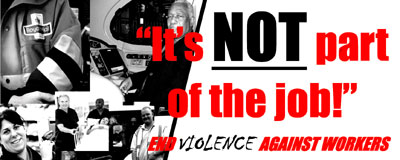
#STUC16 No worker should accept violence as part of their job. Whether they work in schools, colleges or other public and public facing services, staff should be able to work without fear of threat, abuse or intimidation. See all STUC reports on the website.
That was the clear message from delegates to the STUC as they backed a NASUWT call for proper resources from the Scottish Government to tackle the problem.
Showing posts with label Violence at work. Show all posts
Monday, 18 April 2016
Violence at work is unacceptable and must be tackled
Friday, 23 October 2015
Big increase in assaults on public service workers, says UNISON
Friday 23 October 2015
UNISON Scotland is publishing today Violence at Work: A Survey of UNISON employers and Staff in Scotland 2015. It shows an increase of 1,227 assaults compared with 2014.
The total recorded assaults on public sector workers in Scotland in 2015 was 38,279. This compares to 20,000 in 2006.
UNISON report included a survey, to ask what staff had suffered, how they had felt about it, and what action their managers had taken to try to make sure they were safer in the future. Nine out of ten people who responded to this survey were women, and well over half were age between 45 – 60 years old.
UNISON Members told us
- “patient was verbally abusive and looming over me ”
- “Bitten, being threatened with 'weapons', head butted, kicked, things been thrown at me, verbal abuse, pushed and shoved, cornered with threatening behaviour”
- “Grabbed, attempted strangle, punched, slapped, glasses broken”
- “an irate male jumped onto myself while I was seated at a computer”
- “Screamed and swore at. Items thrown at me. Kicked punched bitten scratched nipped. Hair pulled. Strangled. Pushed, walking sticked wacked across me."
- “Too many incidents to describe.”
UNISON members also told us they felt undervalued, frightened, afraid, disrespected and sick. One summed it up as being “really upset and in tears most nights after work.”
Worryingly many members accepted it as “Fine. It's my job”. Other said they were “mostly sad for the people that have resorted to violence not great obviously but its my job and sometimes these things happen, we just have to deal with it”
Scott Donohoe chair of UNISON health and safety committee said, “The abuse of staff is intollerable and no one should have to experience it as part of their work. This level of violence is simply unacceptable. There is no doubt the recording continues to improve, however the problem is clearly growing, rather than decreasing.
Public service workers have a right to carry out their duties free from fear of attack. Whatever the difficulties faced by some of those who are assaulting staff we need to ensure special measures such as extra training, additional staffing or sanctions should be introduced by managers. We would urge employers to follow guidelines like the ones set out in the Centre for Healthy Working Lives Managing occupational violence in the workplace”.
ENDS
Notes
- Report http://www.unison-scotland.org.uk/safety/
ViolentAssaultsonPublicServiceStaff_
UNISONScotlandFollowUpSurvey_Oct2015.pdf - UNISON is the biggest trade union in Scotland. We are the UK public services union
- Since 2006, UNISON Scotland has carried out an annual survey of assaults to public sector workers by issuing a Freedom of Information (FoI) request to all employers of UNISON members in the public sector. This year we included a qualitative survey of members this 2015 survey was carried out from August to October 2015
- For the qualitative data we received responses from health service workers, council staff, education and social work, community and voluntary sector, librarians and parking attendants. 88% of our respondents were female, over 60% were aged between 45 and 65; 39% had experienced physical violence, 43% had been threatened with violence, 65% had been verbally assaulted.
Thursday, 15 January 2015
Union offers safety advice to staff following hospital sexual assaults
Thursday 15 January 2015
NHS union UNISON Scotland is advising staff to be more vigilant than normal after two separate incidents of sexual assault at the Glasgow Royal Infirmary (GRI) in recent weeks.
The union has also contacted employers demanding that specific advice about personal safety and relevant details are shared with local staff to ensure that they are aware of the issue and can take reasonable steps to ensure their safety.
Branch Secretary Cathy Miller said, “we have been in touch with the employers demanded extra security be put in place; that staff are given some basic information to help them stay safe at work and that local managers are pro active around staff safety when taking decisions.”
“In the absence of any formal advice to staff UNISON felt it was important that we let our members know that we are aware of the issue and are pressing for action. We would urge staff to be extra vigilant; where possible to travel to and from work with colleagues (and not alone); to report any suspicious behaviour to your line manager and local security and if appropriate to record any specific concerns about safety in the datex system.”
The message being given by UNISON to staff in the GRI is;
The chance of you becoming a victim of this kind of crime are relatively low – even in the current circumstance. Police Scotland advise that there are a number of simple steps you can take to further reduce the risk to yourself.
What general steps can I take?
- Plan your journey.
- Tell someone when and where you’re going and when to expect you to get there.
- Carry a mobile phone and make sure it’s charged.
- Be aware of your surroundings and look confident about where you are going.
- Avoid listening to personal stereos which can make you less aware of what’s happening around you.
- Personal attack alarms are good to have – makes sure you carry it in your hand so you can use it immediately. Choose a type which continues to sound if you activate and then drop it.
- DON’T carry weapons or items such as pepper spray – this is illegal.
How do I stay safe on foot?
- When out walking, always attempt to walk facing the traffic so that a car cannot pull up behind you.
- If you think someone is following you, check by safely crossing to the other side of the street - cross more than once if necessary. If the person behind you crosses also and you believe that your suspicions are confirmed, stay to main, busy routes until you get to the first safe place and contact the police. Avoid using a phone box in the street as this gives the person following you an opportunity to trap you.
- If you regularly go jogging or cycling, try to vary your route and the time you go. Stick to well-lit, preferably busy, roads with pavements and avoid wooded areas.
- Don't take short-cuts through dark alleyways, parks or waste ground
Please pass this advice on to your colleagues across GRI.
Friday, 24 October 2014
Violence against public service staff has nearly doubled - UNISON Scotland
Fri 24 October 2014
Violence against public service workers in Scotland has increased yet again last year and has nearly doubled over the past eight years.UNISON's Scottish Organiser, Dave Watson, will present the union's annual survey of violent incidents to UNISON Scotland's health and safety conference at Stirling University on Friday 24 October.
37,052 incidents were reported to public service employers last year – up 3,363 and almost double the 20,000 reported when the first survey was first conducted in 2006. He will highlight assaults on council workers, who have suffered four out of five job cuts in Scotland. They are seeing a year on year increase in violent incidents - 15,729 last year an increase of 850.
He will welcome improvements in data recording, although some public bodies are still failing to collate data properly. If they can’t collate data – they don’t know where to take the necessary action.
Dave Watson said:
“It is entirely unacceptable for staff who serve the public to be assaulted for simply doing their job. These statistics record reported incidents and are therefore only the tip of the iceberg of misery faced by workers across Scotland’s public services”.
"The biggest increase in violent incidents is happening in those services that have suffered staffing cuts. Workers are stretched too thinly, dealing with service users who are coping with cuts in the services they rely on. This is a toxic cocktail that is putting hard pressed workers at greater risk of violent assault."
Scott Donohoe, chair of UNISON Scotland’s Health and Safety Committee, said:
“To seriously tackle violence against staff we need proper monitoring, backed up by effective workplace measures to minimise the risks. We also need better legal protection for workers in the civil and criminal courts.”
There were 330 convictions under the Emergency Workers Act last year. Due to the limited scope of the Act few violent incidents result in criminal action. Sadly, efforts to address this were blocked by the Scottish Government when they opposed Hugh Henry MSP’s Protection of Worker’s Bill. The UK Government has also undermined protection for workers with cuts to the Criminal Injury Compensation scheme.
ENDS
Note for editors:
The UNISON Scotland Survey of Violence at Work 2014 is online here:
http://www.unison-scotland.org.uk/safety/ViolenceAtWorkSurveyOctober2014.pdf
There is clear guidance for councils on how to address this issue in Managing Occupational Violence in the Workplace (2010). NHS Scotland has similar PIN policies.
Friday, 25 October 2013
Toxic cocktail of spending cuts and violence
Toxic cocktail of spending
cuts and violence
A
'toxic cocktail' of spending cuts and violence against public service workers
has resulted in another increase in violent incidents across Scottish councils
and NHS Scotland.
33,689
incidents were reported to public service employers last year - almost 14,000
more than when the first survey was first conducted in 2006.
In
probably the only employment group protected from cuts, police officers, the
number of incidents fell by around one-third (by 3074 to 6187). However,
council and NHS workers, who face big staffing reductions, have seen an
increase in violent incidents. Incidents in councils have increased by 730 to
14,879. NHS incidents are up by 1744 to 12618.
UNISON's Scottish Organiser Dave Watson will present the union's annual survey of violent incidents to UNISON's health and safety conference at Stirling University on Friday 26 October. He said:
"The biggest increase in violent
incidents is happening in those services that have suffered staffing cuts.
Workers are stretched too thinly, dealing with the public who are coping with
cuts in the services they rely on. This is a toxic cocktail that is putting
hard pressed workers at greater risk of violent assault."
There
has been some improvement in recording, particularly in the NHS, but some councils
couldn’t even produce statistics. There are also indications that a number of
public bodies are preparing for further problems when the full impact of
welfare reform happens.
Scott Donohoe, chair of UNISON Scotland’s Health and Safety Committee, said:
"These numbers only cover recorded incidents – the tip of the iceberg of misery for many staff. While we are pleased that employers are improving their systems, others have obviously got some way to go. If they can’t produce decent statistics they cannot be tackling the problem”.
Convictions under the Emergency Workers Act have increased again last year by 32 to 355. Due to the limited scope of the Act few violent incidents result in criminal action. Sadly, efforts to address this were blocked by the Scottish Government when they opposed Hugh Henry MSP’s, Protection of Worker’s Bill. The UK Government has also undermined protection for workers with cuts to the Criminal Injury Compensation scheme.
ENDS
Note
for editors:
The UNISON Scotland Survey of Violence at Work 2012 is online here:
http://www.unison-scotland.org.uk/safety/ViolenceAtWorkSurveyOctober2013.pdf
The UNISON Scotland Survey of Violence at Work 2012 is online here:
http://www.unison-scotland.org.uk/safety/ViolenceAtWorkSurveyOctober2013.pdf
The councils that couldn’t even collate the
statistics are: Angus, Aberdeenshire, West Dunbartonshire, East Dunbartonshire
and East Renfrewshire.
There is very clear guidance for councils on
how to address this issue in Managing Occupational Violence in the Workplace
(2010). NHS Scotland has similar PIN guidelines.
For further information please
contact:
Dave Watson, UNISON Scottish Organiser, on 07958 122 409
Monday, 26 November 2012
More than 70% of healthcare assistants face violence at work – UNISON survey
26 Nov 12
More than 70% of healthcare assistants have been the victim of aggression and violence at work, a new survey from UNISON has revealed.
The survey of nearly 1200 healthcare assistants and assistant practitioners revealed that 13% of those who had been the victim of violence at work had been threatened with a weapon, while nearly a fifth had been the victim of an assault that required medical assistance or first aid.
The survey paints a shocking picture of the reality of work for healthcare assistants and assistant practitioners in today’s NHS, with more than 40% of respondents saying that they had considered leaving their profession either fairly or very seriously over the last year.
The results shine a harsh light on the problems facing the NHS as a result of government cuts, with more than 85% saying they felt staffing levels had become insufficient over the last year. Only 11% believed that staffing levels were adequate in their clinical area.
Commenting on the survey, Christina McAnea, UNISON head of health said:
“This survey illustrates the sometimes grim reality for healthcare assistants and assistant practitioners, whose already challenging job is made harder by inadequate staffing and the threat of aggression and violence.
“HCAs and APs provide a fundamental care to some of the most vulnerable patients, yet what we are seeing is that they do not feel valued by their employers, and even less so by the government, whose cuts agenda is placing them, and professionals across the health service, under enormous pressure.
“When four in ten HCAs are considering leaving the profession, something is very wrong. This survey is demonstrating the real impact of government cuts – demoralised staff who are trying to deliver the best possible care they can in ever more difficult circumstances.
“It is time for the government to think again about the damage that its demand for £20bn in so called ‘efficiency savings’ is having on the NHS. Cuts aren’t working, and if these vital professionals are depleted even more, the impact on patient care will be enormous.”
Healthcare assistants and assistant practitioners play a vital role in healthcare delivery, yet only 2.1% said they felt the government respected their role, a stark contrast to the almost 80% who said that patients valued their work.
More than 80% of those who responded said they believed that HCAs should be regulated in the same way as other healthcare professionals such as nurses, to protect patients, ensure high standards and maintain skills.
The survey coincides with UNISON’s annual Healthcare Assistant Seminar in Glasgow, which will look at the current debates and hot issues affecting Healthcare Assistants in today’s healthcare environment, including regulation, role design and best practice.
ENDS
NB: Full details of UNISON Scotland's most recent survey of violence against public service workers are on our website at: http://www.unison-scotland.org.uk/news/2012/septoct/2510.htm
.
Thursday, 25 October 2012
Public service staff face 'toxic cocktail' of cuts and violence at work - UNISON
Thursday 25 October 2012
A 'toxic cocktail' of cutbacks and violence against public service workers has resulted in a huge increase in the number of violent incidents reported to employers, according to a survey by UNISON Scotland.
The union's annual survey of violent incidents reported to public service employers shows that 34,739 staff reported violent incidents last year - almost 15,000 more than when it was first conducted in 2006.
Scott Donohoe, chair of UNISON Scotland’s Health and Safety Committee, said:
"The biggest increase in violent incidents is happening in those council services that are facing the brunt of spending cuts. Staff are stretched too thinly, dealing with service users facing cuts in the services they rely on. This is a toxic cocktail that is putting hard pressed workers at greater risk of violent assault."
UNISON's Scottish Organiser Dave Watson will present the survey results to the UNISON's health and safety conference at Stirling University on Friday 26 October.
Dave Watson said:
"The latest figures demonstrate an appalling level of violent incidents faced by staff who are simply doing their job."
The report shows 34,739 staff reported incidents last year. This compares to 20,000 incidents when the first survey was undertaken in 2006.
There has been a big increase in incidents over the last year in local government by 2257 to 14274. While there has been a marked improvement in reporting that may explain some of the increase, there are also 7,000 fewer staff working for councils.
The NHS shows a further decrease over the last year in incidents by 967 to 10,974. However, the two largest health boards (Glasgow and Lothian) were unable to produce figures this year, so these figures have to be treated with caution.
Dave Watson criticised employers who failed to produce figures:
"While we are pleased that many employers are improving their systems, others have obviously got some way to go. If they can’t produce decent statistics they cannot be tackling the problem”.
Convictions under the Emergency Workers Act have increased over the last year by 44 to 324. Due to the limited scope of the Act few violent incidents result in criminal action. Efforts to address this were blocked by the Scottish Government when they opposed Hugh Henry MSP’s, Protection of Worker’s Bill.
Dave Watson said:
"Employers must redouble their efforts to protect workers and the Scottish Government must play its role by strengthening the criminal law."
ENDS
Note for editors:
The UNISON Scotland Survey of Violence at Work 2012 is online here:
http://www.unison-scotland.org.uk/safety/ViolenceAtWorkSurveyOctober2012.pdf
.
Thursday, 13 October 2011
UNISON survey shows nearly 28,000 violent incidents against public service workers last year
UNISON, Scotland’s largest union in public services will launch its annual violence at work survey at a health and safety conference at Stirling University tomorrow (14 October).
The survey shows that 27,775 violent incidents were recorded last year by Scotland’s public bodies. While the overall numbers remained stable there was a reduction in incidents in the NHS (down 1281 to 13,552) but a significant increase in councils (up 780 to 12,168). While there had been some improvement in monitoring by 18 councils, others had taken no action to review their policies in line with the new guidance on managing occupational violence – more than a year after it was launched in 2010.
UNISON Scottish Organiser Dave Watson said:
“These figures highlight an appalling level of violent incidents perpetrated on staff who are simply doing their job. While some employers are taking this issue seriously, others are not doing enough.”
“There are also early signs that spending cuts are impacting on the number of violent incidents. 21,000 job losses mean that staff are being stretched thinly in many public services, particularly in local government. This means less support for staff in high risk areas. UNISON will be undertaking further work to monitor this in the coming year.“
The survey also shows 280 convictions under the Emergency Workers (Scotland) Act, a small decrease on the previous year. This Act has limited scope and UNISON, together with other trade unions have campaigned for stronger legislation to protect public service workers.
Dave Watson said:
“The Scottish Government opposed measures to strengthen the law in this area when Hugh Henry MSP proposed the Protection of Workers Bill. There is a level of complacency over violence in the workplace that workers in the front line find bewildering. We need a combination of efficient recording, effective workplace measures, monitoring and stronger legislation to protect workers from unacceptable levels of violence.”
.
Wednesday, 22 December 2010
Thanks to all who emailed MSPs to support Protection of Workers Billl
The Protection of Workers (Scotland) Bill was defeated in the Scottish Parliament today by 75 votes to 42. Thanks to all those who sents emails to their MSPs to ask them to vote for the Bill, which was promoted by Hugh Henry MSP and supported by UNISON along with other unions and the STUC.
See reports on BBC News and STV News.
Also see UNISON Scotland Health & Safety campaign page on the Bill at www.unison-scotland.org.uk/safety/protectionofworkers/ for more info including briefings and press releases.
.
See reports on BBC News and STV News.
Also see UNISON Scotland Health & Safety campaign page on the Bill at www.unison-scotland.org.uk/safety/protectionofworkers/ for more info including briefings and press releases.
.
UNISON Scotland urges MSPs to support Protection of Workers Bill
Wednesday, 22 December 2010
UNISON Scotland has called on MSPs not to turn their backs on those who face violence at work, and to support a Bill to protect them.
MSPs will debate the Protection of Workers (Scotland) Bill at stage one in Parliament today (Wednesday, December 22) and will decide whether or not the Bill should proceed to stage two.
Violent incidents at work are a major problem in Scotland. UNISON Scotland’s annual Violence at Work survey highlighted more than 30,000 recorded incidents in the public sector last year alone. However, as not all violent incidents are reported, this is only the tip of the iceberg.
Last month, the Economy Energy and Tourism Committee recommended that Parliament should oppose the Bill, claiming it would not extend the protection currently available to workers under the common law. But, as the committee recognised, there is no statistical evidence that this approach works. UNISON believes incidents involving uniformed staff may be taken more seriously than the lower level – but just as traumatic – incidents which involve thousands of our members and fall below the radar of current criminal law provisions.
UNISON believes legislation is only part of the solution and must go hand-in-hand with public awareness campaigns, workplace measures and criminal legislation.
Dave Watson, UNISON’s Scottish Organiser, said: “Each year, thousands of dedicated staff providing vital services in our communities are being assaulted at work. These people deserve stronger legal protection and better protective measures and MSPs can not turn their backs on these workers.
“While legislation on its own is not enough, it is part of the solution and sends a clear message that violence against workers is unacceptable and will not be tolerated in our society. We therefore urge MSPs to take this matter seriously and to support this Bill to protect workers from violence.”
ends
Notes to editors
1. Click here to view UNISON’s Violence at Work Survey (PDF)
2. For further details on the Bill visit www.unison-scotland.org.uk/safety/index.html
For further information contact:
Dave Watson, Scottish Organiser, on 07958 122 409
Trisha Hamilton, Communications Officer, on 0141 342 2877 / 07939 478 461
.
Monday, 20 December 2010
Take action now! Email your MSPs to support Protection of Workers Bill
Latest: Protection of Workers (Scotland) Bill will be debated on Wed 22 Dec 2010...
Click here to take action now! Email all of your MSPs for support
It's not part of the job - end violence against workers
UNISON Scotland wants to end violent attacks on public service workers
UNISON Scotland, along with other unions and the STUC, has supported Hugh Henry, Labour MSP for Paisley South, in promoting the Protection of Workers (Scotland) Bill. This will make it an offence for anyone to assault a public service worker carrying out their job or because of the job they do.
The Bill's first stage debate was expected to be in January 2011 but has been brought forward to Wednesday 22 December 2010 - this Wednesday - in the Scottish Parliament.
You can help by urging your MSPs (including your regional list MSPs) to support the Bill.
Send emails - click here
.
Click here to take action now! Email all of your MSPs for support
UNISON Scotland wants to end violent attacks on public service workers
UNISON Scotland, along with other unions and the STUC, has supported Hugh Henry, Labour MSP for Paisley South, in promoting the Protection of Workers (Scotland) Bill. This will make it an offence for anyone to assault a public service worker carrying out their job or because of the job they do.
The Bill's first stage debate was expected to be in January 2011 but has been brought forward to Wednesday 22 December 2010 - this Wednesday - in the Scottish Parliament.
You can help by urging your MSPs (including your regional list MSPs) to support the Bill.
Send emails - click here
.
Friday, 26 November 2010
MSPs Failing to protect workers from violence says UNISON
UNISON Scotland today responded angrily to the announcement by the Economy, Energy and Tourism Committee (EET) that they will recommend to the Parliament that the general principles of the Protection of Workers Bill are not agreed to.
UNISON Scottish Organiser Dave Watson said:
“The nearly 30,000 public service workers subjected to recorded violent incidents last year will today feel badly let down by the majority of MSPs on the committee who reached this decision. They will be joined by many thousands of other workers subjected to violence in the workplace who need Parliament to take action to protect them.”
“UNISON has always accepted that legislation is only part of the solution. But to argue that the current criminal law is adequate, when the prosecution authorities don’t even keep statistics, is a less than adequate response.”
UNISON Scotland welcomes the recommendations urging the prosecution authorities to take this issue more seriously, introduce new guidelines and to collect proper data. However, this has been identified as an issue over many years and little has happened. Meanwhile every year more workers are assaulted.
UNISON Scotland will be calling on MSP’s to reject this recommendation and approve the general principles of the Bill when it is debated in the chamber early next year.
.
Subscribe to:
Posts (Atom)