Showing posts with label Equal pay. Show all posts

Monday, 22 October 2018

Busting The Myths Around #EqualPayGlasgow Strikes


Here are all the facts you need about the #EqualPayGlasgow strikes, from our blog published on @ScottishTUC site.

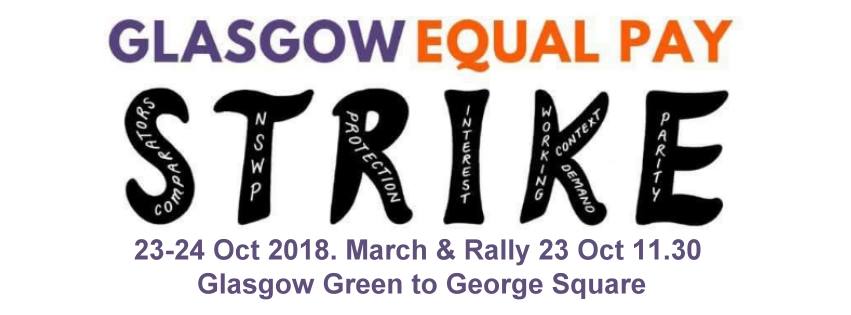
March & Rally 23 Oct 11.30 Glasgow Green to George Sq
@Unison_Glasgow @GMBGlasgowCC

MYTH:  The Unions agreed to the Glasgow pay system but are now suing against their own agreement.
FACT:  UNISON’s local branch and equality team vetoed the Workforce Pay and Benefits  Review (WPBR). The tribunal decision records that the unions walked out on the job evaluation process, took a grievance and formally complained to the council  leader. The council admitted in the litigation that the jobs were graded by managers and consultants alone. In no sense is WPBR a union scheme.

“Nothing agreed, nothing offered, nothing proposed.

We demand real negotiations.”

The council approved WPBR on 16th October 2006. The committee report reflects the fact there was no agreement. Instead the report recommends imposing WPBR and contemplates doing so by mass dismissals. Under a Labour majority,  the report was approved. Workers got three chances to accept WPBR over the winter of 2006/07. Then it was imposed.
All this is “on the record”. In 12 years of argument over WPBR, including 14 disputes, 10 strikes and over 12,000 legal claims, no council official has ever said this was a union approved scheme. Anyone saying that now is making mischief.

MYTH: If the unions had employed their industrial muscle on this long before now we wouldn’t be in this position.
FACT:  No current Scottish pay system has faced more disputes and legal conflict than
WPBR. There have been 14 separate WPBR disputes in 11 years and 10 strikes.

“Start looking at settlement proposals so negotiations can finally start.

All we have had for nine months are talks about talks.”

Nearly 6,000 workers have been balloted in WPBR disputes and 3,500 have taken strike action. In parallel with the strikes there are 12,500 legal claims, many of which date back to 2008. Are the council honestly saying we could or should have been MORE aggressive?
Militancy is not the issue. None of this conflict would have been necessary if the council had not suppressed the findings of the statutory investigation by the Equality & Human Rights Commission in 2010.
In 2010 the EHRC conducted a statutory investigation of WPBR and told the council it was discriminatory. That report was suppressed. In 2018 Councillor Aitken correctly ordered the release of the secret report. Although that instruction has not been met in full we know enough from the material released to say that discrimination should have ended long before now.
What was needed to resolve this dispute in 2010 was not greater union militancy or legal wizardry, but simply the regular transparency of a council meeting. The officials were able to block and suppress the EHRC until 2018 because councillors never met to discuss equal pay issues between 2006 and 2018. Councillor Aitken exposed the fact that all Glasgow councillors failed, and failed badly. That is something we agree on. The big questions are simple – who knew what about the EHRC, when did they know, and what did they do? How did they silence a statutory agency that held expert evidence of discrimination at the council?

MYTH: The reasons for the strike do not justify strike action.
FACT: The reason for the strike is clear – the claimants have lost faith in the willingness of senior officials to deliver Councillors Aitken’s instructions. In December 2017, the parties agreed to adopt a joint timetable with clear stages or milestones. The workers were already low on confidence in March 2018 when they told Anne Robinson’s BBC documentary that they were going to the union to demand a strike.

“The women know the reason for the dispute because it was the women who called the strike.”

In May, a consultative ballot extracted a council commitment to adequate funding, a new joint timetable with milestones and a deadline of Christmas. In August the council missed their milestones, tore up the timetable and told the unions there would be no money until April 2019. We don’t know if the officials had councillor approval for the actions that triggered the strike vote. We shared that information openly with the members, as a trade union should, and the reaction was as clear as it was predictable. The call for strike action was overwhelming. This is a member led campaign and the members are angry. Very angry.

MYTH: The women don’t know why they are striking because the union misinformed them.
FACT: The council get irritated when we advise them how to address equality issues but it has to be said that publicly patronising powerful women who have high value legal claims is a high risk strategy. The members meet at least once a month to plan and execute their campaign. The members went to the Court of Session and there were over 30 claimants at the recent tribunal hearing. They know how the scheme was designed, they know about the EHRC cover up, they know the detail of the 42 point settlement plan and they know the council tore it up. They have battled through 14 disputes over 11 years and they know this is the conclusion of a long slow battle. The women know the reason for the dispute because it was the women who called the strike. It’s that simple.

MYTH: The unions know that council officers are carrying out the instructions of the council leader.
FACT: Cllr Aitken told the officials to end the EHRC cover-up and produce the report in full. In fact she told them three times. But we are still waiting for the truth behind the cover up. Councillor Aitken asked for a time table with milestones and dispute resolution. The officials missed the milestones, tore up the timetable and refused to go to mediation before 2019. Was that what the officials were instructed to do? We genuinely don’t think so.

MYTH: Any delay in making payments is due to the strike, not the actions of the council
FACT: The claimants’ representatives have been available to talk, without condition, since December 2017. It was the council who left the talks in response to the strike notice. The strike does not delay settlement. What delays settlement is the council’s attitude to the strike – their decision to walk away shows a lack of respect for low paid women. Every dispute is settled by discussion. The only way forward is to talk.

MYTH: The union’s escalated the campaign when the SNP defeated labour in 2017
FACT: With 6000 workers in 14 disputes, 10 strikes and 8,000 legal claims the campaign was very assertive against the Labour administration. What escalated the scale and significance of the campaign even further was the Court of Session decision in August 2017. Labour presided over the WPBR years and the SNP administration has set a course towards equality. Accepting the Court of Session ruling and removing WPBR were strong decisions that have received credit from the workforce and their representatives. But the unions are clear – we are in dispute with the employer, not the elected members. Party politics is irrelevant.

MYTH: The union’s are covering their backs for their discrimination over the last 12 years
FACT: This briefing sets out our actions. We vetoed WPBR before it was adopted. We commissioned the leading UK expert to analyse its impact after it was imposed and went straight to mass litigation. Every member received advice and we encouraged them to join the campaign. Although we lost the tribunal and the first appeal we kept fighting. In parallel with the litigation we organised Cordia workers against the discrimination within the ALEO policy and Cordia’s daily practices. We closed Cordia down and took the workers home to equality within the council. Working with Action4Equality we had to change the law of equal pay to bring equality to Glasgow. UNISON organised the mass participation of low paid women and removed the discrimination of tribunal fees to restore access to justice for all – in Glasgow and across the UK. We succeeded where the EHRC failed. This is not “union back-covering”. This is pay equality & pay justice.

Monday, 18 April 2016

Time to make equal pay a reality for women

#STUC16 The STUC is calling for equal pay to be a manifesto commitment for all parties ahead of the Scottish election and for the establishment of an “Equal Pay Employer Scheme” to provide accreditation for equal pay employers. See all reports on the website

Supporting the University and College Union motion, UNISON’s Davena Rankin, who is also the Chair of the STUC Women’s Committee, told delegates that the pay gap is still very much alive today despite the 1970 Equal Pay Act.

Wednesday, 28 October 2015

UNISON wins £ multi-million compensation for 1400 women in Fife Council

Date: Wednesday 28 October 2015
UNISON has reached a multi million pound settlement with Fife Council for over 1400, mainly low paid women UNISON members, for their equal pay claims.

UNISON members will now be properly recompensed for historic discriminatory pay practices within Fife Council. It is a deal worth £millions and will include compensation for members back pay in some cases to 2006.

UNISON has been at the forefront of the legal campaign to fight for equal pay for women workers and to ensure they receive the back pay to which they are entitled.

Dougie Black, UNISON regional organiser for Fife local government said, ‘This has been a long time coming, many claims stretch back to 2006, we can only thank UNISON members for their hard work and patience. We will now discuss individual claims with the employer to ensure each claim is calculated properly. This a good day for low paid women workers and UNISON is proud to have been a part of it.’

Suzanne Craig, UNISON’s legal officer said, ‘UNISON will be seeking early payment from the employers. Regrettably it took the threat of proceeding to an Employment Tribunal to focus the employer’s minds to settle, but it is great news for everyone that we have agreed.  This settlement also agrees the legal principles for moving forward to ensure wherever possible that job evaluation and pay practices remain free from discrimination in the future. Members will receive individual letters, in due course, outlining their settlement figures. I want to thank everyone for their patience.’
 
UNISON continues to fight for equal pay particularly for low paid women across Scotland

END

Notes
  • UNISON is the public services union and the largest union in Scotland, and the largest union in local government across UK.
  • UNISON is negotiating equal pay claims in councils across Scotland. It has been running equal pay claims in Fife since 2006
  • UNISON has agreed the principles of the settlement and how we calculate each settlement. We now need to agree each individual settlement a process which we will complete as soon as possible

Sunday, 8 June 2014

North Lanarkshire Council are treating low paid women workers with contempt, says UNISON

UNISON, the trade union representing the equal pay claims of low paid women workers in North Lanarkshire, have reacted with utter disbelief to today’s statement released by North Lanarkshire Council regarding Equal Pay of low paid women workers

Low paid women workers, represented by UNISON, have been fighting for over six years for fair pay.

North Lanarkshire Council eventually conceded at an equal pay tribunal in March 2014 that it had wrongly scored the jobs of thousands of low paid women employees. Many hundreds of low paid women are still waiting for compensation.

Friday, 23 May 2014

'Pay up now' - UNISON demands North Lanarkshire council stops stalling on equal pay claims

Date: Friday 23 May 2014

UNISON Branch to take to streets to pressure council into fairness

UNISON North Lanarkshire is stepping up the pressure on North Lanarkshire Council in the union’s long running campaign to end the unfair treatment of low paid women. UNISON is demanding the Council settle their many outstanding equal pay claims. As well as continuing to use  internal council procedures UNISON is planning to campaign publicly with  leaflets and ad trailers.

The Council has conceded that many of the 1200 equal pay claims that UNISON has brought will be settled.  The Council has had little choice in this after admitting that it had destroyed records, altered results of assessments, and its job evaluations were not reliable

John Mooney, UNISON Branch Secretary said:
“NLC cannot continue to dodge the issue of equal pay. We have been clear all along that the Employment Tribunal claims we have lodged will prove to be successful. We call on NLC to do the right thing and settle all cases now. For an employer to purposely change job scores which lowered pay rates and to admit that they have destroyed the paperwork is astonishing and UNISON demand to know who sanctioned such disgusting behaviour.”

One of the predominant groups affected are Home Support Workers and Mooney said:
 “Home Support Workers receive poor pay for doing an extremely demanding and responsible job. They are charged with looking after our elderly and vulnerable people, but who has looked out for them? Certainly not NLC who deliberately paid lower wages than these workers deserved. 

Home Support Workers have died waiting for the Council to give them what they should rightfully have earned. UNISON has again asked the Council to hear the grievances of this group of workers and settle the matter once and for all.” 

“Despite owning up to deliberately keeping low paid workers on low pay with no justification. North Lanarkshire Council remain at Employment Tribunal spending thousands of pounds of Council Tax tax payers money defending their actions. The Council needs to face up to its responsibility to its workforce and the people of North Lanarkshire and end this charade now” 

Friday, 11 April 2014

UNISON members in South Lanarkshire Council continue their campaign for equal pay

Friday 11 April 2014

UNISON Scotland is writing to 6000 UNISON members who work in South Lanarkshire Council to give them another opportunity to make a new claim for equal pay.

The trade union believes that some staff may not be receiving the same pay as those in other job groups who do work of equal value. If that proves to be the case, UNISON will argue that their pay should be increased now, and any shortfall over the past 5 years should be paid as back pay.
Staff who may be eligible include home carers, caterers, cleaners, nursery nurses and school support assistants.

South Lanarkshire was the first council in Scotland to bring women and men together under a single status pay system, however UNISON’s experts believe that the South Lanarkshire scheme does not comply fully with subsequent advances in equality law.

Commenting on this latest action, Mike Kirby, UNISON Scottish secretary, said:
 “UNISON’s wants a long term settlement that is fair to all. We recognise it’s a difficult task to compare very different jobs; that is why legal claims take so many years to decide. However UNISON is committed to negotiating improvements with the council so that our members do not have to wait years for pay equality”

Thursday, 27 June 2013

UNISON women's equal pay success making the news - and winning support

#JoinUNISON www.joinunison.org #equalpay

A strong editorial in today's Herald newspaper criticised Dumfries & Galloway council's "grudging statement" on UNISON's equal pay victory.

It said the council's apparent stance is exactly what led to the Equal Pay Act in the first place, following the 1968 case of the Ford women machinists.

The similarities with the Ford women in Dumfries led to a situation where "a nursery assistant could look out of the window at a groundsman mowing the grass and know he was entitled to extra benefits and pay while she was not. That could not be fair."

The editorial concludes that it would be entirely wrong for Scottish councils to "perpetuate inequalities that should have been erased from the workplace 40 years ago."

Here's a few more links to coverage of UNISON's historic Supreme Court equal pay victory.

Wednesday, 26 June 2013

UNISON wins historic equal pay case worth millions of pounds for members

Elaine North, centre, and Mike Kirby, left of Elaine,
filmed by TV crews as they heard the news from the court today

#EqualPay


Nearly two thousand women members of UNISON are celebrating a historic equal pay victory today.

They have finally demolished the long-running defence by Scottish councils of paying men discriminatory bonuses that are denied to women.

 The UNISON Scotland members can expect to share in an estimated nearly £12 million in compensation after the UK Supreme Court today handed down judgment in their favour in the seven-year case of North & Others v Dumfries and Galloway Council.

 Having conceded that council bonuses were discriminatory, more than 20 Scottish councils joined Dumfries in arguing that women should only get equal pay compensation if they worked at the same location as their male comparators.

 UNISON had appealed after the Court of Session said the 251 classroom assistants, support for learning assistants and nursery nurses in Dumfries were not able to compare themselves with groundsmen, refuse collectors and drivers and leisure attendants who received bonuses, but were based at depots, not in the women’s schools.

Today’s judgment overturns that decision, saying that UK equal pay law which allows a woman to compare herself with a man “in the same employment” does apply, even though the women worked at different ‘establishments’.

Thursday, 25 April 2013

Women’s equality at work no better than when Scottish Parliament opened in 1999


25 April 2013

UNISON today provided damning evidence to MSPs that major obstacles remain to women achieving equality in the workplace and that low paid women deserve action not more words.

Equalities Officer Eileen Dinning told the Scottish Parliament’s Equal Opportunities Committee in written evidence that if anything women’s position in employment has worsened since the Parliament opened in 1999.

She welcomed the Committee’s Inquiry into Women and Work and called on members to use their “power and influence to effect change and convert the rhetoric of equality into money for underpaid women.”

Eileen, who is chair of the STUC Women’s Committee, said after the meeting: “As recognised by the Scottish Government and many economists, women’s participation in the labour market contributes significantly to the Scottish economy.

“But we are making the same points today about the obstacles to women’s participation as we were when the Parliament opened. Women across Scotland need MSPs to stop talking and deliver on equality in the workplace.”

UNISON’s evidence listed a six point plan including: ensuring all public authorities meet equal pay obligations, free and comprehensive childcare; addressing health problems women face around shift working and ensuring employers carry out equality impact assessments on proposed changes to terms and conditions to avoid further discrimination against low paid women.

Eileen told MSPs that free and comprehensive childcare is essential in modern Scottish society. Flexible working is not just about meeting caring responsibilities but about a better work and home life for everyone. Free childcare should be provided in the way we provide primary and secondary education.

She added:  “The STUC is increasingly concerned about the growth of zero hours contracts and the casualisation of the workforce. Zero hours contracts are not about flexible working. Flexible working should be negotiated and agreed. Zero hours contracts show a total lack of commitment on the part of the employers.”

And on equal pay, Eileen said: “Equal pay audits should be compulsory. Employment tribunals on equal pay are still costing the public purse millions of pounds. This could be avoided if reporting and auditing is built in from the beginning.”

 
ENDS


Notes to editors:

1. UNISON is Scotland’s largest trade union representing 160,000 members working in the public sector in Scotland - including all of Scotland's local authorities. More than 70% of our members are women; many are low paid or work part time.

2. UNISON’s evidence to the Equal Opportunities Committee is online at www.scottish.parliament.uk/S4_EqualOpportunitiesCommittee/Papers_18_April.pdf


3. UNISON says that the following steps are required to address the current imbalance that continues to discriminate against women in the workplace and in accessing the labour market:-

·         Establish through comprehensive research the current obstacles to flexible working;

·         Free and comprehensive childcare;

·         Addressing the universal health concerns relating to women and shift working;

·         Take steps to ensure that ALL public authorities meet their obligations under the Equal Pay provisions of the Equality Act 2010;

·         Take steps to ensure that all public authorities have in place robust recording systems in order to fulfil their obligations under the The Equality Act 2010 (Specific Duties) (Scotland) Regulations 2012 No. 162.

·         Call for employers to equality impact assess proposed changes to terms and conditions and avoid further discriminating against low paid women.

 
Anne Johnstone, in The Herald, says: "It's hard to imagine a more effective way of getting women back to work than free childcare." www.heraldscotland.com/comment/columnists/theres-a-lot-to-do-to-get-women-back-to-work.20903557

.
 

Wednesday, 24 April 2013

Women taking brunt of cuts in public sector - casualisation hitting hard


24 April 2013


UNISON's Equalities Officer Eileen Dinning hit out today at the casualisation of the female workforce in Scotland.


Interviewed on BBC Radio Scotland's Newsdrive, Eileen was commenting on new research in a Fawcett Society report .

This showed (as reported in the Scotsman here) that women have borne the brunt of cuts to public sector jobs.

The study warned that the number of women out of work is hitting a 25 year high. And it says the labour market will be characterised by "persistent and rising levels" of female unemployment, worsening pay and a widening of the gender pay gap.

Eileen, chair of the STUC women's committee, told BBC Radio Scotland that there is a major problem with an increasing number of part-time jobs, and women in zero hours contracts in the private sector, with underemployment having "a huge impact on economic activity".

She said that women's earnings are essential, but the pay gender gap persists and that the results of an STUC employment summit with the Scottish Government last year showed an increasing casualisation of the workforce.

One policy proposal from trade unions is for the Scottish Government to use the Procurement Reform Bill to ensure that public contracts have clauses that protect employment rights and extend payment of the Living Wage, both of which would help women in the jobs market.

The full interview is online here (just after 1hr 21 mins)

Eileen is giving evidence to the Scottish Parliament's Equal Opportunities Committee on Thursday 25 April.


UNISON’s evidence to the Committee says that the following steps are required to address the current imbalance that continues to discriminate against women in the workplace and in accessing the labour market:

·   Establish through comprehensive research the current obstacles to flexible working;
·   Free and comprehensive childcare;
·   Addressing the universal health concerns relating to women and shift working;
·   Take steps to ensure that ALL public authorities meet their obligations under the Equal Pay provisions of the Equality Act 2010;
·   Take steps to ensure that all public authorities have in place robust recording systems in order to fulfil their obligations under the Equality Act 2010 (Specific Duties) (Scotland) Regulations 2012 No. 162;
·   Call for employers to equality impact assess proposed changes to terms and conditions and avoid further discriminating against low paid women.


.


Wednesday, 17 April 2013

Women and work – STUC demands good quality jobs, not zero hours and less pay

 
#stuc13 17 April 2013
 
UNISON's Equalities Officer Eileen Dinning, highlighted the pressures on women in the workforce in her speech to STUC Congress today.
 
Eileen, in her role as chair of the STUC Women's Committee, said: "Women are struggling under the Coalition Government’s austerity programme.
 
"According to the 2011 Workplace Employment Relations Study zero hours contracts are on the increase. Thousands more workers are now in jobs without any guarantee of regular hours or regular wages. More than half of these are women.

"Tackling child poverty means tackling women’s poverty. The STUC Women’s Committee will continue to argue for secure well paid employment for all.

"Women are present in increasing numbers in our conferences and in the trade union movement. We will speak up for them, and give them hope for the future.”
 
 
Her full speech is below.


CONFERENCE, THANKS FOR THE OPPORTUNITY TO ADDRESS YOU ON BEHALF OF THE STUC WOMEN’S COMMITTEE.


I AM NOT SURE HOW MUCH HAS BEEN SAID TODAY ABOUT THATCHER.
BUT THERE WAS A SIGNIFICANT AMOUNT OF DROSS SPOKEN LAST WEEK ABOUT HER.
THE NOTION SHE WAS A ROLE MODEL FOR WOMEN WAS DELUSIONAL.
SUCH A SUGGESTION IS DELUSIONAL.
SHE CREATED NO POSITIVE CHANGE FOR WOMEN.
SHE HAD THE ACCIDENT OF BEING BORN FEMALE – NOTHING MORE.
AS BEA CAMPBELL STATED.... "SHE HAS NOT FEMINISED POLITICS BUT HAS OFFERED FEMININE ENDORSEMENT FOR PATRIARCHAL POWER."
AND THOSE PATRIARCHS ARE CARRYING ON HER WORK WITH OBSCENE ENTHUSIASM.
IF SHE DID ANYTHING POSITIVE IT’S TO BE A CONSTANT REMINDER OF HOW IMPORTANT THE TU MOVEMENT IS TO WOMEN.

SCOTTISH TUC REPRESENTS OVER 300,000 TRADE UNION WOMEN IN SCOTLAND.
INCREASINGLY, WOMEN ARE THE MAJORITY IN MANY OF OUR AFFILIATES. IN SOME CASES 60 – 70%.
MAJORITY ARE LOW PAID.
MANY ARE STRUGGLING UNDER THIS GOVERNENT’S AUSTERITY PROGRAMME.
OR LET’S CALL IT WHAT IT REALLY IS – A DIRECT ATTACK ON THE POOR, A PROTECTION RACKET FOR THE RICH AND OUTRIGHT CONTEMPT FOR WORKING PEOPLE.
AND IF THE SCOTTISH GOVERNMENT WANT TO HELP MITIGATE THE WORST ASPECTS OF THE BEDROOM TAX, THEN MAKE THE CHANGES TO LEGISLATION THAT WILL PREVENT UNNECESSARY EVICTIONS THAT WILL DISPROPORTIONATELY IMPACT ON WOMEN, CHILDREN AND THE DISABLED.

WITH THAT BEING THE BACKGROUND THE WOMEN’S COMMITTEE WORK PLAN FOR 2013 NEEDED TO REFLECT THESE CHALLENGES.
THE THEMES WITHIN WHICH THE COMMITTEE IS WORKING ARE:
  1. ECONOMY AND EMPLOYMENT

  2. INCREASING WOMEN’S REPRESENTATION AND PARTICIPATION

  3. EDUCATION AND LIFELONG LEARNING

  4. SOCIAL JUSTICE

  5. HEALTH

  6. COMBATING VIOLENCE AGAINST WOMEN AND CHILDREN

  7. INTERNATIONAL ISSUES.


OUR PRIORITIES FOCUS ON:
    • ECONOMY AND EMPLOYMENT

    • INCREASING WOMEN’S REPRESENTATION AND PARTICIPATION


THAT DOESN’T MEAN THAT THE OTHER ISSUES ARE ANY LESS IMPORTANT BUT WE NEED TO BE CLEAR THAT WOMEN’S EMPLOYMENT IS CRUCIAL AND THAT WOMEN’S REPRESENTATION CAN PLAY A BIG PART IN MAKING THAT A REALITY.

LAST YEAR, AND WORKING WITH THE SCOTTISH GOVERNMENT, WE PARTICIPATED IN A SUCCESSFUL WOMEN’S EMPLOYMENT SUMMIT.

SOME OF THE PRIORITIES TO BE PROGRESSED TOGETHER FOLLOWING THE SUMMIT ARE:

  • STATE FUNDED CHILDCARE PROVISION, INCLUDING INVESTING IN THE WORKFORCE IN THE SECTOR;

  • CHALLENGING THE INCREASED CASUALISATION OF THE LABOUR MARKET;

  • EXPERIENCE AND CHALLENGES FOR WOMEN OVER 50 IN THE LABOUR MARKET;

  • AND PROMOTING EMPLOYMENT OPPORTUNITIES FOR WOMEN IN ALL SECTORS.

ACCORDING TO 2011 WORKPLACE EMPLOYMENT RELATIONS STUDY, ZERO HOURS CONTRACT ARE ON THE RISE AND THIS FOLLOWS A SURGE IN THE NUMBER OF PUBLIC SECTOR SERVICES CONTRACTED OUT TO PRIVATE PROVIDERS.
FIGURES BY THE ONS FOUND THAT THE NUMBER OF WORKER IN JOBS WITHOUT ANY GUARANTEE OF REGULAR HOURS OR PAY REACHED 200,000 IN THE FINAL QUATER OF 2012 – 40,000 MORE THAN THE SAME QUARTER IN 2011.
A BREAKDOWN SHOWS 52% ARE WOMEN AND 48% ARE MEN.
THAT IS WHY IT IS ESSENTIAL THAT THE SCOTTISH GOVERNMENT ENSURES THAT THE PROCUREMENT REFORM BILL SHOULD BE USED TO PROMOTE :-
  • LABOUR RIGHTS AND WORKFORCE PROTECTIONS

  • A POSITIVE EMPLOYMENT AGENDA

  • THE SCOTTISH LIVING WAGE - BOTH FOR DIRECTLY EMPLOYED STAFF AND FOR

EMPLOYEES WORKING FOR CONTRACTORS

IN RESPECT OF INCREASING WOMEN’S PARTICIPATION IN PUBLIC LIFE, WE ARE PUTTING THE 50/50 CAMPAIGN BACK ON THE AGENDA THROUGH BUILDING LINKS WITH PARLIAMENTARIANS, WOMEN’S ORGANISATIONS, AND SCOTTISH CIVIC SOCIETY, IN PARTICULAR CAMPAIGNING FOR INCLUSION OF COMMITMENTS ON WOMEN’S REPRESENTATION DURING THE DEBATE ON CONSTITUTIONAL CHANGE.
OUR OTHER PRIORITIES – WHICH ARE INEXTRICABLY LINKED TO WOMEN’S EMPLOYMENT AND PUBLIC LIFE – WE ARE PURSUING THE GOAL OF FREE SCHOOL MEALS; WORKING TO ENSURE THAT WOMEN IN RURAL AREAS FEEL SUPPORTED AND CONTINUING TO GIVE PRIORITY TO THE CAMPAIGN OF COMBATTING VIOLENCE AGAINST WOMEN.

LAST MONTH WE ATTENDED THE SCOTTISH WOMEN’S CONVENTION’S INTERNATIONAL WOMEN’S DAY EVENT IN THE SCOTTISH PARLIAMENT.

THE THEME WAS WOMEN OF INFLUENCE.

WE LISTENED TO WOMEN POLITICIANS FROM MOST POLITICAL PARTIES HIGHLIGHTING THE VERY ISSUES WE SPEAK ABOUT EVERY YEAR.

  • CHILDCARE,

  • LIVING WAGE,

  • FLEXIBLE WORKING,

  • EQUAL PAY.


WE MADE THE POINT THAT YOU CANNOT INFLUENCE IF YOU DON’T HAVE FINANCIAL CLOUT.

WE TOLD THEM – YOU WANT EQUAL PAY ?

TELL PUBLIC AUTHORITIES TO STOP FIGHTING CLAIMS AND TRYING TO DEFEND THE INDEFENSIBLE.

 
WE ALSO TOLD THEM – IF YOU DON’T DEAL WITH WOMEN’S POVERTY – YOU WON’T DEAL WITH CHILD POVERTY.

CONGRESS, WE ARE WITNESSING AN INCREASINGLY FEMALE TRADE UNION MOVEMENT.

WE NEED TO RESPOND TO THAT AND GIVE WOMEN HOPE AND RAISE THEIR EXPECTATIONS.

THAT IS THE RESPONSIBILITY OF THE WHOLE TRADE UNION MOVEMENT.

TWO YEARS AGO THE STUC WOMEN’S COMMITTEE MEMBERS, PAST AND PRESENT, EMBARKED ON A PROJECT TO CELEBRATE AND HIGHLIGHT THE ACHIEVEMENTS OF WOMEN IN THE TRADE UNION MOVEMENT.

THAT ACTIVITY AND THE CONTRIBUTION MADE BY THESE WOMEN HAS LED TO CHANGES IN THE WAY SCOTLAND IS GOVERNED.


IT WAS NEVER INTENDED TO BE A GLOSSY PUBLICATION THAT WOULD GATHER DUST.

RATHER, IT WILL BE A CAMPAIGNING AND EDUCATIONAL RESOURCE THAT WILL HOPEFULLY INSPIRE OTHER WOMEN TO RECORD THEIR OWN CONTRIBUTION.

I WANT TO THANK THE WOMEN WHO GAVE UP SO MUCH OF THEIR TIME TO MAKE THIS BOOK A REALITY.

SO I HOPE YOU’LL MAKE SURE YOU HAVE A COPY OF OUR BOOK ‘INSPIRING WOMEN’ BEFORE CONFERENCE FINISHES TOMORROW.

 
FINALLY, AS CHAIR OF THE WOMEN’S COMMITTEE, I WANT TO THANK ANN HENDERSON, OUR SECRETARY, AND THE STAFF AT THE STUC, WHO GO MORE THAN THE EXTRA MILE FOR US, AS WELL THE REST OF THE COMMITTEE FOR THEIR SUPPORT AND ADVICE.


CONFERENCE, I HOPE THE REMAINDER OF YOUR SESSIONS ARE SUCCESSFUL AND I LOOK FORWARD TO WORKING WITH YOU ALL THROUGHOUT THE YEAR.

THANK YOU.


.


Wednesday, 30 January 2013

Glasgow equal pay tribunal victory for UNISON


Wed 30 Jan 2013

UNISON Scotland has welcomed an Employment Appeal Tribunal ruling on equal pay which could improve the chances of low paid workers, mainly women, seeking fair comparison with other workers in councils and their associated “arms length organisations” (ALEOs).

The Employment Appeal Tribunal has decided that UNISON members working in ALEOs set up by Glasgow City Council can compare themselves with Council employees, and with employees of other Council ALEOs when claiming equal pay.

Mandy McDowall, UNISON Scotland Regional Organiser said:
“This is a welcome ruling by the Employment Appeal Tribunal and an important victory for our members.

“It means that the law allows employees of one employer to compare themselves with workers in another employer if the employers are associated – and that councils can’t slip out of their duty to ensure equal pay and fair treatment simply by hiving off services into arms length organisations.”

The Council had argued that the ALEOs were not associated employers but were completely separate companies. They also argued that because some of the ALEOs were limited liability partnerships, they could not be an associated employer, because that only applied to companies.

The Appeal Tribunal dismissed that argument, declaring that there was no justification for putting such a narrow meaning on the legislation. They went on to say that the provision allowing comparisons across associated employers was an anti-avoidance measure to prevent employers splitting up their workforce to avoid equal pay comparisons. In order to achieve that aim, they were prepared to give a broad interpretation to the legislation.

Mandy McDowall added:
“This victory shows that workers seeking equal pay are stronger together in UNISON.”


Notes for editors

1. UNISON is Scotland’s largest trade union representing 160,000 members working mainly in the public sector in Scotland and represents staff in all of Scotland’s local authorities.

2. The Employment Appeal Tribunal ruling in the case of the Glasgow ALEOs was confirmed on Friday 25 January. The claimants in this case are mostly low paid women who were transferred out to the ALEOs but want to claim equal pay with their former male bonus-earning colleagues within the Council and other ALEOs like City Building LLP.


.

Wednesday, 23 January 2013

UNISON welcomes South Ayrshire equal pay settlement

Wed 23 Jan 2013

Local government union UNISON is today celebrating a historic equal pay settlement for hundreds of council staff in South Ayrshire. The deal finalised this week will be worth thousands of pounds for some of the lowest paid staff, mainly women, in manual, admin, clerical and support jobs.

Renee Gillan, UNISON South Ayrshire Branch Secretary, said:
 “We are absolutely delighted with this fantastic news for hundreds of workers who have faced pay discrimination for many years and who will now receive substantial compensation. This win will make a massive difference to everyone who has been involved in this campaign.” 

The South Ayrshire deal settles more than 500 claims which were lodged in 2006. These had been subject to legal challenge by the Council on a technicality which ultimately failed at the Court of Session. A planned appeal by the Council to the Supreme Court is being put on hold as part of the settlement deal.

Joe Lynch, Regional Organiser, said:
“UNISON is proud to stand up for the principle of ‘equal pay for work of equal value’. We have had to fight this through the courts - which has taken a long time - but today’s settlement means we have won on that principle.

“This victory shows once again that workers are stronger together in UNISON.”

ends
Notes for editors
1. UNISON is Scotland’s largest trade union representing 160,000 members working mainly in the public sector in Scotland and represents staff in all of Scotland’s local authorities. 

2. The equal pay claims were brought mainly by female staff who were claiming that their work was of equal value to male manual workers who received a bonus. The Council argued that the female employees had not complied with necessary procedural steps so the claims were invalid. The UNISON claimants won the point at the Employment Tribunal and the Court of Session. The Council had appealed to the Supreme Court, but that appeal will now be put on hold pending the settlement of the individual claims.


.