UNISON's Dave Watson warned that 'the sharks are circling again' as the CBI and right wing think tanks campaign for Water privatisation. UNISON's Dave Watson warned that 'the sharks are circling again' as the CBI and right wing think tanks campaign for Water privatisation. Read more at http://www.unison-scotland.org.uk/stuc2010/9.html
.
.

UNISON. Scotland's biggest and liveliest trade union, representing members delivering public and related services.
Tuesday, 20 April 2010


STUC: Rebuilding collective prosperity - a charter for public services
STUC: UNISON's Matt Smith lays out a strategy for public services. "saying to the people of Scotland that we will not stand idly by while attempts are made to make the many pay for the greed and folly of a wealthy few". Read more at http://www.unison-scotland.org.uk/stuc2010/8.html
.
.
STUC: Alliance to challenge local government cuts: 'Service users pay three times as Edinburgh Council prepares for sell-off Proposals', says UNISON
UNISON's John Stevenson pledges that, standing up for jobs and services, the union would make sure that the public knew exactly what is happening. "Edinburgh is Not for Sale", he said. Read more at http://www.unison-scotland.org.uk/stuc2010/7.html
.
.
Monday, 19 April 2010
STUC: Re-visit bus deregulation to address failures of Thatcher
Fractured and inconsistent bus services with not enough new build means bus services cannot be left exclusively to the private market, said the STUC backing a motion from Unite. "There is no bigger barrier for disabled people than the design of, and access to public transport. Although Charlie's bill was a small step for disabled people, it was nevertheless, an important one", says UNISON's John Nisbet.
.
.
STUC: Children must have a right to music in schools
Seconding a Musicians' Union motion, UNISON's John Stevenson said that the chance to learn a musical instrument is crucial to encouraging creativity.
See more at http://www.unison-scotland.org.uk/stuc2010/5.html
.
See more at http://www.unison-scotland.org.uk/stuc2010/5.html
.
STUC: Councils must deliver on additional support needs for children
The STUC urged all local authorities to make sure that children with additional support needs continue to get thre services they are entitled to in law to support them to achieve their potential.
Supporting a motion from the Educational Institute of Scotland, UNISON's Sam McCartney stressed the key role of UNISON members like classroom assistants andsupport for learning auxiliaries in providing support to ensure children can access all parts of the school curriculum.
"Sadly these can be the very posts most vulnerable to cutbacks with the resulting impact on the education of our most vulnerable children. This must not be allowed to happen.", said Sam.
More STUC news at http://www.unison-scotland.org.uk/stuc2010/index.html
.
Supporting a motion from the Educational Institute of Scotland, UNISON's Sam McCartney stressed the key role of UNISON members like classroom assistants andsupport for learning auxiliaries in providing support to ensure children can access all parts of the school curriculum.
"Sadly these can be the very posts most vulnerable to cutbacks with the resulting impact on the education of our most vulnerable children. This must not be allowed to happen.", said Sam.
More STUC news at http://www.unison-scotland.org.uk/stuc2010/index.html
.
STUC: Building a sustainable economy: Invest in training and jobs and restore trade union rights
The 113th Scottish Trade Union Congress kicked off today by slamming the 'unjust and inefficient' banking model that led to the financial crisis.
http://www.unison-scotland.org.uk/stuc2010/2.html
.
http://www.unison-scotland.org.uk/stuc2010/2.html
.
Pensions – private sector cutbacks threaten burden on the state
 The action of private sector bosses in cutting staff’s pensions is likely to threaten the UK’s economy, UNISON's Mike Kirby told the STUC today. Mike, UNISON Scotland Convener, pointed to the closure of large numbers of decent private sector pension schemes, and raise the spectre of a huge increase in benefits demands by their shortchanged staff.
He said, “Far from the tired old myth peddled by the CBI and the Tax Dodgers Alliance - that public sector pensions are unsustainable, and a huge drain on the taxpayer - the real demand on the taxpayer is likely to come from employees of their own members who have had fair pensions cut, while their bosses protect their own large pensions. The private sector wants the public purse to bail out their employees pensions shortfall, just as it bailed out the busted banks and caused this recession.”
The STUC called on government to maintain fair and decent public sector pensions, and not to heed misleading calls by the private sector and the media condemning public service workers to reliance on means-tested benefits.
Mike said, “The real time-bomb for the taxpayer is the means-tested benefits bill, and increased take up of social care and health services to support people who have been shut out of saving for their retirement. We already face such demands thanks to the irresponsible actions of the banking fat cats like those at Goldman Sachs, and the selfish actions of private firms cutting their own staff pensions. Closing public sector schemes would see the bill to the taxpayer rocket by billions.”
The STUC unanimously backed a call for decent pensions for all workers, public and private sector, and go on to call for an increased state pension, linked to earnings.
.
Monday, 12 April 2010
Rally in sunshine to Stop the Cuts - video
UNISON Scotland public service workers marched in Glasgow on Saturday 10 April with comrades and friends to demonstrate against cuts in public funding. Here's the 4 minute video of the march around Glasgow's west end in glorious sunshine.
And this is Matt Smith, Scottish Secretary, explaining what the demo is all about in just a minute.
More videos at our YouTube channel http://www.youtube.com/user/UNISONScotland
And don't forget to check the UNISON Scotland website: http://www.unison-scotland.org.uk for more on our Public Works and Stop the Cuts campaigns.
.
And this is Matt Smith, Scottish Secretary, explaining what the demo is all about in just a minute.
More videos at our YouTube channel http://www.youtube.com/user/UNISONScotland
And don't forget to check the UNISON Scotland website: http://www.unison-scotland.org.uk for more on our Public Works and Stop the Cuts campaigns.
.
Saturday, 10 April 2010
BBC News: UNISON protest over public sector cuts
BBC News - Protest over public sector cuts:

Thousands of union members have joined a demonstration in Glasgow against public service cuts.
Unison, the public services union, has held a march and rally in the city's west end to urge Scots to defend their services as the general election looms.
Unison said about 2,500 people took part in the event.
Unison's Scottish convenor said the cuts were threatening various services, from classroom assistants' hours to mobile libraries and meals on wheels.
Convenor Mike Kirby said: "Unison members, who deliver services across Scotland, are reporting that cuts are already threatening services for Scots from the cradle to the grave.
"And this is just the start of a sustained period of attacks on the public sector.
"As politicians vie with one another to out trump each other's cuts to pay for the bail out of the banks, we urge our members and community campaigns to join Unison's Public Works campaign.
"We will urge them to tell politicians at all levels - in Westminster, in Holyrood and locally, that you will not accept cuts in our vital public services to bail out the fat cats."
Unison's UK president, Gerry Gallagher, STUC general secretary, Grahame Smith, and the Scottish president of the Public and Commercial Services Union, Janice Godrich, also spoke at the rally.
'Own story'
A similar demonstration was held in London's Trafalgar Square at the same time.
Mr Gallagher said: "In Glasgow and in London today our key message is that public services should not suffer because of the bank bailout.
"Our members didn't cause the crash, and neither did the people we serve every day in communities across Scotland.
"You all have your own story to tell. And tell them you should.
"Because it is the combined voice of public service workers and service users that need to be heard in corridors of power."
The marchers set off from Kelvin Way, walked through the west end before holding a rally in Kelvingrove Park.
.
Thousands of union members have joined a demonstration in Glasgow against public service cuts.
Unison, the public services union, has held a march and rally in the city's west end to urge Scots to defend their services as the general election looms.
Unison said about 2,500 people took part in the event.
Unison's Scottish convenor said the cuts were threatening various services, from classroom assistants' hours to mobile libraries and meals on wheels.
Convenor Mike Kirby said: "Unison members, who deliver services across Scotland, are reporting that cuts are already threatening services for Scots from the cradle to the grave.
"And this is just the start of a sustained period of attacks on the public sector.
 |  Our members didn't cause the crash, and neither did the people we serve every day in communities across Scotland Our members didn't cause the crash, and neither did the people we serve every day in communities across Scotland  Gerry Gallagher Unison UK president |
"As politicians vie with one another to out trump each other's cuts to pay for the bail out of the banks, we urge our members and community campaigns to join Unison's Public Works campaign.
"We will urge them to tell politicians at all levels - in Westminster, in Holyrood and locally, that you will not accept cuts in our vital public services to bail out the fat cats."
Unison's UK president, Gerry Gallagher, STUC general secretary, Grahame Smith, and the Scottish president of the Public and Commercial Services Union, Janice Godrich, also spoke at the rally.
'Own story'
A similar demonstration was held in London's Trafalgar Square at the same time.
Mr Gallagher said: "In Glasgow and in London today our key message is that public services should not suffer because of the bank bailout.
"Our members didn't cause the crash, and neither did the people we serve every day in communities across Scotland.
"You all have your own story to tell. And tell them you should.
"Because it is the combined voice of public service workers and service users that need to be heard in corridors of power."
The marchers set off from Kelvin Way, walked through the west end before holding a rally in Kelvingrove Park.
.
UNISON demo urges - stop to 'cradle to grave' cuts
Sat 10 April 2010
 UNISON – Scotland’s largest public service union, is holding a major march and rally in Glasgow’s West End today (Saturday) where speakers representing thousands of UNISON members from different public services across Scotland will urge Scots to defend their services. The union will also be supported by its UK President, Gerry Gallagher, STUC General Secretary, Grahame Smith, and PCS Scottish President, Janice Godrich.
UNISON’s Scottish Convenor, Mike Kirby said:
“UNISON members, who deliver services across Scotland are reporting that cuts are already threatening services for Scots from the cradle to the grave. Fewer full time places will be available for under fives in Edinburgh. Play groups or under fives groups might have funding withdrawn in East Ayrshire, classroom assistants hours are being cut in Falkirk, Dumfries & Galloway, Highland, Inverclyde, and others.
“Many communities will see their mobile library service withdrawn, eg in Falkirk, Clackmannan and Moray. If you find yourself out of work due to the recession, better get yourself up to speed on how the benefit system works as Welfare Rights Units employed by councils to make sure you get your due entitlement are cut back or closed in Aberdeen, Glasgow, and East Lothian.
“The annual spring clean that some elderly people receive is being abolished in Fife. The cost of meals on wheels for the elderly and vulnerable is going up in the Borders or switching from fresh to frozen food in Midlothian. And the cuts don’t stop when you die as the cost of being buried or cremated is increased to more closely reflect charges at private crematoria in Fife. No-one is exempt.
“And this is just the start of a sustained period of attacks on the public sector. As politicians vie with one another to out trump each other’s cuts to pay for the bail out of the banks, we urge our members and community campaigns to join UNISON’s Public Works campaign and tell politicians at all levels – in Westminster, in Holyrood and locally, that you will not accept cuts in our vital public services to bail out the fat cats.”
UNISON UK President, Gerry Gallagher will bring greetings to the marchers from a similar rally in London.
He will say:
“In Glasgow and in London today our key message is that public services should not suffer because of the bank bailout. Our members didn’t cause the crash, and neither did the people we serve every day in communities across Scotland.
“Cuts will damage recovery from recession; Cuts will hit public services we all depend on; Cuts will threaten the wellbeing of our members and their families. You all have your own story to tell. And tell them you should. Because it is the combined voice of public service workers and service users that need to be heard in corridors of power.”
UNISONScotland’s Public Works campaign will now target the election, with hustings at Scottish and local level, and by questioning political parties and individual candidates.
ENDS
March and Rally - Map and details
View Stop the Cuts - UNISON March & Rally - Glasgow 10 April 2010 in a larger map
Assemble (green marker) from 9.30am in Kelvin Way for march off at about 10am.
March Route (in blue) via Gibson Street, Woodlands Road, Great Western Road, Byres Road and University Avenue back to Kelvin Way
End of march - Kelvin Way - enter park (purple marker)
11am Rally in Kelvingrove Park.
Rally plus fun stuff for kids will be held on grassy slope below Park Circus (pink marker)
.
.
UNISON’s Scottish Convenor, Mike Kirby said:
“UNISON members, who deliver services across Scotland are reporting that cuts are already threatening services for Scots from the cradle to the grave. Fewer full time places will be available for under fives in Edinburgh. Play groups or under fives groups might have funding withdrawn in East Ayrshire, classroom assistants hours are being cut in Falkirk, Dumfries & Galloway, Highland, Inverclyde, and others.
“Many communities will see their mobile library service withdrawn, eg in Falkirk, Clackmannan and Moray. If you find yourself out of work due to the recession, better get yourself up to speed on how the benefit system works as Welfare Rights Units employed by councils to make sure you get your due entitlement are cut back or closed in Aberdeen, Glasgow, and East Lothian.
“The annual spring clean that some elderly people receive is being abolished in Fife. The cost of meals on wheels for the elderly and vulnerable is going up in the Borders or switching from fresh to frozen food in Midlothian. And the cuts don’t stop when you die as the cost of being buried or cremated is increased to more closely reflect charges at private crematoria in Fife. No-one is exempt.
“And this is just the start of a sustained period of attacks on the public sector. As politicians vie with one another to out trump each other’s cuts to pay for the bail out of the banks, we urge our members and community campaigns to join UNISON’s Public Works campaign and tell politicians at all levels – in Westminster, in Holyrood and locally, that you will not accept cuts in our vital public services to bail out the fat cats.”
UNISON UK President, Gerry Gallagher will bring greetings to the marchers from a similar rally in London.
He will say:
“In Glasgow and in London today our key message is that public services should not suffer because of the bank bailout. Our members didn’t cause the crash, and neither did the people we serve every day in communities across Scotland.
“Cuts will damage recovery from recession; Cuts will hit public services we all depend on; Cuts will threaten the wellbeing of our members and their families. You all have your own story to tell. And tell them you should. Because it is the combined voice of public service workers and service users that need to be heard in corridors of power.”
UNISONScotland’s Public Works campaign will now target the election, with hustings at Scottish and local level, and by questioning political parties and individual candidates.
ENDS
March and Rally - Map and details
View Stop the Cuts - UNISON March & Rally - Glasgow 10 April 2010 in a larger map
Assemble (green marker) from 9.30am in Kelvin Way for march off at about 10am.
March Route (in blue) via Gibson Street, Woodlands Road, Great Western Road, Byres Road and University Avenue back to Kelvin Way
End of march - Kelvin Way - enter park (purple marker)
11am Rally in Kelvingrove Park.
Rally plus fun stuff for kids will be held on grassy slope below Park Circus (pink marker)
.
.
Friday, 9 April 2010
Stop the Cuts - join the UNISON Scotland Rally to defend public services - Glasgow, Saturday 10 April
The weather forecast is for sunshine in Glasgow on Saturday. And you couldn’t do much better than to spend some of it with friends and colleagues from UNISON demonstrating your support for the services that our members provide.
Join us at Kelvin Way in Glasgow's Kelvingrove Park from 9.30am on Saturday 10 April. Bring your family and friends, there’s plenty for children to do too – bouncy castle, face painting, story telling, balloons, beat the goalie – and of course everything that Kelvingrove Park has to offer.
Why you should demonstrate on Saturday
Public services should not suffer because of the bank bailout. Our members didn't cause the crash, and neither did the people we serve every day in our communities.
Public services should not suffer because of the bank bailout. Our members didn't cause the crash, and neither did the people we serve every day in our communities.
Cuts will damage recovery from recession; cuts will hit public services we all depend on; cuts will threaten our members and their families.
March and Rally - Map and details
View Stop the Cuts - UNISON March & Rally - Glasgow 10 April 2010 in a larger map
Assemble (green marker) from 9.30am in Kelvin Way for march off at about 10am.
March Route (in blue) via Gibson Street, Woodlands Road, Great Western Road, Byres Road and University Avenue back to Kelvin Way
End of march - Kelvin Way - enter park (purple marker)
11am Rally in Kelvingrove Park.
Rally plus fun stuff for kids will be held on grassy slope below Park Circus (pink marker)
See you on Saturday!
.
Main healthcare union to quiz candidates and Cabinet Secretary
UNISON - Scotland's largest healthcare union, will hold its annual health conference today (Friday) in Glasgow, and will hear from the Cabinet Secretary for Health and Wellbeing, Nicola Sturgeon MSP, who will give the keynote speech.
In addition the group conference, involving representatives of the 50,000+ UNISON members working in Scotland's Healthcare, will hold an election hustings, where candidates from the four main parties in Scotland will put forward their policies on healthcare, and other issues.
Chair of UNISON's Scottish Health Group, Tom Waterson said "We are taking the opportunity of this election, to promote our Public Works campaign, and quiz candidates on their party's policies to defend our public services and those who provide them, in the teeth of the business campaign to cut them.
"We know that our Health Service is vital, that its spending actually boosts our economy, and that we can afford to provide decent care."
Nicola Sturgeon MSP will also address the conference on the current issues facing Scotland's NHS, she will answer questions from the delegates UNISON is Scotland's largest Healthcare union and has continued to increase its membership for the third year running.
In addition the group conference, involving representatives of the 50,000+ UNISON members working in Scotland's Healthcare, will hold an election hustings, where candidates from the four main parties in Scotland will put forward their policies on healthcare, and other issues.
Chair of UNISON's Scottish Health Group, Tom Waterson said "We are taking the opportunity of this election, to promote our Public Works campaign, and quiz candidates on their party's policies to defend our public services and those who provide them, in the teeth of the business campaign to cut them.
"We know that our Health Service is vital, that its spending actually boosts our economy, and that we can afford to provide decent care."
Nicola Sturgeon MSP will also address the conference on the current issues facing Scotland's NHS, she will answer questions from the delegates UNISON is Scotland's largest Healthcare union and has continued to increase its membership for the third year running.
Thursday, 8 April 2010
UNISON slams water sell-off report as ideological dogma
Date: 8 April 2010
UNISON Scotland today condemned the conclusions of the report published by the Centre for Public Policy and Regions (CPPR), calling for private sector take over of Scottish Water, as bizarre, saying that Scotland’s water is a national asset - not a pool for multinationals to drain profits from.
UNISON Scottish Organiser Dave Watson said;
“This report is simply another attempt by consultants to exploit the financial crisis to advocate privatisation. The CPPR report correctly says that Scottish Water is a ‘notable success’, but then, bizarrely, goes on to recommend failed private sector models like PPP/ PFI or even privatisation. Given the ‘success’ of private sector banks recently this sounds like the recipe for disaster, poorer service and higher water charges.
“The report says that the Scottish Government can no longer afford the small borrowing line it provides to Scottish Water, and it should be spent elsewhere on ‘front line’ services. Since when is providing quality water supplies and removing sewage not a front line service? All their ‘alternatives’ are failed privatising schemes.
“Scottish Water gave up on PFI some 12 years ago for good reasons - because it costs a fortune. Even the pro-privatisation Water Industry Commission has stated that the schemes are not cost effective.
“Privatisation or mutualisation would mean selling off public assets built up over many years, at taxpayers expense, at a knock down price. Add to that dividends, profits, fat cat salaries and consultancy fees - all to be funded by the water charge payer. Ask any fan of Manchester Utd if they think bringing in a new debt laden owner is a good business model!.
“There appears to be no logical rationale behind this rehashed report. The real reason for it is that the usual suspects just hate a successful public sector model. It goes against their dogma - it doesn't fit the ideology.
“People want Scotland’s water to remain a public service – not a pool that multi nationals drain for profit."
ENDS
Note for Editors:
1) The unions have produced a discussion paper It’s Scotland’s Water outlining ways to greater accountability for Scottish Water. It is available on the UNISON website at http://www.unison-scotland.org.uk/water/scotland's_water.pdf
For Further Information Please Contact:
Dave Watson (Scottish Organiser) 07958 122 409 (m)
Chris Bartter (Communications Officer) 0771 558 3729 (m)
.
UNISON Scotland today condemned the conclusions of the report published by the Centre for Public Policy and Regions (CPPR), calling for private sector take over of Scottish Water, as bizarre, saying that Scotland’s water is a national asset - not a pool for multinationals to drain profits from.
UNISON Scottish Organiser Dave Watson said;
“This report is simply another attempt by consultants to exploit the financial crisis to advocate privatisation. The CPPR report correctly says that Scottish Water is a ‘notable success’, but then, bizarrely, goes on to recommend failed private sector models like PPP/ PFI or even privatisation. Given the ‘success’ of private sector banks recently this sounds like the recipe for disaster, poorer service and higher water charges.
“The report says that the Scottish Government can no longer afford the small borrowing line it provides to Scottish Water, and it should be spent elsewhere on ‘front line’ services. Since when is providing quality water supplies and removing sewage not a front line service? All their ‘alternatives’ are failed privatising schemes.
“Scottish Water gave up on PFI some 12 years ago for good reasons - because it costs a fortune. Even the pro-privatisation Water Industry Commission has stated that the schemes are not cost effective.
“Privatisation or mutualisation would mean selling off public assets built up over many years, at taxpayers expense, at a knock down price. Add to that dividends, profits, fat cat salaries and consultancy fees - all to be funded by the water charge payer. Ask any fan of Manchester Utd if they think bringing in a new debt laden owner is a good business model!.
“There appears to be no logical rationale behind this rehashed report. The real reason for it is that the usual suspects just hate a successful public sector model. It goes against their dogma - it doesn't fit the ideology.
“People want Scotland’s water to remain a public service – not a pool that multi nationals drain for profit."
ENDS
Note for Editors:
1) The unions have produced a discussion paper It’s Scotland’s Water outlining ways to greater accountability for Scottish Water. It is available on the UNISON website at http://www.unison-scotland.org.uk/water/scotland's_water.pdf
For Further Information Please Contact:
Dave Watson (Scottish Organiser) 07958 122 409 (m)
Chris Bartter (Communications Officer) 0771 558 3729 (m)
.
Tuesday, 6 April 2010
Stop the Cuts: UNISON march & rally in Glasgow, Sat 10 April
Stop the Cuts: Public Works! The fightback starts here... UNISON March & Rally against cuts on 10 April in Glasgow. Assemble from 9.30am at Kelvin Way for march off around 10am. See route in Google map below.
Click here to view a larger map of the route for Stop the Cuts - UNISON March & Rally - Glasgow 10 April 2010 - opens in new window
See UNISON Scotland website for more info on the demo.
.
Click here to view a larger map of the route for Stop the Cuts - UNISON March & Rally - Glasgow 10 April 2010 - opens in new window
See UNISON Scotland website for more info on the demo.
.
Thursday, 1 April 2010
New Glasgow Clyde Health branch video
We've favourited this new video by NHS Greater Glasgow, Clyde & CVS Branch.
"This film was made to represent the work of UNISON NHS Glasgow Clyde & CVS branch in 2009. In was shown at our branch Annual General Meeting."
More videos at our YouTube channel http://www.youtube.com/user/UNISONScotland
.
"This film was made to represent the work of UNISON NHS Glasgow Clyde & CVS branch in 2009. In was shown at our branch Annual General Meeting."
More videos at our YouTube channel http://www.youtube.com/user/UNISONScotland
.
Wednesday, 31 March 2010
Chris Bartter's response to the Ryanair model and the "three wise men"
On Tuesday Douglas Fraser, the BBC’s Business and Economy editor raised a number of issues about public services, charging and the ‘three wise men’ in his blog BBC - Douglas Fraser's Ledger: Priority Boarding for Public Services. Fraser raised the prospect of a Ryanair business model for public services as promoted by PricewaterhouseCoopers consultants and quoted Crawford Beveridge as saying that "nothing was off limits". UNISON Scotland's Chris Bartter was minded to comment on Faser's blog – here’s what Chris had to say:
"I suspect these three wise men do not, in fact, have an 'open remit'. All Mr Beveridge has said so far indicates that they are assuming that we need to cut public services. This is simply a big business driven assumption.
In fact, a) UK debt is not significantly larger than other comparable European countries, b) the deficit is not as large proportionally as after the War, when we were able to create the NHS.
What has happened is that a very large amount of public cash has been given to failing, private businesses (mainly banks) to stop them going bust. Now they and other private companies (including PriceWaterhouseCoopers – what is their responsibility for auditing these failed banks one wonders?) say we have to cut other public sector spending to pay for this.
I think the people of Scotland (and the UK) would rather like to consider other alternatives. For example:
We could make the sector that caused the imbalance in public sector spending, (if imbalance it is) contribute rather more than they currently are doing to pay off the money they owe. (Either by increased taxes, or by paying back loans etc). Indeed Ryanair themselves might consider a realistic payment to compensate for the climate damage they do.
We could look at the whole public spending package and see if there are genuine items of waste - UNISON has recently suggested cutting the use of private consultants by the public sector, not replacing Trident, or introducing ID cards, abolishing the Scottish Futures Trust and other forms of PFI. Are the three going to consider these options?
It may well be that (boosted by the continuing investment by the public sector) return to growth is faster than predicted. There are some signs of increased growth already. If taxation is fair, that is one method of cutting the deficit.
However the likely truth is that it will require some of all of this. What it does NOT need is for damaging cuts to be speedily implemented on our increasingly in-demand public services. That way lies increased poverty and suffering, more demand on public finances (via increased demand for benefits etc) and a real risk of a return to recession.
Are these items on the three's agenda? If not, they should be."
.
"I suspect these three wise men do not, in fact, have an 'open remit'. All Mr Beveridge has said so far indicates that they are assuming that we need to cut public services. This is simply a big business driven assumption.
In fact, a) UK debt is not significantly larger than other comparable European countries, b) the deficit is not as large proportionally as after the War, when we were able to create the NHS.
What has happened is that a very large amount of public cash has been given to failing, private businesses (mainly banks) to stop them going bust. Now they and other private companies (including PriceWaterhouseCoopers – what is their responsibility for auditing these failed banks one wonders?) say we have to cut other public sector spending to pay for this.
I think the people of Scotland (and the UK) would rather like to consider other alternatives. For example:
We could make the sector that caused the imbalance in public sector spending, (if imbalance it is) contribute rather more than they currently are doing to pay off the money they owe. (Either by increased taxes, or by paying back loans etc). Indeed Ryanair themselves might consider a realistic payment to compensate for the climate damage they do.
We could look at the whole public spending package and see if there are genuine items of waste - UNISON has recently suggested cutting the use of private consultants by the public sector, not replacing Trident, or introducing ID cards, abolishing the Scottish Futures Trust and other forms of PFI. Are the three going to consider these options?
It may well be that (boosted by the continuing investment by the public sector) return to growth is faster than predicted. There are some signs of increased growth already. If taxation is fair, that is one method of cutting the deficit.
However the likely truth is that it will require some of all of this. What it does NOT need is for damaging cuts to be speedily implemented on our increasingly in-demand public services. That way lies increased poverty and suffering, more demand on public finances (via increased demand for benefits etc) and a real risk of a return to recession.
Are these items on the three's agenda? If not, they should be."
.
UNISON’s green workplace project wins Climate Challenge funding
Date: 31 March 2010
Public service workers in Lanarkshire today won more than £60,000 for a trade union climate change project.
UNISON Scotland congratulated branch members in South Lanarkshire on their successful Climate Challenge Fund bid. The ideas they come up with for greening the workplace could lead the way for similar union work across the public sector.
 UNISON South Lanarkshire Branch Secretary Stephen Smellie said:
“We are very pleased to have been awarded funding for our Green Workers project which will help contribute to Scottish climate change targets.
“The aim is to raise awareness of the carbon footprints of our members, give advice on how to reduce emissions and empower members to raise ideas on how to make a difference not only at home but in their workplace.”
The project will work with UNISON members across South Lanarkshire Council, South Lanarkshire College, South Lanarkshire Leisure, Lanarkshire Joint Valuation Board and a number of voluntary and private sector employers.
It will focus on encouraging reduced emissions through energy efficiency and greener travel options. Members will be able to borrow energy monitors to check their energy use at home, and develop alternative public transport plans for each workplace. The UNISON branch will also audit its own activity to reduce carbon use – eg in communicating with activists and members.
UNISON Scottish Organiser Dave Watson said:
“This project will demonstrate the contribution trade unions can make to tackling climate change in the workplace by engaging with our members on the issue.
“By doing so members will not only start to reduce their own emissions but will be more likely to demand action in the workplace.
“More than two thirds of carbon emissions are work related and UNISON is encouraging similar action across Scotland.
“Most workplace projects on cutting carbon are led by employers. A bottom up project, promoted by the trade union, stands a much better chance of winning workforce support and making the real changes needed.
“As part of Stop Climate Chaos Scotland, UNISON campaigned for the Climate Change Act 2009 to be as strong as possible with a clear duty on the public sector, ensuring it leads by example.
“All public bodies need to comply with that duty from January next year. We are calling for negotiated green workplace agreements to help them do that.”
ENDS
Notes for Editors:
1) The Scottish Government Climate Challenge Fund awarded £60,728 to this project, part of a £5.5m announcement. Details are at www.scotland.gov.uk/News/Releases/2010/03/31101337
2) UNISON has a Greening the Workplace toolkit for branches at www.unison.org.uk/green/pages_view.asp?did=7384
3) The STUC Scottish Government joint Communique on Climate Change is at www.stuc.org.uk/news/643/stuc-and-scottish-government-issue-joint-communique-on-climate-change
It promises partnership working to develop policies to green the workplace and states that: “The greening of the workplace has a central role to play in delivering emissions cuts and promoting environmental action throughout society. Worker involvement is the key to culture change in the workplace. Good practice developed in the workplace will also have a positive influence in the home and community.”
.
Public service workers in Lanarkshire today won more than £60,000 for a trade union climate change project.
UNISON Scotland congratulated branch members in South Lanarkshire on their successful Climate Challenge Fund bid. The ideas they come up with for greening the workplace could lead the way for similar union work across the public sector.
 UNISON South Lanarkshire Branch Secretary Stephen Smellie said:
“We are very pleased to have been awarded funding for our Green Workers project which will help contribute to Scottish climate change targets.
“The aim is to raise awareness of the carbon footprints of our members, give advice on how to reduce emissions and empower members to raise ideas on how to make a difference not only at home but in their workplace.”
The project will work with UNISON members across South Lanarkshire Council, South Lanarkshire College, South Lanarkshire Leisure, Lanarkshire Joint Valuation Board and a number of voluntary and private sector employers.
It will focus on encouraging reduced emissions through energy efficiency and greener travel options. Members will be able to borrow energy monitors to check their energy use at home, and develop alternative public transport plans for each workplace. The UNISON branch will also audit its own activity to reduce carbon use – eg in communicating with activists and members.
UNISON Scottish Organiser Dave Watson said:
“This project will demonstrate the contribution trade unions can make to tackling climate change in the workplace by engaging with our members on the issue.
“By doing so members will not only start to reduce their own emissions but will be more likely to demand action in the workplace.
“More than two thirds of carbon emissions are work related and UNISON is encouraging similar action across Scotland.
“Most workplace projects on cutting carbon are led by employers. A bottom up project, promoted by the trade union, stands a much better chance of winning workforce support and making the real changes needed.
“As part of Stop Climate Chaos Scotland, UNISON campaigned for the Climate Change Act 2009 to be as strong as possible with a clear duty on the public sector, ensuring it leads by example.
“All public bodies need to comply with that duty from January next year. We are calling for negotiated green workplace agreements to help them do that.”
ENDS
Notes for Editors:
1) The Scottish Government Climate Challenge Fund awarded £60,728 to this project, part of a £5.5m announcement. Details are at www.scotland.gov.uk/News/Releases/2010/03/31101337
2) UNISON has a Greening the Workplace toolkit for branches at www.unison.org.uk/green/pages_view.asp?did=7384
3) The STUC Scottish Government joint Communique on Climate Change is at www.stuc.org.uk/news/643/stuc-and-scottish-government-issue-joint-communique-on-climate-change
It promises partnership working to develop policies to green the workplace and states that: “The greening of the workplace has a central role to play in delivering emissions cuts and promoting environmental action throughout society. Worker involvement is the key to culture change in the workplace. Good practice developed in the workplace will also have a positive influence in the home and community.”
.
Tuesday, 30 March 2010
Sharks circling Scottish Water - UNISON
Date: 30 March 2010
The largest union in Scottish Water, UNISON, today accused government agencies of being part of a concerted campaign to use the financial crisis as cover for the privatisation of Scotland’s water.
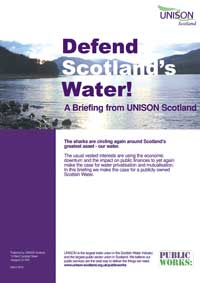 In launching its policy briefing Defend Scotland’s Water, the union pointed to previous statements in favour of privatisation by the Water Industry Commission Chair, Sir Ian Byatt; the recent announcement by The Scottish Futures Trust (SFT) that it is looking at privatisation; and the comments of one of the Scottish Government’s ‘Independent’ Budget Review panel members – Crawford Beveridge - on BBC Newsnight Scotland last night, suggesting this issue should be examined again.
Speaking at a meeting of UNISON water representatives, Dave Watson UNISON Scottish Organiser said:
“The sharks are circling again around Scotland’s greatest asset – our water. The regulatory regime has been preparing Scottish Water for privatisation for some time, driven by the ideological zeal of the Water Industry Commission Chair, Sir Ian Byatt. He has been joined by the SFT led by another privatisation advocate and banker, Sir Angus Grossart. Given this concerted campaign supported by the private sector who are keen to get their hands on our water at a knock down price, we need to make it crystal clear, that water is both, an essential public service, and, given the global water crisis, one of Scotland’s greatest economic assets.”
The UNISON briefing outlines the huge costs of privatisation to the water charge payer, including higher borrowing costs, billing systems, and dividends It also points to the beneficiaries of privatisation being the corporate financiers, consultants and company directors – particularly of the big overseas water multinationals who would target the privatised company.
UNISION also points to the continued ‘marking down’ of the value of Scottish Water’s assets, from £15bn when the corporation was created, down to current discussions of around £1bn, This is in order to make the package an attractive price for the private sector, particularly given the massive programme of investments the taxpayer has funded. Despite this investment and the additional costs of delivering this service in Scotland charges are lower than the UK average.
UNISON also rejects the supposed ‘alternative’ of mutualisation. Dave Watson said:
“In a capital intensive industry like water, mutualisation is not a co-operative solution. All services would be delivered by private water companies with all the costs of privatisation. It sounds cuddly and safe, but in reality it is a Trojan horse for privatisation. “UNISON, along with the STUC and the other unions involved in the water industry have been engaged in the debate about the future of Scottish Water, and we all believe that we should join with the worldwide movement in favour of democratisation of this essential service*.”
ENDS
Note for Editors:
1) The UNISON briefing is available on the UNISONScotland website at http://www.unison-scotland.org.uk/water/defendscotlandswater_mar2010.pdf
2) *The unions have produced a discussion paper It’s Scotland’s Water outlining ways to greater accountability for Scottish Water. It is available on the UNISON website at http://www.unison-scotland.org.uk/water/scotland's_water.pdf
.
The largest union in Scottish Water, UNISON, today accused government agencies of being part of a concerted campaign to use the financial crisis as cover for the privatisation of Scotland’s water.
Speaking at a meeting of UNISON water representatives, Dave Watson UNISON Scottish Organiser said:
“The sharks are circling again around Scotland’s greatest asset – our water. The regulatory regime has been preparing Scottish Water for privatisation for some time, driven by the ideological zeal of the Water Industry Commission Chair, Sir Ian Byatt. He has been joined by the SFT led by another privatisation advocate and banker, Sir Angus Grossart. Given this concerted campaign supported by the private sector who are keen to get their hands on our water at a knock down price, we need to make it crystal clear, that water is both, an essential public service, and, given the global water crisis, one of Scotland’s greatest economic assets.”
The UNISON briefing outlines the huge costs of privatisation to the water charge payer, including higher borrowing costs, billing systems, and dividends It also points to the beneficiaries of privatisation being the corporate financiers, consultants and company directors – particularly of the big overseas water multinationals who would target the privatised company.
UNISION also points to the continued ‘marking down’ of the value of Scottish Water’s assets, from £15bn when the corporation was created, down to current discussions of around £1bn, This is in order to make the package an attractive price for the private sector, particularly given the massive programme of investments the taxpayer has funded. Despite this investment and the additional costs of delivering this service in Scotland charges are lower than the UK average.
UNISON also rejects the supposed ‘alternative’ of mutualisation. Dave Watson said:
“In a capital intensive industry like water, mutualisation is not a co-operative solution. All services would be delivered by private water companies with all the costs of privatisation. It sounds cuddly and safe, but in reality it is a Trojan horse for privatisation. “UNISON, along with the STUC and the other unions involved in the water industry have been engaged in the debate about the future of Scottish Water, and we all believe that we should join with the worldwide movement in favour of democratisation of this essential service*.”
ENDS
Note for Editors:
1) The UNISON briefing is available on the UNISONScotland website at http://www.unison-scotland.org.uk/water/defendscotlandswater_mar2010.pdf
2) *The unions have produced a discussion paper It’s Scotland’s Water outlining ways to greater accountability for Scottish Water. It is available on the UNISON website at http://www.unison-scotland.org.uk/water/scotland's_water.pdf
.
Friday, 26 March 2010
Save Britain's waterways by creating the first truly national park says UNISON
Fri 26 March
UNISON, the UK's leading public sector union, has today (26 March)
written to the Department for Energy, Food and Rural Affairs (DEFRA),
the Scottish Government, and British Waterways, calling on them to
secure the future of Britain's network of canals and waterways, by
agreeing to establish them as a cross-border national park.
DEFRA and British Waterways* are currently consulting on plans to turn
Britain's waterways into a charity, but the union fears that the tight
squeeze on third sector funding could see the nation's waterways fall
into disrepair, or locked up from public use entirely.
Inland waterways and national parks are both devolved functions in
Scotland, and funding for waterways in Scotland has had a positive
relationship in the public sector that many would be reluctant to lose.
A Canals National Park would deliver increased potential for
regeneration, and could provide a positive model for joint working to
regenerate areas of special interest. UNISON members in British
Waterways are well experienced and successful at this kind of
partnership working.
Dave Prentis, UNISON General Secretary, said:
"Turning Britain's waterways into a National Park would breathe new life
into our network of canals, safeguarding them for future generations. It
would be a gift to Britain, on a par with the formation of national
parks last century.
"As a truly national park, linking England, Scotland and Wales,
Britain's waterways could still reap all the benefits of charitable
status, applying for lottery funding, and working with volunteer groups,
but the future would be more secure - for the people using the rivers
and canals, and for those working on them.
"Generations of children and families have enjoyed Britain's network of
canals and waterways - they are part of our cultural heritage. No longer
in use for transporting freight around the country, they provide
much-needed leisure spaces in cities, and are vital habitats for
wildlife and conservation.
"But they are stuck in a legal grey area, classed as transport
facilities, making it tough to attract significant funding, throwing
their future into jeopardy. The funding crisis in the third sector,
means that any plans to switch to charitable status would only fuel this
insecurity.
"Severe lack of funding for charities could see the locks and paths
along Britain's waterways fall into disrepair. Canals could fill with
debris and rubbish, threatening conservation efforts. Whilst boaters and
anglers already pay to use waterways, additional entrance fees may be
introduced to raise funds, taking away the public's right to use and
enjoy Britain's Waterways free of charge."
UNISON represents white collar workers in British Waterways.
*DEFRA consultation: 'Waterways for everyone' and British Waterways
consultation: 'Setting a New Course'.
.
UNISON, the UK's leading public sector union, has today (26 March)
written to the Department for Energy, Food and Rural Affairs (DEFRA),
the Scottish Government, and British Waterways, calling on them to
secure the future of Britain's network of canals and waterways, by
agreeing to establish them as a cross-border national park.
DEFRA and British Waterways* are currently consulting on plans to turn
Britain's waterways into a charity, but the union fears that the tight
squeeze on third sector funding could see the nation's waterways fall
into disrepair, or locked up from public use entirely.
Inland waterways and national parks are both devolved functions in
Scotland, and funding for waterways in Scotland has had a positive
relationship in the public sector that many would be reluctant to lose.
A Canals National Park would deliver increased potential for
regeneration, and could provide a positive model for joint working to
regenerate areas of special interest. UNISON members in British
Waterways are well experienced and successful at this kind of
partnership working.
Dave Prentis, UNISON General Secretary, said:
"Turning Britain's waterways into a National Park would breathe new life
into our network of canals, safeguarding them for future generations. It
would be a gift to Britain, on a par with the formation of national
parks last century.
"As a truly national park, linking England, Scotland and Wales,
Britain's waterways could still reap all the benefits of charitable
status, applying for lottery funding, and working with volunteer groups,
but the future would be more secure - for the people using the rivers
and canals, and for those working on them.
"Generations of children and families have enjoyed Britain's network of
canals and waterways - they are part of our cultural heritage. No longer
in use for transporting freight around the country, they provide
much-needed leisure spaces in cities, and are vital habitats for
wildlife and conservation.
"But they are stuck in a legal grey area, classed as transport
facilities, making it tough to attract significant funding, throwing
their future into jeopardy. The funding crisis in the third sector,
means that any plans to switch to charitable status would only fuel this
insecurity.
"Severe lack of funding for charities could see the locks and paths
along Britain's waterways fall into disrepair. Canals could fill with
debris and rubbish, threatening conservation efforts. Whilst boaters and
anglers already pay to use waterways, additional entrance fees may be
introduced to raise funds, taking away the public's right to use and
enjoy Britain's Waterways free of charge."
UNISON represents white collar workers in British Waterways.
*DEFRA consultation: 'Waterways for everyone' and British Waterways
consultation: 'Setting a New Course'.
.
Thursday, 25 March 2010
Streamlined pay bargaining should be added to Public Service Reform Bill
Scotland's largest public service union - UNISON - is urging MSPs to support a series of amendments to the Public Service Reform Bill in today's debate in the Scottish Parliament.
The union is supporting a series of amendments to the Bill (nos 217 -222) that provide for one bargaining committee, covering all Non Departmental Public Bodies, and Public Corporations. This would streamline the large range of different pay negotiating bodies in the sector and recognise the reality of the decision-making process on public service pay.
Dave Watson, UNISON's Scottish organiser, said "Currently, the number of processes any pay discussions have to go through, mean that the bureaucracy constrains negotiations at local level, takes too long, and has lead to many recent damaging disputes. We think that, if the government is serious about streamlining and simplifying the exercise of public functions, this is a clear and definite step they could take."
ENDS
Note for Editors:- UNISON is Scotland's largest public service union, representing well over 160,000 workers working in Scotland's public services. A briefing on the UNISON supported amendments is available on the website at http://www.unison-scotland.org.uk/briefings/MSPBriefing_PSR_Bill_Amendment_March2010.pdf
The union is supporting a series of amendments to the Bill (nos 217 -222) that provide for one bargaining committee, covering all Non Departmental Public Bodies, and Public Corporations. This would streamline the large range of different pay negotiating bodies in the sector and recognise the reality of the decision-making process on public service pay.
Dave Watson, UNISON's Scottish organiser, said "Currently, the number of processes any pay discussions have to go through, mean that the bureaucracy constrains negotiations at local level, takes too long, and has lead to many recent damaging disputes. We think that, if the government is serious about streamlining and simplifying the exercise of public functions, this is a clear and definite step they could take."
ENDS
Note for Editors:- UNISON is Scotland's largest public service union, representing well over 160,000 workers working in Scotland's public services. A briefing on the UNISON supported amendments is available on the website at http://www.unison-scotland.org.uk/briefings/MSPBriefing_PSR_Bill_Amendment_March2010.pdf
Threatened Edinburgh Staff Win UK Award
Staff at the City of Edinburgh Council, who face wholesale privatisation, have just received a UK award for delivering efficiencies that are unrivalled across the UK. The Government Business Awards cover a variety of categories and Edinburgh is the outright winner of the Financial Performance Award.
The City Council recently announced the intention to bring the private sector in to run a whole range of council services in the hope of delivering efficiencies and savings.
Reports to council expressed concern at the ability of existing managers to deliver budget savings and highlighted English examples of privatisation as an alternative way forward for Edinburgh. However, the Government Business Award for Financial Performance places a serious massive question mark against the benefit to be gained from breaking up a winning team.
Commenting on the award Kevin Duguid said: “We share the council’s aspiration to be the best and to provide efficient services to the tax payers of Edinburgh. What this award shows is that the grass isn’t always greener on the other side of the fence. UNISON has always had faith in the work of our members and we’re delighted that this dedication and efficiency has been recognised and rewarded at the highest level. And the people of Edinburgh share this view – 89% voted against privatisation in a recent poll. Its just a pity that the council sits alone in failing to see that when it comes to council services in Edinburgh – “Public Works”. Our message to the leader of the administration is simple “if it ain’t broke don’t fix it”
More details and 10 points from UNISON's damning analysis of the council plans is at http://www.unison-edinburgh.org.uk/citynotforsale
The City Council recently announced the intention to bring the private sector in to run a whole range of council services in the hope of delivering efficiencies and savings.
Reports to council expressed concern at the ability of existing managers to deliver budget savings and highlighted English examples of privatisation as an alternative way forward for Edinburgh. However, the Government Business Award for Financial Performance places a serious massive question mark against the benefit to be gained from breaking up a winning team.
Commenting on the award Kevin Duguid said: “We share the council’s aspiration to be the best and to provide efficient services to the tax payers of Edinburgh. What this award shows is that the grass isn’t always greener on the other side of the fence. UNISON has always had faith in the work of our members and we’re delighted that this dedication and efficiency has been recognised and rewarded at the highest level. And the people of Edinburgh share this view – 89% voted against privatisation in a recent poll. Its just a pity that the council sits alone in failing to see that when it comes to council services in Edinburgh – “Public Works”. Our message to the leader of the administration is simple “if it ain’t broke don’t fix it”
More details and 10 points from UNISON's damning analysis of the council plans is at http://www.unison-edinburgh.org.uk/citynotforsale
Wednesday, 24 March 2010
Campaign against sell-off starts in Edinburgh
UNISON has launched a campaign against 'reckless' council plans to sell-off services and over 3,000 jobs.
The "Our City's Not For Sale" campaign will work with other unions, community groups and the public to expose the dangers of the council's 'alternative business models'.
"Services like front line customer contact, revenue and benefits, catering, cleaning, security, cleansing and vehicle and grounds maintenance, along with HR are all up for grabs with cultural services, transport and legal services also being primed for outsourcing through multi-million pound 'strategic partnerships' or 'joint ventures' - privatisation, to you and me", said Agnes Petkevicius, UNISON Edinburgh Branch Secretary.
"UNISON's own studies have revealed that, at best, council claims about savings are wishful thinking. No credible evidence exists to support them. Worse still, the evidence that does exist points to failures, worse services, increased costs and huge bills to bring failed services back in-house.
"To go ahead with this, in an exercise likely to top £1million wasted on consultants, without learning the lessons of the social care tendering fiasco is nothing short of reckless".
"If services are delivered in-house with no need to make a profit, how can they be delivered more cheaply while making a profit on top? Something has to give and that is usually the quality of the service or indeed the whole service - along with any decency in the pay and conditions of those delivering the service", added Branch President John Stevenson.
"You still pay your taxes but instead of the money going on the service and those who deliver it, it goes to company profits. Like the banks, or even perhaps the trams contract, these companies will become 'too big to fail' and will have the council over a barrel. It is time for the council to abandon these plans and concentrate on efficient and quality services in-house".
UNISON lead negotiator Kevin Duguid said, "The union has stressed that it is always ready to fully engage with the council on better and more efficient ways of delivering quality services. "However, the refusal to seriously look at in-house options means there is no real attempt to look at improving services, just a headlong drive to privatise".
"Nowhere is this more evident than the council leaving key issues out of the tendering advert like bidders having to comply with legal requirements such as the equalities duty, Climate Change Act etc, in case it deters them from applying".
"Staff are demoralised at how they are being treated with their jobs being sold from under them to the lowest bidder who will cut their terms and conditions to deliver profits for their shareholders first, with service delivery coming second."
More details and 10 points from UNISON's damning analysis of the council plans is at http://www.unison-edinburgh.org.uk/citynotforsale/10points.html
The "Our City's Not For Sale" campaign will work with other unions, community groups and the public to expose the dangers of the council's 'alternative business models'.
"Services like front line customer contact, revenue and benefits, catering, cleaning, security, cleansing and vehicle and grounds maintenance, along with HR are all up for grabs with cultural services, transport and legal services also being primed for outsourcing through multi-million pound 'strategic partnerships' or 'joint ventures' - privatisation, to you and me", said Agnes Petkevicius, UNISON Edinburgh Branch Secretary.
"UNISON's own studies have revealed that, at best, council claims about savings are wishful thinking. No credible evidence exists to support them. Worse still, the evidence that does exist points to failures, worse services, increased costs and huge bills to bring failed services back in-house.
"To go ahead with this, in an exercise likely to top £1million wasted on consultants, without learning the lessons of the social care tendering fiasco is nothing short of reckless".
"If services are delivered in-house with no need to make a profit, how can they be delivered more cheaply while making a profit on top? Something has to give and that is usually the quality of the service or indeed the whole service - along with any decency in the pay and conditions of those delivering the service", added Branch President John Stevenson.
"You still pay your taxes but instead of the money going on the service and those who deliver it, it goes to company profits. Like the banks, or even perhaps the trams contract, these companies will become 'too big to fail' and will have the council over a barrel. It is time for the council to abandon these plans and concentrate on efficient and quality services in-house".
UNISON lead negotiator Kevin Duguid said, "The union has stressed that it is always ready to fully engage with the council on better and more efficient ways of delivering quality services. "However, the refusal to seriously look at in-house options means there is no real attempt to look at improving services, just a headlong drive to privatise".
"Nowhere is this more evident than the council leaving key issues out of the tendering advert like bidders having to comply with legal requirements such as the equalities duty, Climate Change Act etc, in case it deters them from applying".
"Staff are demoralised at how they are being treated with their jobs being sold from under them to the lowest bidder who will cut their terms and conditions to deliver profits for their shareholders first, with service delivery coming second."
More details and 10 points from UNISON's damning analysis of the council plans is at http://www.unison-edinburgh.org.uk/citynotforsale/10points.html
Tuesday, 23 March 2010
Private consultants cost Scots councils £42m in a year
Date: 23 March 2010
UNISON – the union representing staff delivering local services – today said that savings of over £40m could be made from local council costs, by cutting back on the amount of use they make of private consultancy firms.
Using the Freedom of Information (Scotland) Act (FOI), the union asked all councils what they spent on consultants last year, and the figures that have so far been received - from 28 of 32 councils – show that last year councils poured over £42m of public money into the pockets of these private firms. Earlier figures obtained by the union show that nearly £6m of this went to one firm – KPMG, who are busy advising Scotland’s councils where they can save money by cutting services, staff and conditions.
Dave Watson, UNISON’s Scottish Organiser, said:
“Rather than concentrating on cutting services, politicians and the media might profitably look more closely at cutting the use of private consultants in local councils if there is a need to save money. UNISON has published an alternative budget at UK level that highlights much waste that could be saved including by ending central government use of consultants*, and this waste could also be cut in Scotland.”
The union also points to the huge increase in the Scottish Governments public service reform budget as a contributory factor in the high use of consultants.
Dave Watson said:
“It is clear that the use of consultants is hugely increased by the demand for reorganisations, shared services and investigating outsourcing services. Given the Scottish Government’s drive towards these, it is ironic that our earlier FOI question on the national use of consultants was refused by the government, and by the Improvement Service – who advise councils on this topic. We suspect that this information would drive up the amount of money wasted on private consultants.”
The council spending the most on consultants last year is City of Edinburgh, where the council is involved in a number of initiatives aimed at investigating outsourcing a huge raft of public services. They spent £6.4m last year on consultants. One consultant was adviser to Lehmann Brothers, Ernst & Young.
Dave Watson said:
“It is scandalous that it is same firm that endorsed Lehman Brothers’ methods of business-leading to the major world recession-that is now advising massive privatisation to Edinburgh City as their solution to the financial crisis, earning a nice fee for them as consultants. Our information is that Edinburgh plans to increase its spending on consultants as a part of this wasteful and damaging exercise.”
ENDS
Note for editors: *UNISON’s alternative budget is at - http://www.unison.org.uk/acrobat/18887.pdf
.
UNISON – the union representing staff delivering local services – today said that savings of over £40m could be made from local council costs, by cutting back on the amount of use they make of private consultancy firms.
Using the Freedom of Information (Scotland) Act (FOI), the union asked all councils what they spent on consultants last year, and the figures that have so far been received - from 28 of 32 councils – show that last year councils poured over £42m of public money into the pockets of these private firms. Earlier figures obtained by the union show that nearly £6m of this went to one firm – KPMG, who are busy advising Scotland’s councils where they can save money by cutting services, staff and conditions.
Dave Watson, UNISON’s Scottish Organiser, said:
“Rather than concentrating on cutting services, politicians and the media might profitably look more closely at cutting the use of private consultants in local councils if there is a need to save money. UNISON has published an alternative budget at UK level that highlights much waste that could be saved including by ending central government use of consultants*, and this waste could also be cut in Scotland.”
The union also points to the huge increase in the Scottish Governments public service reform budget as a contributory factor in the high use of consultants.
Dave Watson said:
“It is clear that the use of consultants is hugely increased by the demand for reorganisations, shared services and investigating outsourcing services. Given the Scottish Government’s drive towards these, it is ironic that our earlier FOI question on the national use of consultants was refused by the government, and by the Improvement Service – who advise councils on this topic. We suspect that this information would drive up the amount of money wasted on private consultants.”
The council spending the most on consultants last year is City of Edinburgh, where the council is involved in a number of initiatives aimed at investigating outsourcing a huge raft of public services. They spent £6.4m last year on consultants. One consultant was adviser to Lehmann Brothers, Ernst & Young.
Dave Watson said:
“It is scandalous that it is same firm that endorsed Lehman Brothers’ methods of business-leading to the major world recession-that is now advising massive privatisation to Edinburgh City as their solution to the financial crisis, earning a nice fee for them as consultants. Our information is that Edinburgh plans to increase its spending on consultants as a part of this wasteful and damaging exercise.”
ENDS
Note for editors: *UNISON’s alternative budget is at - http://www.unison.org.uk/acrobat/18887.pdf
.
Tuesday, 16 March 2010
Big business group rattled by UNISON video
Well it is clear who the Tax Dodgers Alliance see as their main opponent in their campaign to attack services for the people of the UK – they have been burning the midnight oil over at their plush offices in the right-wing enclave in Tufton Street (provided free by Avanta, and their Chief Executive David Alberto) to cut and paste their lists of so-called ‘non-jobs’ onto UNISON’s video attacking public spending cuts - which has been posted on the union's Million Voices campaign page http://www.unison.org.uk/million/ .
Utilising the Telegraph blog of Tory MEP Daniel Hannan they have put a response video out in the media to claim (as they always do) that there are loads of non-jobs in the public sector.
Hannan, in case you don't immediately recognise him, is the man who recently rubbished the NHS as a ’60-year mistake’ in America (on Fox news - http://www.youtube.com/watch?v=FiSPRkq28iU - it's worth a look too.)
The so-called Taxpayers' lists of so-called non-jobs are also instructive. Many of them (for all the fancy names) are about dealing with the media. Are they suggesting that the public sector doesn’t have to deal with the misinformation that they and others pump out on a daily basis? Indeed, I notice they themselves have just appointed a ‘New Media Co-ordinator’. I assume that is someone to co-ordinate, ‘new media’ rather than a ‘new’ co-ordinator of all media. So, assuming that someone deals with the ‘old’ media, that means that they have at least two. Well what is sauce for the goose …!
Dramatherapists? – I think most clinicians know the value of therapy in healthcare – obviously the TPA neither knows nor cares. Green jobs – doesn’t surprise me. What are the TPA’s policies on climate change? Do they accept that carbon emissions are increasing global warming or not? Do they think that the polluters are going to reform themselves without regulation? Most people actually think that the public sector should lead the way in reducing carbon emissions and carry out the function of protecting the environment – who do they think should do it? Exxon?
But the one I am most surprised to notice is the ‘Street Football Co-ordinator’. Maybe they think people have forgotten their most widely dropped clanger – but we haven’t. This post was created by Moray Council in 2006 and – two years later - the TPA whipped up its usual froth of righteous indignation about it. However Moray Council’s press office (yes that non-job) had other ideas and put the true story out.
The job was in fact part-time, and therefore the cost was half what the TPA – who had only noticed the top-line salary – claimed. It was only part-funded by the council, the rest being paid by the police, by other agencies and by the private sector – the TPA’s chums – who were delighted that the work was taking kids away from vandalism and other anti social behaviour. So much so in fact that the council has been able to secure funding until later this year –from all the original partners.
So now we know – if you want increased vandalism, environmental damage, poorer healthcare and authorities who are unable to put their views into the media – lets thank the TPA!
Chris Bartter
UNISON Scotland Communications Officer
.
Utilising the Telegraph blog of Tory MEP Daniel Hannan they have put a response video out in the media to claim (as they always do) that there are loads of non-jobs in the public sector.
Hannan, in case you don't immediately recognise him, is the man who recently rubbished the NHS as a ’60-year mistake’ in America (on Fox news - http://www.youtube.com/watch?v=FiSPRkq28iU - it's worth a look too.)
The so-called Taxpayers' lists of so-called non-jobs are also instructive. Many of them (for all the fancy names) are about dealing with the media. Are they suggesting that the public sector doesn’t have to deal with the misinformation that they and others pump out on a daily basis? Indeed, I notice they themselves have just appointed a ‘New Media Co-ordinator’. I assume that is someone to co-ordinate, ‘new media’ rather than a ‘new’ co-ordinator of all media. So, assuming that someone deals with the ‘old’ media, that means that they have at least two. Well what is sauce for the goose …!
Dramatherapists? – I think most clinicians know the value of therapy in healthcare – obviously the TPA neither knows nor cares. Green jobs – doesn’t surprise me. What are the TPA’s policies on climate change? Do they accept that carbon emissions are increasing global warming or not? Do they think that the polluters are going to reform themselves without regulation? Most people actually think that the public sector should lead the way in reducing carbon emissions and carry out the function of protecting the environment – who do they think should do it? Exxon?
But the one I am most surprised to notice is the ‘Street Football Co-ordinator’. Maybe they think people have forgotten their most widely dropped clanger – but we haven’t. This post was created by Moray Council in 2006 and – two years later - the TPA whipped up its usual froth of righteous indignation about it. However Moray Council’s press office (yes that non-job) had other ideas and put the true story out.
The job was in fact part-time, and therefore the cost was half what the TPA – who had only noticed the top-line salary – claimed. It was only part-funded by the council, the rest being paid by the police, by other agencies and by the private sector – the TPA’s chums – who were delighted that the work was taking kids away from vandalism and other anti social behaviour. So much so in fact that the council has been able to secure funding until later this year –from all the original partners.
So now we know – if you want increased vandalism, environmental damage, poorer healthcare and authorities who are unable to put their views into the media – lets thank the TPA!
Chris Bartter
UNISON Scotland Communications Officer
.
Public Service Cuts Hurt: video
The latest Million Voices campaign video from UNISON.
See the Million Voices campaign page here:
http://www.unison.org.uk/million/ and sign up to support us in defending public services.
More UNISON videos at:
http://www.youtube.com/user/UNISONTV
and at the UNISON Scotland YouTube page:
http://www.youtube.com/user/UNISONScotland
.
Monday, 15 March 2010
MSPs urged to ‘love their libraries’
Date: 15 March 2010
In the teeth of threatened public spending cuts, reduced opening hours, closures and reduced staff numbers, public service union – UNISON – has joined forces with Highland MSP Peter Peacock to promote the great service public libraries provide, and to urge the Scottish Government and local councils to maintain public support for them.
The union, which represents library staff in public, education and special libraries, has launched a UK-wide ‘Love your Libraries’ campaign, and in Scotland, has produced a special briefing for its branches urging them to scrutinise cuts proposals put forward by councils to identify attacks on library services, and to lobby their MSPs to get them to support the motion submitted by Peter Peacock MSP to the Scottish Parliament (Motion number S3M-05898).
Dave Watson – UNISON’s Scottish Organiser, said:
“Currently around 1 million Scots borrow books from Scotland’s 541 libraries and 82 mobile libraries, and many more use the much wider services that libraries provide via learning centres, and digital access. But there is evidence that authorities are cutting back on libraries, opening hours and qualified staff as a response to the unprecedented financial cutbacks.”
In a UK UNISON library members survey, more than 40% reported cuts in service, and two thirds reported inadequate staffing levels. In Scotland a number of UNISON branches are reporting proposed closures of libraries as the public spending squeeze begins to bite. The union is currently running a ‘Public Works’ campaign to defend public services from funding cuts.
Gray Allan, a UNISON Branch Secretary and library worker in Falkirk said:
“Libraries in Scotland are increasingly busy since the recession, and we need more resources to deliver the service that people want and need. More people in Scotland go to libraries than go to football matches. Our members deliver an essential service and people appreciate that, that is why I, many other branch members, and community service users will be marching in Glasgow on 10 April to Stop the Cuts.”
The union is also scathing about the attempt by Glasgow City Council to hive off its libraries to a trust, and suggests it has failed to deliver any of the planned extra funding.
Dave Watson said:
“Culture & Sport Glasgow, was promoted in 2007 in order to attract private finance. In fact the only money it has attracted is by tax avoidance, and the Trust is now facing a £1.7m cut this year, wants to freeze staff pay and close libraries. It has already drastically reduced book-buying in the final months of this financial year.”
ENDS
Notes for editors: UNISON’s briefing is available on our website – http://www.unison-scotland.org.uk/briefings/225libraries.pdf
The Public Works campaign details can be found on http://www.unison-scotland.org.uk/publicworks/index.html
.
In the teeth of threatened public spending cuts, reduced opening hours, closures and reduced staff numbers, public service union – UNISON – has joined forces with Highland MSP Peter Peacock to promote the great service public libraries provide, and to urge the Scottish Government and local councils to maintain public support for them.
The union, which represents library staff in public, education and special libraries, has launched a UK-wide ‘Love your Libraries’ campaign, and in Scotland, has produced a special briefing for its branches urging them to scrutinise cuts proposals put forward by councils to identify attacks on library services, and to lobby their MSPs to get them to support the motion submitted by Peter Peacock MSP to the Scottish Parliament (Motion number S3M-05898).
Dave Watson – UNISON’s Scottish Organiser, said:
“Currently around 1 million Scots borrow books from Scotland’s 541 libraries and 82 mobile libraries, and many more use the much wider services that libraries provide via learning centres, and digital access. But there is evidence that authorities are cutting back on libraries, opening hours and qualified staff as a response to the unprecedented financial cutbacks.”
In a UK UNISON library members survey, more than 40% reported cuts in service, and two thirds reported inadequate staffing levels. In Scotland a number of UNISON branches are reporting proposed closures of libraries as the public spending squeeze begins to bite. The union is currently running a ‘Public Works’ campaign to defend public services from funding cuts.
Gray Allan, a UNISON Branch Secretary and library worker in Falkirk said:
“Libraries in Scotland are increasingly busy since the recession, and we need more resources to deliver the service that people want and need. More people in Scotland go to libraries than go to football matches. Our members deliver an essential service and people appreciate that, that is why I, many other branch members, and community service users will be marching in Glasgow on 10 April to Stop the Cuts.”
The union is also scathing about the attempt by Glasgow City Council to hive off its libraries to a trust, and suggests it has failed to deliver any of the planned extra funding.
Dave Watson said:
“Culture & Sport Glasgow, was promoted in 2007 in order to attract private finance. In fact the only money it has attracted is by tax avoidance, and the Trust is now facing a £1.7m cut this year, wants to freeze staff pay and close libraries. It has already drastically reduced book-buying in the final months of this financial year.”
ENDS
Notes for editors: UNISON’s briefing is available on our website – http://www.unison-scotland.org.uk/briefings/225libraries.pdf
The Public Works campaign details can be found on http://www.unison-scotland.org.uk/publicworks/index.html
.
Thursday, 11 March 2010
Public service cuts threaten safety and care standards - UNISON
Reports from public service workers throughout Scotland indicate that vacancy freezes and lack of absence cover are threatening safety, and reducing the levels of care to vulnerable said the public service union UNISON today.
An email survey of members, undertaken over the last few weeks, for the union's Public Works campaign is showing that this is the main impact of funding cuts over the last two years.
Dave Watson - UNISON's Scottish Organiser, said "It is too early to provide a comprehensive picture of cuts through this survey, but over 50% of respondents identified a vacancy freeze operating in their workplace. As this survey only covers the last two years of cuts, it means that the horrendous future cuts threatened can only directly threaten the safety of both staff and service users.
"Members are highlighting to us the dangers to people in their care, the risk of reduced safety cover, and how backroom staff cuts force staff off the frontline. That is why we are calling a march and rally in Glasgow on April 10 to bring together communities and service deliverers to call on politicians to stop the cuts and to adopt UNISON's alternative budget "
UNISON's email survey of members is still being analysed but key findings have already come to light. Many members have taken the opportunity to identify concerns about how these cuts impact in their workplace.
A number of quotes from anonymous responders follow.
'The weekly food budget for residents of this care home has been reduced from £72 per resident to less than £17' - cook, residential care home
'In this small section, no cover has been provided for one maternity leave and two long term sickness absences...' - member, Environmental Health Section.
'vulnerable adults now get less care hours, and staff no longer have the time to spend on each individuals needs. They are left alone for a greater period of time, hence increasing the risk.' - member, care service
'Admin takes up an inordinate amount of my time. Time better used doing face-to-face work with young people.' - youth worker
Dave Watson said "Politicians shouting for public spending cuts should listen to the voices from the frontline. Services are already stretched to breaking point, the further cuts that some propose will bring service levels far below acceptable levels - either of care, or even of safety."
ENDS
Notes for editors: The survey was taken from a random sample by email through UNISON's membership system and is currently being analysed fully, but of 269 responses, 144 identified a vacancy freeze and 28, no absence cover or overtime. Quotes have been provided under cover of anonymity.
.
An email survey of members, undertaken over the last few weeks, for the union's Public Works campaign is showing that this is the main impact of funding cuts over the last two years.
Dave Watson - UNISON's Scottish Organiser, said "It is too early to provide a comprehensive picture of cuts through this survey, but over 50% of respondents identified a vacancy freeze operating in their workplace. As this survey only covers the last two years of cuts, it means that the horrendous future cuts threatened can only directly threaten the safety of both staff and service users.
"Members are highlighting to us the dangers to people in their care, the risk of reduced safety cover, and how backroom staff cuts force staff off the frontline. That is why we are calling a march and rally in Glasgow on April 10 to bring together communities and service deliverers to call on politicians to stop the cuts and to adopt UNISON's alternative budget "
UNISON's email survey of members is still being analysed but key findings have already come to light. Many members have taken the opportunity to identify concerns about how these cuts impact in their workplace.
A number of quotes from anonymous responders follow.
'The weekly food budget for residents of this care home has been reduced from £72 per resident to less than £17' - cook, residential care home
'In this small section, no cover has been provided for one maternity leave and two long term sickness absences...' - member, Environmental Health Section.
'vulnerable adults now get less care hours, and staff no longer have the time to spend on each individuals needs. They are left alone for a greater period of time, hence increasing the risk.' - member, care service
'Admin takes up an inordinate amount of my time. Time better used doing face-to-face work with young people.' - youth worker
Dave Watson said "Politicians shouting for public spending cuts should listen to the voices from the frontline. Services are already stretched to breaking point, the further cuts that some propose will bring service levels far below acceptable levels - either of care, or even of safety."
ENDS
Notes for editors: The survey was taken from a random sample by email through UNISON's membership system and is currently being analysed fully, but of 269 responses, 144 identified a vacancy freeze and 28, no absence cover or overtime. Quotes have been provided under cover of anonymity.
.
Monday, 8 March 2010
Executives and CoSLA have undermined bargaining machinery - UNISON
Monday 8 March
UNISON, the union representing around 100,000 Scottish Council staff, today responded to the news that 32 high paid local council officials had agreed to waive their agreed pay rise.
Dougie Black, UNISON Regional Organiser, and Lead Negotiator said:
“It is unfortunate that the chief executives did not see fit to raise this first through the negotiating machinery, which delivers their pay. Neither should the employers have engaged in deals with one group which undermine the agreed procedures that affect a much larger number. Cosy deals with their most senior employees would seem to be more important than delivering for the low-paid workers, who are at the sharp end of service delivery.”
.
UNISON, the union representing around 100,000 Scottish Council staff, today responded to the news that 32 high paid local council officials had agreed to waive their agreed pay rise.
Dougie Black, UNISON Regional Organiser, and Lead Negotiator said:
“It is unfortunate that the chief executives did not see fit to raise this first through the negotiating machinery, which delivers their pay. Neither should the employers have engaged in deals with one group which undermine the agreed procedures that affect a much larger number. Cosy deals with their most senior employees would seem to be more important than delivering for the low-paid workers, who are at the sharp end of service delivery.”
.
Thursday, 4 March 2010
Taxpayers' Alliance gets its sums wrong on local government pensions, again
UNISON has accused the Taxpayers' Alliance of deliberately manipulating figures to suit their claims that local government pensions face a black hole*.
The TA, a tax-cutting pressure group, in comparing liabilities to assets, is deliberately making a ridiculous assumption that everyone will retire at once, tomorrow.
The local government pension scheme is affordable and sustainable and its income exceeded expenditure by almost £6 billion in the last year.
Dave Watson (UNISON Scottish organiser), said: "The so-called Taxpayers' Alliance deliberately distorts the true picture to suit their claims and their tax cutting aims. Their claims are based on the nonsensical supposition that everyone is going to retire at once, tomorrow. Neither do these pensions cost £1 of every £5 of council tax, because council tax makes up only a small percentage of funding.
"Local government pensions are affordable and sustainable. A new scheme has recently been agreed that increases staff contributions. They are funded by employers, employees and by investment income. The LGPS generates one-third of its own income, and contributions from employers in Scotland are going down.
"Remember, too, that we are not talking about gold-plated pensions, here. Local government workers like classroom assistants, home carers, social workers, refuse collectors, and dinner ladies, contribute all their working lives to gain a pension that averages just £3,800 pa, yet the Taxpayer's Alliance, would apparently prefer them to have that pension cut and force them to rely on state benefits. What we need is some perspective here and a move away from a race to the bottom on pensions.
"The real pensions scandal in this country is that the majority of company directors can retire at 60, with a final salary pension 25 times higher than the national average which they accrue twice as fast as both their workforce and the public sector workforce. They then campaign for low paid public service workers to take a pension cut.
"The so-called 'Taxpayers Alliance' would be better employed directing their firepower at the real gold-plated pensioners. Big business bosses who award themselves generous pensions while closing decent schemes for their staff. But they won't of course, because this would be biting the hand that feeds them".
* Council pensions report by the Taxpayers' Alliance
Note for editors:
THE FACTS ABOUT THE LOCAL GOVERNMENT PENSION SCHEME:
1. It is funded by employer contributions, employee contributions and investment income.
2. It is cash positive - member benefits paid out in 2008-2009 were £5.6 billion against gross income of £10.2 billion.
3. The total value of combined assets in England, Wales, Scotland and NI was £143 billion (in 2008).
4. That's 5 times greater than the largest single pension fund in the UK.
5. Total assets of the 89 LGPS funds are equivalent to 10% of GDP.
6. 60% of the fund is invested in equities or shares - in UK and global stock markets.
7. By 2008, more than £1 billion was invested in each of the top four FTSE companies and it owned 1.3% of seven of the top nine companies in the UK.
8. £4.7 billion invested in the big four banks - Barclays, HBOS, HSBC, RBS and
9. £2.3 billion in the 49 largest companies delivering UK public services in local government, the NHS and the utilities.
.
The TA, a tax-cutting pressure group, in comparing liabilities to assets, is deliberately making a ridiculous assumption that everyone will retire at once, tomorrow.
The local government pension scheme is affordable and sustainable and its income exceeded expenditure by almost £6 billion in the last year.
Dave Watson (UNISON Scottish organiser), said: "The so-called Taxpayers' Alliance deliberately distorts the true picture to suit their claims and their tax cutting aims. Their claims are based on the nonsensical supposition that everyone is going to retire at once, tomorrow. Neither do these pensions cost £1 of every £5 of council tax, because council tax makes up only a small percentage of funding.
"Local government pensions are affordable and sustainable. A new scheme has recently been agreed that increases staff contributions. They are funded by employers, employees and by investment income. The LGPS generates one-third of its own income, and contributions from employers in Scotland are going down.
"Remember, too, that we are not talking about gold-plated pensions, here. Local government workers like classroom assistants, home carers, social workers, refuse collectors, and dinner ladies, contribute all their working lives to gain a pension that averages just £3,800 pa, yet the Taxpayer's Alliance, would apparently prefer them to have that pension cut and force them to rely on state benefits. What we need is some perspective here and a move away from a race to the bottom on pensions.
"The real pensions scandal in this country is that the majority of company directors can retire at 60, with a final salary pension 25 times higher than the national average which they accrue twice as fast as both their workforce and the public sector workforce. They then campaign for low paid public service workers to take a pension cut.
"The so-called 'Taxpayers Alliance' would be better employed directing their firepower at the real gold-plated pensioners. Big business bosses who award themselves generous pensions while closing decent schemes for their staff. But they won't of course, because this would be biting the hand that feeds them".
* Council pensions report by the Taxpayers' Alliance
Note for editors:
THE FACTS ABOUT THE LOCAL GOVERNMENT PENSION SCHEME:
1. It is funded by employer contributions, employee contributions and investment income.
2. It is cash positive - member benefits paid out in 2008-2009 were £5.6 billion against gross income of £10.2 billion.
3. The total value of combined assets in England, Wales, Scotland and NI was £143 billion (in 2008).
4. That's 5 times greater than the largest single pension fund in the UK.
5. Total assets of the 89 LGPS funds are equivalent to 10% of GDP.
6. 60% of the fund is invested in equities or shares - in UK and global stock markets.
7. By 2008, more than £1 billion was invested in each of the top four FTSE companies and it owned 1.3% of seven of the top nine companies in the UK.
8. £4.7 billion invested in the big four banks - Barclays, HBOS, HSBC, RBS and
9. £2.3 billion in the 49 largest companies delivering UK public services in local government, the NHS and the utilities.
.
Wednesday, 3 March 2010
Troubled city college merger faces further challenge
One of the Colleges making up the new proposed 'super college' in Glasgow is being referred to the Equalities and Human Rights Commission over their closure of a staff and student nursery, the education union, UNISON said today.
A complaint is being made to the EHRC by the union, and they have asked for an enforcement order to be served against the college to ensure the nursery remains open.
The College of Nautical Studies has been in a wrangle with its staff unions over the closure of the Thistle Nursery with the loss of 23 full time jobs, since July 2009.
Despite a successful industrial action ballot, a campaign to save the nursery, and a commitment to examine the union's case, the college subsequently reconfirmed its decision to shut the nursery from July this year.
Assistant UNISON branch secretary Scott Donohoe said: "Despite admitting the closure of the nursery would impact unfairly on female staff, the Equalities Impact Assessment provided by the college is totally inadequate, and was only done after the decision hade been taken, when UNISON asked to see it. The college seems to be simply ticking boxes, and even then only after they are pushed by UNISON."
UNISON maintains that the closure of the nursery is connected with the merger, where, despite the large amount of public money invested, no nursery provision is planned. News of the complaint comes just a day after teaching unions warned the new City of Glasgow College about concerns regarding compulsory redundancies and terms and conditions. UNISON argues that the new college should have a nursery on campus.
Scott Donohoe said "Many parents, students and staff use the nursery. Closing the facility will threaten the chances of many women to take life changing opportunities. In particular, forcing low paid women out to the expensive private sector could mean having to choose between study and the dole."
ENDS
Notes for Editors: The Equality Act 2006 amended the Sex Discrimination Act 1975 and introduced an Equality Duty on public authorities when carrying out their functions to ensure services, practices and policies are developed with the different needs of men and women in mind.
.
A complaint is being made to the EHRC by the union, and they have asked for an enforcement order to be served against the college to ensure the nursery remains open.
The College of Nautical Studies has been in a wrangle with its staff unions over the closure of the Thistle Nursery with the loss of 23 full time jobs, since July 2009.
Despite a successful industrial action ballot, a campaign to save the nursery, and a commitment to examine the union's case, the college subsequently reconfirmed its decision to shut the nursery from July this year.
Assistant UNISON branch secretary Scott Donohoe said: "Despite admitting the closure of the nursery would impact unfairly on female staff, the Equalities Impact Assessment provided by the college is totally inadequate, and was only done after the decision hade been taken, when UNISON asked to see it. The college seems to be simply ticking boxes, and even then only after they are pushed by UNISON."
UNISON maintains that the closure of the nursery is connected with the merger, where, despite the large amount of public money invested, no nursery provision is planned. News of the complaint comes just a day after teaching unions warned the new City of Glasgow College about concerns regarding compulsory redundancies and terms and conditions. UNISON argues that the new college should have a nursery on campus.
Scott Donohoe said "Many parents, students and staff use the nursery. Closing the facility will threaten the chances of many women to take life changing opportunities. In particular, forcing low paid women out to the expensive private sector could mean having to choose between study and the dole."
ENDS
Notes for Editors: The Equality Act 2006 amended the Sex Discrimination Act 1975 and introduced an Equality Duty on public authorities when carrying out their functions to ensure services, practices and policies are developed with the different needs of men and women in mind.
.
Friday, 26 February 2010
UNISON calls on SPT to recognize staff work
UNISON, the main union representing staff in Strathclyde Partnership for Transport (SPT) is calling for the partnership meeting today (Friday) to acknowledge the work put in by staff during the turmoil caused by the high profile resignations of senior board members and management.
Robert Rae (UNISON regional organiser) said "While the fallout of expenses revelations and resignations continue to be played out in the media, UNISON members within SPT continue to provide a valuable service for the travelling public in Strathclyde. This seems to have been overlooked in the current climate."
UNISON is calling upon the SPT officers at their meeting, and their new chairperson, to acknowledge the commitment of their employees.
Robert Rae said: "We would urge the officers of SPT to acknowledge their staff's commitment to getting the job done. They are working diligently providing a public service day in, day out despite the issues at the top."
Robert Rae (UNISON regional organiser) said "While the fallout of expenses revelations and resignations continue to be played out in the media, UNISON members within SPT continue to provide a valuable service for the travelling public in Strathclyde. This seems to have been overlooked in the current climate."
UNISON is calling upon the SPT officers at their meeting, and their new chairperson, to acknowledge the commitment of their employees.
Robert Rae said: "We would urge the officers of SPT to acknowledge their staff's commitment to getting the job done. They are working diligently providing a public service day in, day out despite the issues at the top."
Thursday, 25 February 2010
Union fury at slap in face for low paid
Date: Thu 25 February 2010
Unions representing around 150,000 Scottish Council staff, today reacted with anger at what they said was CoSLA’s high-handed dismissal of their pay claim. UNISON, along with fellow unions Unite and GMB had submitted the claim for 3% for 2010-2011, but at a meeting yesterday, the claim was simply dismissed without any negotiations.
Dougie Black, UNISON Regional Organiser, and Lead Negotiator said: “Despite the fact that CoSLA have already agreed to pay teaching staff 2.4% and their senior managers 2.5% this year, as part of multi-year deals, it appears that the value that they put on the main group of staff who deliver their services is nothing. These staff include the lowest paid in Scottish Local Government. For them it is a slap in the face.”
The unions are also angry that the employers chose not to address the detail of the trade unions’ claim but simply dismissed it in its entirety.
Jimmy Farrelly, Senior Industrial Organiser Unite, said: “Just as the rejection of their claim shows how little councils value their staff, the brusque and dismissive treatment of their negotiators is further proof of the lack of understanding that these employers have. It is similar to the treatment that lords offered to their serfs.”
John Begley, GMB Organiser, said: “Despite many authorities making provision for pay for SJC employees this year they now appear to want to backtrack on this and leave our members high and dry.”
Further talks have been offered by the employers, and the unions will now consult with their branches and consider if there is any likelihood of serious negotiations.
.
Unions representing around 150,000 Scottish Council staff, today reacted with anger at what they said was CoSLA’s high-handed dismissal of their pay claim. UNISON, along with fellow unions Unite and GMB had submitted the claim for 3% for 2010-2011, but at a meeting yesterday, the claim was simply dismissed without any negotiations.
Dougie Black, UNISON Regional Organiser, and Lead Negotiator said: “Despite the fact that CoSLA have already agreed to pay teaching staff 2.4% and their senior managers 2.5% this year, as part of multi-year deals, it appears that the value that they put on the main group of staff who deliver their services is nothing. These staff include the lowest paid in Scottish Local Government. For them it is a slap in the face.”
The unions are also angry that the employers chose not to address the detail of the trade unions’ claim but simply dismissed it in its entirety.
Jimmy Farrelly, Senior Industrial Organiser Unite, said: “Just as the rejection of their claim shows how little councils value their staff, the brusque and dismissive treatment of their negotiators is further proof of the lack of understanding that these employers have. It is similar to the treatment that lords offered to their serfs.”
John Begley, GMB Organiser, said: “Despite many authorities making provision for pay for SJC employees this year they now appear to want to backtrack on this and leave our members high and dry.”
Further talks have been offered by the employers, and the unions will now consult with their branches and consider if there is any likelihood of serious negotiations.
.
Wednesday, 24 February 2010
Scottish Centre for Healthy Working Lives issues guidelines to tackle violence in the workplace
Date: Wed 24 February 2010
Scotland’s local authorities have come together to protect staff from violence in the workplace following the launch of new guidelines.
The Scottish Centre for Healthy Working Lives has teamed up with the Convention of Scottish Local Authorities (CoSLA) and the Scottish Trades Union Congress (STUC) in an effort to stamp out the risk of physical and verbal abuse.
They have drawn together good practice to form guidelines, believed to be the first of its kind in the UK, which aim to provide a tool for those working in local authorities, whether they are practitioners, managers, individual workers or elected members.
The guidelines, Managing Occupational Violence and Aggression in the Workplace: Tools and Strategies, was launched today, Wednesday, 24th February, at an event held in CoSLA’s headquarters in Edinburgh.
Kenny MacAskill, MSP, Cabinet Secretary for Justice, spoke at the event which was attended by representatives from 21 local authorities, trade unions, health boards and the Scottish Business Crime Centre.
The new guidelines will allow local authorities to compare recommendations against their existing standards and encourage the involvement of staff in agreeing and monitoring procedures.
It is estimated that 38% of people working in a public-facing occupation in Scotland have suffered verbal abuse by a member of the public in the last 12 months. The number of assaults reported against people working in local government rose from 9,121 to 9,910 in 2009.
Over a million people in Scotland deal with the public as part of the daily working routine and those who face possible verbal or physical abuse can include classroom assistants, refuse collectors, care workers and councillors.
Many incidents however go unreported due to a lack of robust reporting procedures or perceptions that being abused is part of the job.
Linda Shanahan, Violence Prevention Manager for the Scottish Centre for Healthy Working Lives, has led on the development of the guidelines which aims to raise awareness of the reasons behind why some violence occurs, and to provide tools to manage it.
She said: “Over the past year, we have been working closely with CoSLA, UNISON and a range of local authorities to develop these guidelines which are unique in its approach and encourage local government to take a pro-active approach to developing best practice.
“Employers have a duty to protect their staff and the Centre can provide them with support to tackle this unacceptable issue and reassure them that the reporting of incidents involving violence in the workplace need not be a complicated process.
“Being on the receiving end of work-related violence can contribute to long-term health problems such as stress and depression, resulting in extra costs from absenteeism and leading to difficulties in staff retention.”
At the launch of the guidelines were over 20 Scottish local authority representatives from a range of disciplines as well as others including trade unions and the NHS. They heard from a range of speakers including Steve Bell, Strategic Director of the Scottish Centre for Healthy Working Lives; Dave Watson, UNISON’S Scottish Organiser, and Ronnie McColl, CoSLA’s health and wellbeing spokesperson.
UNISON Scottish Organiser Dave Watson said: “Any act of violence on a member of staff providing vital public services is completely unacceptable.
“It is clear that where rigorous monitoring and active preventative measures are in place; this has resulted in improved staff safety. This new guidance will give local authorities the tools to make real progress in tackling this issue.”
Ronnie McColl, CoSLA’s health and wellbeing spokesperson, added: “Local authorities recognise staff are their greatest asset, so it is essential we do all we can to provide a safe working environment and provide guidance on how to minimise risk to the personal safety of council staff and elected members when doing their jobs.
“A great deal of work has been done in councils across Scotland on developing policies to tackle violence in the workplace and much of this good work has been incorporated into this guidance.
“I welcome this guidance and believe it will promote the sector as an exemplar in good practice to which others can aspire.”
The guidance collates examples of best practice in the prevention of violence against staff and involved input from 15 local authorities, along with a range of other experts.
The Scottish Centre for Healthy Working Lives is helping to reduce work-related ill health by 20 per cent and days lost to ill health by 30 per cent. In Scotland, 2.2 million working days are lost every year due to sickness absence at a cost to employers of £1.2 billion (£1,600 per employee).
Local authorities can receive a copy of the new guidelines or free and confidential advice from the Scottish Centre for Healthy Working Lives, by visiting www.healthyworkinglives.com or by calling the adviceline on 0800 019 2211.
Ends
Issued by the BIG Partnership on behalf of the Scottish Centre for Healthy Working Lives.
For further information or interview requests, contact Kim Munro on 0141 333 9585 (office), 07966 224910 (mobile) or kim.munro@bigpartnership.co.uk or Ross Barker on 0141 333 9585 (office), 07963 349762 (mobile) or ross.barker@bigpartnership.co.uk
Note to Editors
The Scottish Centre for Healthy Working Lives was established in 2005 as part of NHS Scotland. It can offer advice on the latest health and safety legislation, occupational health support and help with health promotion. For a free and confidential advice or to arrange a workplace visit, please call the adviceline on 0800 019 2211.
.
Scotland’s local authorities have come together to protect staff from violence in the workplace following the launch of new guidelines.
The Scottish Centre for Healthy Working Lives has teamed up with the Convention of Scottish Local Authorities (CoSLA) and the Scottish Trades Union Congress (STUC) in an effort to stamp out the risk of physical and verbal abuse.
They have drawn together good practice to form guidelines, believed to be the first of its kind in the UK, which aim to provide a tool for those working in local authorities, whether they are practitioners, managers, individual workers or elected members.
The guidelines, Managing Occupational Violence and Aggression in the Workplace: Tools and Strategies, was launched today, Wednesday, 24th February, at an event held in CoSLA’s headquarters in Edinburgh.
Kenny MacAskill, MSP, Cabinet Secretary for Justice, spoke at the event which was attended by representatives from 21 local authorities, trade unions, health boards and the Scottish Business Crime Centre.
The new guidelines will allow local authorities to compare recommendations against their existing standards and encourage the involvement of staff in agreeing and monitoring procedures.
It is estimated that 38% of people working in a public-facing occupation in Scotland have suffered verbal abuse by a member of the public in the last 12 months. The number of assaults reported against people working in local government rose from 9,121 to 9,910 in 2009.
Over a million people in Scotland deal with the public as part of the daily working routine and those who face possible verbal or physical abuse can include classroom assistants, refuse collectors, care workers and councillors.
Many incidents however go unreported due to a lack of robust reporting procedures or perceptions that being abused is part of the job.
Linda Shanahan, Violence Prevention Manager for the Scottish Centre for Healthy Working Lives, has led on the development of the guidelines which aims to raise awareness of the reasons behind why some violence occurs, and to provide tools to manage it.
She said: “Over the past year, we have been working closely with CoSLA, UNISON and a range of local authorities to develop these guidelines which are unique in its approach and encourage local government to take a pro-active approach to developing best practice.
“Employers have a duty to protect their staff and the Centre can provide them with support to tackle this unacceptable issue and reassure them that the reporting of incidents involving violence in the workplace need not be a complicated process.
“Being on the receiving end of work-related violence can contribute to long-term health problems such as stress and depression, resulting in extra costs from absenteeism and leading to difficulties in staff retention.”
At the launch of the guidelines were over 20 Scottish local authority representatives from a range of disciplines as well as others including trade unions and the NHS. They heard from a range of speakers including Steve Bell, Strategic Director of the Scottish Centre for Healthy Working Lives; Dave Watson, UNISON’S Scottish Organiser, and Ronnie McColl, CoSLA’s health and wellbeing spokesperson.
UNISON Scottish Organiser Dave Watson said: “Any act of violence on a member of staff providing vital public services is completely unacceptable.
“It is clear that where rigorous monitoring and active preventative measures are in place; this has resulted in improved staff safety. This new guidance will give local authorities the tools to make real progress in tackling this issue.”
Ronnie McColl, CoSLA’s health and wellbeing spokesperson, added: “Local authorities recognise staff are their greatest asset, so it is essential we do all we can to provide a safe working environment and provide guidance on how to minimise risk to the personal safety of council staff and elected members when doing their jobs.
“A great deal of work has been done in councils across Scotland on developing policies to tackle violence in the workplace and much of this good work has been incorporated into this guidance.
“I welcome this guidance and believe it will promote the sector as an exemplar in good practice to which others can aspire.”
The guidance collates examples of best practice in the prevention of violence against staff and involved input from 15 local authorities, along with a range of other experts.
The Scottish Centre for Healthy Working Lives is helping to reduce work-related ill health by 20 per cent and days lost to ill health by 30 per cent. In Scotland, 2.2 million working days are lost every year due to sickness absence at a cost to employers of £1.2 billion (£1,600 per employee).
Local authorities can receive a copy of the new guidelines or free and confidential advice from the Scottish Centre for Healthy Working Lives, by visiting www.healthyworkinglives.com or by calling the adviceline on 0800 019 2211.
Ends
Issued by the BIG Partnership on behalf of the Scottish Centre for Healthy Working Lives.
For further information or interview requests, contact Kim Munro on 0141 333 9585 (office), 07966 224910 (mobile) or kim.munro@bigpartnership.co.uk or Ross Barker on 0141 333 9585 (office), 07963 349762 (mobile) or ross.barker@bigpartnership.co.uk
Note to Editors
The Scottish Centre for Healthy Working Lives was established in 2005 as part of NHS Scotland. It can offer advice on the latest health and safety legislation, occupational health support and help with health promotion. For a free and confidential advice or to arrange a workplace visit, please call the adviceline on 0800 019 2211.
.
Saturday, 20 February 2010
Edinburgh takes to streets to isolate Nazis
Thousands of people demonstrated in Edinburgh today peacefully under the 'Scotland United' banner to further humiliate the so-called English/Scottish Defence League's attempt to bring its message of hate to the city.
While demonstrators from trade unions, faith groups, students and ordinary members of the public staged a peaceful protest through the city centre, less than 100 fascists were corralled in pubs by the police and sent home again humiliated, as they were in Glasgow in November.
In a gesture of unity, the rally in Princes Street Gardens heard from the leadership of all the main parties. Kenny MacAskill, SNP Scottish Justice Minister, Ian Gray, Labour Party leader, the city's Lib Dem council leader Jenny Dawe, and Tory spokesperson Ruth Davidson who beat the BNP candidate into fourth place in Glasgow North East.
It also heard from organiser Aamer Anwar, Osama Saeed of the Scottish-Islamic Foundation, Shami Khan of Edinburgh and Lothians Racial Equality Council, Weyman Bennett of Unite Against Fascism and Dave Moxham, STUC Deputy General Secretary as well as student leader Liam Burns.
Jenny Dawe said there was no place in Edinburgh for racists, Ian Gray called on the memory of the Scots who went to Spain in the 1930s to fight fascism and Weyman Bennet noted that he had always been told to turn the other cheek. "Well I've turned all four and I'm still fighting", he said. Shami Khan said, "Racism is a cancer that has to be cut out".
"We students have one word for the range of cultures in Edinburgh", said student leader Liam Burns. "That is 'welcome'".
The demonstrators marched off up the Mound to the Meadows. So many of them young people determined to stand up against racism. Many others seasoned campaigners alongside a multicultural mix of individuals and families who had never demonstrated before. All with the same purpose; to say there was no place in our city for the fascists. A warmth and a unity that would shame the thugs around the corner.
We were joined by UNISON colleagues from Glasgow, Dundee and parts further.
In a moving moment, the march fell silent outside the Mosque in Potterrow as elders and worshippers stood and waved in dignity.
Meanwhile the so-called Scottish Defence League were surrounded by police at the railway station and in a High Street pub, heckled by anti-racism demonstrators. Later they were herded away by police out of the city.
At the end of the march Dave Moxham and Aamer Anwar praised the demonstrators for standing up against fascism and thanked the council for their help and the police for how they had managed the situation.
Unity indeed on a day when that unity, and decency, stood up to hate.
While demonstrators from trade unions, faith groups, students and ordinary members of the public staged a peaceful protest through the city centre, less than 100 fascists were corralled in pubs by the police and sent home again humiliated, as they were in Glasgow in November.
In a gesture of unity, the rally in Princes Street Gardens heard from the leadership of all the main parties. Kenny MacAskill, SNP Scottish Justice Minister, Ian Gray, Labour Party leader, the city's Lib Dem council leader Jenny Dawe, and Tory spokesperson Ruth Davidson who beat the BNP candidate into fourth place in Glasgow North East.
It also heard from organiser Aamer Anwar, Osama Saeed of the Scottish-Islamic Foundation, Shami Khan of Edinburgh and Lothians Racial Equality Council, Weyman Bennett of Unite Against Fascism and Dave Moxham, STUC Deputy General Secretary as well as student leader Liam Burns.
Jenny Dawe said there was no place in Edinburgh for racists, Ian Gray called on the memory of the Scots who went to Spain in the 1930s to fight fascism and Weyman Bennet noted that he had always been told to turn the other cheek. "Well I've turned all four and I'm still fighting", he said. Shami Khan said, "Racism is a cancer that has to be cut out".
"We students have one word for the range of cultures in Edinburgh", said student leader Liam Burns. "That is 'welcome'".
The demonstrators marched off up the Mound to the Meadows. So many of them young people determined to stand up against racism. Many others seasoned campaigners alongside a multicultural mix of individuals and families who had never demonstrated before. All with the same purpose; to say there was no place in our city for the fascists. A warmth and a unity that would shame the thugs around the corner.
We were joined by UNISON colleagues from Glasgow, Dundee and parts further.
In a moving moment, the march fell silent outside the Mosque in Potterrow as elders and worshippers stood and waved in dignity.
Meanwhile the so-called Scottish Defence League were surrounded by police at the railway station and in a High Street pub, heckled by anti-racism demonstrators. Later they were herded away by police out of the city.
At the end of the march Dave Moxham and Aamer Anwar praised the demonstrators for standing up against fascism and thanked the council for their help and the police for how they had managed the situation.
Unity indeed on a day when that unity, and decency, stood up to hate.
Thursday, 18 February 2010
Accounts Commission report 'misses the point' - UNISON
Thursday 18 February
Commenting on today's report from the Accounts Commission on Scottish Local Government, Dougie Black, UNISON's regional organizer and lead negotiator for local council workers said: "It is disappointing that the Accounts Commission seem to have missed the point again.
"Shared services cost money in the short term, they don't save it; cuts to so-called 'back room' service just mean hauling front line workers away from service delivery to cover background work; and 'alternative delivery' means either expensive profit-driven private provision or services provided on the cheap by cutting resources, training, pay and conditions.
"The real question is - why do bodies like the Accounts Commission not talk to the people who use these services - all of us - the people of Scotland. We didn't cause the recession, we didn't drain the public coffers of money to prop up the banks - why should our services pay for that when the bankers who are responsible are still awarding themselves huge bonuses?
"Local Government is already facing cuts of over £300m, and job losses of 3,500 plus. That is why UNISON is running its Public Works campaign, is contacting local communities who depend on these services, and organising a 'Stop the Cuts, March and Rally' in Glasgow on April 10, as the next stage in that campaign."
ENDS
Note for editors:
Details on UNISON's Public Works Campaign are available on http://www.unison-scotland.org.uk/publicworks/
UNISON's Alternative Budget can be found at http://www.unison.org.uk/million/resources/Alternative_Budget.pdf
.
Commenting on today's report from the Accounts Commission on Scottish Local Government, Dougie Black, UNISON's regional organizer and lead negotiator for local council workers said: "It is disappointing that the Accounts Commission seem to have missed the point again.
"Shared services cost money in the short term, they don't save it; cuts to so-called 'back room' service just mean hauling front line workers away from service delivery to cover background work; and 'alternative delivery' means either expensive profit-driven private provision or services provided on the cheap by cutting resources, training, pay and conditions.
"The real question is - why do bodies like the Accounts Commission not talk to the people who use these services - all of us - the people of Scotland. We didn't cause the recession, we didn't drain the public coffers of money to prop up the banks - why should our services pay for that when the bankers who are responsible are still awarding themselves huge bonuses?
"Local Government is already facing cuts of over £300m, and job losses of 3,500 plus. That is why UNISON is running its Public Works campaign, is contacting local communities who depend on these services, and organising a 'Stop the Cuts, March and Rally' in Glasgow on April 10, as the next stage in that campaign."
ENDS
Note for editors:
Details on UNISON's Public Works Campaign are available on http://www.unison-scotland.org.uk/publicworks/
UNISON's Alternative Budget can be found at http://www.unison.org.uk/million/resources/Alternative_Budget.pdf
.
Saturday, 13 February 2010
98% of city childcare workers threatened and abused
UNISON, the union representing Glasgow’s residential child care staff, today released the results of a survey of their residential childcare members about violence at work over a twelve month period. At the same time, the union at UK level has issued a ten-point plan to address the problem of violence against social work staff.
The survey finds that the vast majority of the city’s residential childcare workers were worried about violence in their job, and they don’t feel that their managers take their concerns seriously.
The survey also found that a majority of workers have been physically assaulted (53%) and threatened with a weapon (51%) in the past year. Almost all workers responding (98%) said that they had suffered threats or verbal abuse.
Andy McCallion, UNISON’s Glasgow branch Residential convenor said: "This survey was organised because our stewards were telling us that the levels of violence were increasing – both in frequency and in extremity. Even we, however, were surprised at the levels of the concern and the frequency of the violence.”
However, the union has found similar problems across the UK, and today issued a ten-point plan* to tackle the issue. Helga Pile, UNISON’s UK Officer for Social workers, said: “There is a chronic problem across the UK with violence and threats against staff working in social care. Threats and assaults contribute to stress, ill-health, sickness absence and high staff turnover. Employers have a responsibility to protect their staff, but sadly, social care has become a high risk job.
“First on the list to tackle this is additional funding from government to tackle violence against social workers and social care staff. Measures to address this should include thorough risk assessments that are revised following any incidents, co-working on visits and redeploying anyone who is threatened or abused whilst the incidents is fully investigated.
“Also vital is a new system to encourage social care staff to come forward and report incidents, and to record them more accurately, as well as improve the way incidents are responded to on a local level.”
In Glasgow, the union also asked their members about attitudes to the violence from their managers, and was concerned to find that 85% of respondents did not feel that management outside the direct workplace took violent incidents seriously enough.
Andy McCallion said "The bald statistic was backed up by many of the comments on the questionnaire. Comments like – ‘we are not being listened too’ or ‘we are the only group of staff where zero tolerance doesn’t count.’. It is time that management started recognising that being verbally abused and threatened on a daily basis is NOT part of the job, that incidents need to be brought out into the open and tackled, and that the placements need to look at all the individual needs of the service user, other service users living in the home, and the resources available.”
UNISON has raised the survey findings in negotiation with management to improve the service to young people in residential units, and to build a safer working environment for our members. The ten point plan will be used both at local level with individual employers, at Scottish level in the joint working group set up with the Scottish Government, the STUC and CoSLA, and directly with employers representative groups.
ends
Note for editors: The survey was carried out during March/April 2009 by sending 286 Questionnaires to members’ home addresses. 55 were received back. Glasgow City Council currently has 17 Children’s Units with 113 young people looked after in them. Copies of the results can be obtained from Chris Bartter (below)
The survey finds that the vast majority of the city’s residential childcare workers were worried about violence in their job, and they don’t feel that their managers take their concerns seriously.
The survey also found that a majority of workers have been physically assaulted (53%) and threatened with a weapon (51%) in the past year. Almost all workers responding (98%) said that they had suffered threats or verbal abuse.
Andy McCallion, UNISON’s Glasgow branch Residential convenor said: "This survey was organised because our stewards were telling us that the levels of violence were increasing – both in frequency and in extremity. Even we, however, were surprised at the levels of the concern and the frequency of the violence.”
However, the union has found similar problems across the UK, and today issued a ten-point plan* to tackle the issue. Helga Pile, UNISON’s UK Officer for Social workers, said: “There is a chronic problem across the UK with violence and threats against staff working in social care. Threats and assaults contribute to stress, ill-health, sickness absence and high staff turnover. Employers have a responsibility to protect their staff, but sadly, social care has become a high risk job.
“First on the list to tackle this is additional funding from government to tackle violence against social workers and social care staff. Measures to address this should include thorough risk assessments that are revised following any incidents, co-working on visits and redeploying anyone who is threatened or abused whilst the incidents is fully investigated.
“Also vital is a new system to encourage social care staff to come forward and report incidents, and to record them more accurately, as well as improve the way incidents are responded to on a local level.”
In Glasgow, the union also asked their members about attitudes to the violence from their managers, and was concerned to find that 85% of respondents did not feel that management outside the direct workplace took violent incidents seriously enough.
Andy McCallion said "The bald statistic was backed up by many of the comments on the questionnaire. Comments like – ‘we are not being listened too’ or ‘we are the only group of staff where zero tolerance doesn’t count.’. It is time that management started recognising that being verbally abused and threatened on a daily basis is NOT part of the job, that incidents need to be brought out into the open and tackled, and that the placements need to look at all the individual needs of the service user, other service users living in the home, and the resources available.”
UNISON has raised the survey findings in negotiation with management to improve the service to young people in residential units, and to build a safer working environment for our members. The ten point plan will be used both at local level with individual employers, at Scottish level in the joint working group set up with the Scottish Government, the STUC and CoSLA, and directly with employers representative groups.
ends
Note for editors: The survey was carried out during March/April 2009 by sending 286 Questionnaires to members’ home addresses. 55 were received back. Glasgow City Council currently has 17 Children’s Units with 113 young people looked after in them. Copies of the results can be obtained from Chris Bartter (below)
Monday, 8 February 2010
Home Carers kicked in teeth by private care company
Date: Mon 8 Feb 2010
UNISON, Scotland’s care workers’ union, today condemned the news that over 300 low paid Home Carers employed by Choices - Care at Home, are to have their contracts of employment ripped up and replaced with “zero hour” contracts, removing any guarantees of how long, or if, they will work in any given period.
Choices Care Workers received letters from the company on 28 January. In them Assistant Director of Operations, Fiona Ford, tells Home Carers that the cut in conditions is due to company difficulties and not enough work from local authorities. The Home Carers, currently paid just 5p above the National Minimum Wage, were shocked at the news and many have contacted UNISON for advice.
Stephen Smellie, Secretary of UNISON in South Lanarkshire, said, “This is an atrocious way to treat a group of dedicated low paid workers who deliver essential services to elderly and disabled people living at home”. UNISON is urging the Home Carers to join the union to fight the company over this and other poor working conditions.
Stephen Smellie said,
“There has been no consultation with anyone over this. Not staff, not UNISON, certainly not service users and not local authorities, were consulted. The company should change their name to “NO Choices Care at Home”.
END
Note to Editors:
Choices bought over the home care company Domiciliary Care Scotland just before the BBC did an expose of DCS’s practices on Panorama last year Local Authorities contract out home care services to companies like Choices because they are cheaper Such companies like Choices Care at Home, already have recruitment and retention issues. The Panorama programme highlighted how poor wages and poor conditions led to a lack of staff and poorer services to service users.
UNISON’s Public works campaign is part of the union’s UK million voices for change campaign. Details at http://www.unison-scotland.org.uk/publicworks/
UNISON’s Alternative Budget can be found at http://www.unison.org.uk/million/resources/Alternative_Budget.pdf
.
UNISON, Scotland’s care workers’ union, today condemned the news that over 300 low paid Home Carers employed by Choices - Care at Home, are to have their contracts of employment ripped up and replaced with “zero hour” contracts, removing any guarantees of how long, or if, they will work in any given period.
Choices Care Workers received letters from the company on 28 January. In them Assistant Director of Operations, Fiona Ford, tells Home Carers that the cut in conditions is due to company difficulties and not enough work from local authorities. The Home Carers, currently paid just 5p above the National Minimum Wage, were shocked at the news and many have contacted UNISON for advice.
Stephen Smellie, Secretary of UNISON in South Lanarkshire, said, “This is an atrocious way to treat a group of dedicated low paid workers who deliver essential services to elderly and disabled people living at home”. UNISON is urging the Home Carers to join the union to fight the company over this and other poor working conditions.
Stephen Smellie said,
“There has been no consultation with anyone over this. Not staff, not UNISON, certainly not service users and not local authorities, were consulted. The company should change their name to “NO Choices Care at Home”.
END
Note to Editors:
Choices bought over the home care company Domiciliary Care Scotland just before the BBC did an expose of DCS’s practices on Panorama last year Local Authorities contract out home care services to companies like Choices because they are cheaper Such companies like Choices Care at Home, already have recruitment and retention issues. The Panorama programme highlighted how poor wages and poor conditions led to a lack of staff and poorer services to service users.
UNISON’s Public works campaign is part of the union’s UK million voices for change campaign. Details at http://www.unison-scotland.org.uk/publicworks/
UNISON’s Alternative Budget can be found at http://www.unison.org.uk/million/resources/Alternative_Budget.pdf
.
Sunday, 7 February 2010
Saturday, 6 February 2010
UNISON General Secretary launches Scottish 'Public Works' campaign
Date: Sat 6 Feb 2010 
 UNISON's general Secretary, Dave Prentis, today launched the public service union's major 'Public Works' campaign fighting back against cuts in public services.
Speaking at a rally in Glasgow Royal Concert Hall, he attacked all political parties' 'Macho Politics' and announced that the union's research has uncovered cuts of £300m across Scottish local government with a planned job loss of over 3,000.
"No school cleaner gambled billions on the stock exchange." He said, "None of them created this recession. Why should they be expected to pay for it?"
Dave also pointed to the danger of cuts plunging the economy back into recession as public spending is the only engine of growth we have. "Spending on public services makes sense if you are trying to grow the economy. "
He said, "for every pound spent on public services, 64 pence goes back into the local economy."
Dave made it clear that all the major parties were to blame in a rush to the bottom, but reserved particular criticism for David Cameron's Tories who, he said, hadn't changed
"They are calling for savage cuts - using the crisis to dismantle the welfare state. 20% cut in public expenditure over two years, but tax cuts for the rich . a world of haves and have nots."
He also urged Gordon Brown to learn from President Barack Obama's decision to stand up to American bankers. "Lets hear more about pay freezes for bankers," He said. "Lets hear Gordon calling for every last dime to be paid back to the taxpayer."
The rally, was attended by around 400 UNISON delegates from branches all ac ross Scotland, and invited guests from communities fighting cuts. It agreed to build towards a mass march and rally later in the spring and decided to make public spending a major campaign issue in the forthcoming General Election campaign
ENDS
Note for editors:
UNISON's Public works campaign is part of the union's UK Million voices for change campaign. Details at http://www.unison-scotland.org.uk/publicworks/
UNISON's Alternative Budget can be found at http://www.unison.org.uk/million/resources/Alternative_Budget.pdf
.
Friday, 5 February 2010
UNISON General Secretary to launch Scottish campaign with attack on £300m local service cuts
Date: Fri 5 Feb 2010
UNISON, Scotland’s largest public service union, will hold a rally in Glasgow Royal Concert Hall, tomorrow (Saturday) at which the union’s General Secretary – Dave Prentis will launch their Public Works – anti cuts campaign.
Dave will announce that the union’s research has uncovered cuts of £300m across Scottish local government with a planned job loss of over 3,000.
The rally, will be attended by around 400 UNISON delegates from branches all across Scotland, and invited guests from communities fighting cuts. It will take place at 12 noon in the exhibition hall of the Royal Concert Hall in Glasgow.
Dave Prentis will urge the government to call time on financiers who say that public spending isn’t sustainable at the same time as taking million pound bonuses.
“No nurse got a million pound bonus for gambling other people’s money,” he will say. “None of our members created this recession, why should they be expected to pay for the recovery?”
He will also point to the danger of cuts plunging the economy back into recession as public spending is the only engine of growth we have.
The media are welcome to attend the rally and to photograph or film. Dave Prentis will be available for interviews. Please contact Chris Bartter, below for access and to arrange any interview.
ENDS
Note for editors: UNISON’s Public works campaign is part of the union’s UK million voices for change campaign. It will be formally launched by UNISON General Secretary Dave Prentis at a rally in Glasgow’s Royal Concert hall on Saturday 6 February at 12 noon.
Details at http://www.unison-scotland.org.uk/publicworks/
UNISON’s Alternative Budget can be found at
http://www.unison.org.uk/million/resources/Alternative_Budget.pdf
.
UNISON, Scotland’s largest public service union, will hold a rally in Glasgow Royal Concert Hall, tomorrow (Saturday) at which the union’s General Secretary – Dave Prentis will launch their Public Works – anti cuts campaign.
Dave will announce that the union’s research has uncovered cuts of £300m across Scottish local government with a planned job loss of over 3,000.
The rally, will be attended by around 400 UNISON delegates from branches all across Scotland, and invited guests from communities fighting cuts. It will take place at 12 noon in the exhibition hall of the Royal Concert Hall in Glasgow.
Dave Prentis will urge the government to call time on financiers who say that public spending isn’t sustainable at the same time as taking million pound bonuses.
“No nurse got a million pound bonus for gambling other people’s money,” he will say. “None of our members created this recession, why should they be expected to pay for the recovery?”
He will also point to the danger of cuts plunging the economy back into recession as public spending is the only engine of growth we have.
The media are welcome to attend the rally and to photograph or film. Dave Prentis will be available for interviews. Please contact Chris Bartter, below for access and to arrange any interview.
ENDS
Note for editors: UNISON’s Public works campaign is part of the union’s UK million voices for change campaign. It will be formally launched by UNISON General Secretary Dave Prentis at a rally in Glasgow’s Royal Concert hall on Saturday 6 February at 12 noon.
Details at http://www.unison-scotland.org.uk/publicworks/
UNISON’s Alternative Budget can be found at
http://www.unison.org.uk/million/resources/Alternative_Budget.pdf
.
Thursday, 4 February 2010
Scotland United against racists and fascists - demo Edinburgh 20 April
Scotland United Rally
Saturday 20 February 2010: Assemble at 11.30am Ross Bandstand ~ Princes St Gardens Edinburgh

‘Scotland United’ is a coming together of trade unionists, anti-racists, and faith groups for one purpose - to hold a rally & march to celebrate multicultural Edinburgh on Saturday 20th February.
This is in response to the anti-Muslim protest planned by racist bigots of the Scottish & English Defence League who wish to march on the same day.
.
Wednesday, 3 February 2010
2010 Budget will fail to deliver for Scotland - UNISON
Date: Weds 3 February
UNISON, Scotland's largest public service union, said today that - despite government claims - damaging cuts in services were being planned by Scotland's authorities, and the Scottish budget would fail to meet the needs of the Scottish people and was likely to threaten the economic recovery.
Matt Smith, UNISON's Scottish Secretary said "The budget will not cover the increased demand that Scottish people now make on their services, nor will it cover the increased costs. That means cuts in services, cuts in jobs and cuts in the amount that public authorities pump into the economy. It looks like a triple whammy for the people of Scotland."
"This crisis was not caused by the public sector and we know that public services work, yet some politicians and media commentators seem to think it axiomatic that our services and those who deliver them should pay for the irresponsibility of our private sector banks. As part of our Public Works campaign, UNISON has produced an alternative budget that shows how the cost of bailing out the country's financial sector can be met without cutting the vital services people depend on"
ENDS
Note for editors:
UNISON's Public works campaign is part of the union's UK million voices for change campaign. It will be formally launched by UNISON General Secretary Dave Prentis at a rally in Glasgow on Saturday 6 February. Details at http://www.unison-scotland.org.uk/publicworks/
UNISON's Alternative Budget can be found at http://www.unison.org.uk/million/resources/Alternative_Budget.pdf
.
UNISON, Scotland's largest public service union, said today that - despite government claims - damaging cuts in services were being planned by Scotland's authorities, and the Scottish budget would fail to meet the needs of the Scottish people and was likely to threaten the economic recovery.
Matt Smith, UNISON's Scottish Secretary said "The budget will not cover the increased demand that Scottish people now make on their services, nor will it cover the increased costs. That means cuts in services, cuts in jobs and cuts in the amount that public authorities pump into the economy. It looks like a triple whammy for the people of Scotland."
"This crisis was not caused by the public sector and we know that public services work, yet some politicians and media commentators seem to think it axiomatic that our services and those who deliver them should pay for the irresponsibility of our private sector banks. As part of our Public Works campaign, UNISON has produced an alternative budget that shows how the cost of bailing out the country's financial sector can be met without cutting the vital services people depend on"
ENDS
Note for editors:
UNISON's Public works campaign is part of the union's UK million voices for change campaign. It will be formally launched by UNISON General Secretary Dave Prentis at a rally in Glasgow on Saturday 6 February. Details at http://www.unison-scotland.org.uk/publicworks/
UNISON's Alternative Budget can be found at http://www.unison.org.uk/million/resources/Alternative_Budget.pdf
.
Monday, 1 February 2010
UNISON signs recognition deal with Police Service Authority
Date: Monday 1 February 2010
Scotland’s public service union, UNISON will today (Monday) sign a recognition agreement with the Scottish Police Services Authority (SPSA), and fellow trade union, Unite, which will confirm them as the unions recognised to represent police staff working for the Authority.
UNISON is the largest union representing police staff in Scotland and has around 550 members currently covered by this agreement across Scotland.
Kenny Laing - Chair of UNISON’s SPSA Sub-Group said:
“I am delighted that this agreement has been drawn up and signed. At a time when there is much work to be done in job evaluation, harmonising conditions and with various modernisation agendas, it is clearly very important that UNISON is able to represent and negotiate with the SPSA as effectively as possible. That is even more important as we face very difficult times for public sector finances.
“I look forward to continuing to work hard, alongside my other UNISON stewards, for the members in this new formal consultation process.”
UNISON has had good relations with this new employer and the agreed structure will enable issues to be addressed in an agreed procedure by both employer and union.
Jo Brigham, SPSA Interim Chief Executive said:
“The establishment of this agreement between SPSA, UNISON and Unite is a very positive step. Although we have been consulting informally with the unions, the agreement will allow us to move forward with a recognised and consistent process. This will strengthen SPSA’s working relationship with the unions and allow us to better understand and communicate with one another. We look forward to our first formal meeting in February.”
Peter Veldon, UNISON’s regional officer for Police staffs said
“It is important that UNISON’s key role within other Police staffs across Scotland, is now replicated in this new authority. There is much to be done in the next few months and membership of UNISON is essential to ensure that staff views are considered in all parts of SPSA and to ensure the best possible results for employees during the negotiations.”
ENDS
.
.
Subscribe to:
Posts (Atom)