COSLA today imposed a revised three year pay deal on Scottish local government workers. The employers withdrew their earlier offer and imposed one made up of 0.65% this year and a pay freeze for the next two years. See BBC report www.bbc.co.uk/news/uk-scotland-11113306
UNISON today reacted angrily to COSLA’s decision to impose a three year pay deal, calling it a kick in the teeth to local government workers.
Stephanie Herd, Chair of UNISON’s Scottish Local Government Committee, said: “COSLA has misrepresented the unions’ negotiating position and has said they value employees, while kicking them in the teeth today.
“Imposing a deal is not the way to do pay bargaining and is totally unfair to hard working local government workers across Scotland.
“UNISON has made the case that there is an alternative to the cuts agenda, an alternative that delivers the quality services Scotland needs, with decent pay and conditions for staff.”
Dougie Black, UNISON trade union side secretary and lead negotiator, said: “All three trade unions jointly sought talks with COSLA and these took place yesterday.
“Our position was that we wanted to look at re-shaping the offer and we were not asking for more money. We simply wanted to talk about re-shaping their offer.
“COSLA had budgeted for 1% this year but have chosen to impose a lower figure than the Tory/Liberal Democrat coalition are prepared to pay public sector workers south of the border.
“It is contemptible that they say they value public service workers. They can’t possibly when they are reducing wages, taking an offer off the table and imposing something worth less.”
ENDS
Notes to Editors:
Three unions make up the trade union side of the Scottish Joint Council: UNISON, Unite and GMB.
.

UNISON. Scotland's biggest and liveliest trade union, representing members delivering public and related services.
Friday, 27 August 2010


UNISON – Police staff cuts 'great news for criminals'
Date: Fri 27 August 2010
UNISON has called for a halt to the proposed job cuts among police staff. The union said that the proposals made by various police forces were "great news for criminals" and that if implemented the sackings would make Scotland less safe.
UNISON has already sought a joint approach to the Scottish government with Strathclyde Police to address the threat to jobs and service levels. The union is widening the approach as the scale of job and service cuts now being proposed across other Scottish police forces becomes clearer.
UNISON organises police staff in forces across Scotland and was reacting to announcements by three forces to cut both police staff and police officers.
A UNISON spokesperson said:
"This is great news for criminals across Scotland as police are taken off the beat to do jobs more usefully, and cost effectively, done by police staff.
"These proposals are turning the clock back thirty years and will wipe out all of the efficiencies and advances we’ve made since then. We now have specialised, trained and dedicated staff whose employment means police officers can be released for frontline duties.
"This is not even a saving - it will actually cost more and take officers away from the frontline where the public rightly expect them to be.
"No one can pretend that Scotland will be a safer place if these cuts are implemented. As they stand these proposals are little more than a charter for criminals."
ends
Note for Editors:
Police staff are a vital part of modern effective policing. Scotland has made progress in "police civilianisation" in recent years but still has some way to go to catch up with the situation in England and Wales. UNISON Scotland's Briefing 209 on Police Civilianisation in Scotland (May 2009) states: "Police staffs comprise 28% of all police personnel in Scotland. In comparison, the figure for England & Wales is 32% (excluding Police Community Support Officers)". The Briefing also reports on studies showing the benefits of civilianisation: "Workforce modernisation studies in England & Wales demonstrate that further civilianisation allied to a reconfiguration of police personnel is associated with a wide range of performance, economic, stakeholder and community benefits for police forces."
UNISON Scotland's Briefing 209 on Police Civilianisation in Scotland (May 2009) is available on the UNISON Scotland website at http://www.unison-scotland.org.uk/briefings/209policecivilianisation.pdf
.
UNISON has called for a halt to the proposed job cuts among police staff. The union said that the proposals made by various police forces were "great news for criminals" and that if implemented the sackings would make Scotland less safe.
UNISON has already sought a joint approach to the Scottish government with Strathclyde Police to address the threat to jobs and service levels. The union is widening the approach as the scale of job and service cuts now being proposed across other Scottish police forces becomes clearer.
UNISON organises police staff in forces across Scotland and was reacting to announcements by three forces to cut both police staff and police officers.
A UNISON spokesperson said:
"This is great news for criminals across Scotland as police are taken off the beat to do jobs more usefully, and cost effectively, done by police staff.
"These proposals are turning the clock back thirty years and will wipe out all of the efficiencies and advances we’ve made since then. We now have specialised, trained and dedicated staff whose employment means police officers can be released for frontline duties.
"This is not even a saving - it will actually cost more and take officers away from the frontline where the public rightly expect them to be.
"No one can pretend that Scotland will be a safer place if these cuts are implemented. As they stand these proposals are little more than a charter for criminals."
ends
Note for Editors:
Police staff are a vital part of modern effective policing. Scotland has made progress in "police civilianisation" in recent years but still has some way to go to catch up with the situation in England and Wales. UNISON Scotland's Briefing 209 on Police Civilianisation in Scotland (May 2009) states: "Police staffs comprise 28% of all police personnel in Scotland. In comparison, the figure for England & Wales is 32% (excluding Police Community Support Officers)". The Briefing also reports on studies showing the benefits of civilianisation: "Workforce modernisation studies in England & Wales demonstrate that further civilianisation allied to a reconfiguration of police personnel is associated with a wide range of performance, economic, stakeholder and community benefits for police forces."
UNISON Scotland's Briefing 209 on Police Civilianisation in Scotland (May 2009) is available on the UNISON Scotland website at http://www.unison-scotland.org.uk/briefings/209policecivilianisation.pdf
.
Thursday, 26 August 2010
Strathclyde Police staff under threat: UNISON's Gerry Crawley on BBC Scotland website
In response to Strathclyde Police proposals to cut jobs UNISON Scotland Regional Organiser Gerry Crawley commented to BBC Scotland as follows:
Unison branch officer Gerry Crawley said that if Strathclyde Police did not achieve its savings targets up to 800 civilian posts could go in addition to 400 police posts.
"Our big fear is that there is going to be compulsory redundancies," he said.
"The only decision that the police authority took today was to effectively cut the voluntary redundancy package on offer to staff.
"Although the cash offer is still unaffected the pension terms have been reduced. How do they expect to achieve 600 voluntary redundancies this way?"
Strike threat
Mr Crawley said Unison had agreed to make a joint approach, with Strathclyde Chief Constable Stephen House, to the Scottish government over the cash crisis facing the force.
He said the scale of the cuts being implemented meant that industrial action "could not be ruled out" and pledged to "fight for every job" under threat.
The scale of the projected budget shortfall facing Strathclyde Police is likely to become clearer after the Scottish government's spending review in October.
The voluntary redundancy package on offer to staff will run until the end of October.
Once the uptake is known, with the likely projected budget shortfall, the force will have to decide whether to pursue voluntary redundancy of support staff.
If any industrial action is called in response to such a decision it is likely to be next year.
(see Strathclyde Police to cut 600 civilian staff 26 August 2010 Last updated at 17:01 on BBC Scotland News website for full story)
.
Unison branch officer Gerry Crawley said that if Strathclyde Police did not achieve its savings targets up to 800 civilian posts could go in addition to 400 police posts.
"Our big fear is that there is going to be compulsory redundancies," he said.
"The only decision that the police authority took today was to effectively cut the voluntary redundancy package on offer to staff.
"Although the cash offer is still unaffected the pension terms have been reduced. How do they expect to achieve 600 voluntary redundancies this way?"
Strike threat
Mr Crawley said Unison had agreed to make a joint approach, with Strathclyde Chief Constable Stephen House, to the Scottish government over the cash crisis facing the force.
He said the scale of the cuts being implemented meant that industrial action "could not be ruled out" and pledged to "fight for every job" under threat.
The scale of the projected budget shortfall facing Strathclyde Police is likely to become clearer after the Scottish government's spending review in October.
The voluntary redundancy package on offer to staff will run until the end of October.
Once the uptake is known, with the likely projected budget shortfall, the force will have to decide whether to pursue voluntary redundancy of support staff.
If any industrial action is called in response to such a decision it is likely to be next year.
(see Strathclyde Police to cut 600 civilian staff 26 August 2010 Last updated at 17:01 on BBC Scotland News website for full story)
.
Wednesday, 25 August 2010
IFS Budget Report - UNISON steps up campaign against cuts
25 August 2010
UNISON, the UK’s leading public sector trade union, today vowed to step up its campaign to protect vital public services against Government cuts, in the wake of the latest research* highlighting the deeply regressive nature of the Government’s budget that is hitting the poorest hardest.
Following the budget, the union accused the Government of declaring war on public services and public service workers calling it “the most draconian budget in decades”, and called for fairer taxation, a transaction tax on banks and action against tax havens and dodgers.
Dave Prentis, UNISON General Secretary, said:
“There is no compassion in this coalition. The Chancellor’s claims that his budget was fair and progressive have been blown out of the water. Well he didn’t fool us then and he’s not fooling anyone now. That is why UNISON is stepping up its campaign to protect the vital public services that the vulnerable and needy rely on most, ahead of the Comprehensive Spending Review.
“The Tories always revert to type. They are still the party that clobbers those on the lowest incomes, whilst helping the rich to get richer. It is a disgrace that children from low-income families are the ones paying the price for this bankers’ recession.
“UNISON has long been warning that the Tories plans would hit the poor hardest. Many families are already struggling to cope with the fall out from the recession, and things will only get worse.
“The Comprehensive Spending Review will pile more misery onto families, with more local communities set to lose vital services. The cost of everyday essentials such as fuel and food are already rising, with inflation and VAT hikes in the pipeline. This spells danger for low-income families, who spend the lion’s share of their money on everyday essentials.”
http://www.unison.org.uk/asppresspack/pressrelease_view.asp?id=1960
*IFS Research – Distributional effect of tax and benefits reforms.
.
UNISON, the UK’s leading public sector trade union, today vowed to step up its campaign to protect vital public services against Government cuts, in the wake of the latest research* highlighting the deeply regressive nature of the Government’s budget that is hitting the poorest hardest.
Following the budget, the union accused the Government of declaring war on public services and public service workers calling it “the most draconian budget in decades”, and called for fairer taxation, a transaction tax on banks and action against tax havens and dodgers.
Dave Prentis, UNISON General Secretary, said:
“There is no compassion in this coalition. The Chancellor’s claims that his budget was fair and progressive have been blown out of the water. Well he didn’t fool us then and he’s not fooling anyone now. That is why UNISON is stepping up its campaign to protect the vital public services that the vulnerable and needy rely on most, ahead of the Comprehensive Spending Review.
“The Tories always revert to type. They are still the party that clobbers those on the lowest incomes, whilst helping the rich to get richer. It is a disgrace that children from low-income families are the ones paying the price for this bankers’ recession.
“UNISON has long been warning that the Tories plans would hit the poor hardest. Many families are already struggling to cope with the fall out from the recession, and things will only get worse.
“The Comprehensive Spending Review will pile more misery onto families, with more local communities set to lose vital services. The cost of everyday essentials such as fuel and food are already rising, with inflation and VAT hikes in the pipeline. This spells danger for low-income families, who spend the lion’s share of their money on everyday essentials.”
http://www.unison.org.uk/asppresspack/pressrelease_view.asp?id=1960
*IFS Research – Distributional effect of tax and benefits reforms.
.
BBC News - Budget hits the poorest hardest, says IFS
 BBC News - 25 August 2010 Last updated at 04:58
The coalition government's first Budget has hit the poorest families hardest, a leading economic think tank has said.
The Institute for Fiscal Studies (IFS) said the measures announced in the Budget in June were "regressive".Its analysis suggests that low income families with children are set to lose the most as a percentage of net income due to benefit cuts announced in the Budget.
The Treasury said it did not accept the "selective" findings of the IFS.
The IFS had already challenged the government's claim that the Budget was "progressive".
Its report concluded: "Once all of the benefit cuts are considered, the tax and benefit changes announced in the emergency Budget are clearly regressive as, on average, they hit the poorest households more than those in the upper middle of the income distribution in cash, let alone percentage, terms."
Read more on BBC News site...
But there is an alternative: See www.unison-scotland.org.uk
.
Wednesday, 18 August 2010
UNISON anger at Edinburgh cuts announcement
UNISON has expressed its anger at the City of Edinburgh Council’s announcement today to cut a further 16 million with 300 jobs to go. It has called for an emergency meeting with the council today.
John Stevenson, Branch President, said: “UNISON is angry for three reasons. Firstly to hear about these cuts through the media is a disgrace. Only yesterday union negotiators met the council leader Jenny Dawe and no mention was made of these cuts.
“Secondly, despite what the council’s press release says, unions were not being briefed on these unnecessary cuts.
“And thirdly, we are not convinced by the crocodile tears of the council leader. It is her coalition government that is forcing through cuts that the economists who actually predicted the crisis say are not needed and will put the economy into an even bigger mess. These cuts have nothing to do with the deficit, they are purely and simply an ideological attack on public services and the people who rely on them”.
Our members have delivered up to £90m in savings in the last four years. They have helped the council win award after award including being shortlisted for ‘council of the year’. This is a disgraceful way to treat them.
John Stevenson, Branch President, said: “UNISON is angry for three reasons. Firstly to hear about these cuts through the media is a disgrace. Only yesterday union negotiators met the council leader Jenny Dawe and no mention was made of these cuts.
“Secondly, despite what the council’s press release says, unions were not being briefed on these unnecessary cuts.
“And thirdly, we are not convinced by the crocodile tears of the council leader. It is her coalition government that is forcing through cuts that the economists who actually predicted the crisis say are not needed and will put the economy into an even bigger mess. These cuts have nothing to do with the deficit, they are purely and simply an ideological attack on public services and the people who rely on them”.
Our members have delivered up to £90m in savings in the last four years. They have helped the council win award after award including being shortlisted for ‘council of the year’. This is a disgraceful way to treat them.
Monday, 16 August 2010
UNISON welcomes call for end to council tax freeze
UNISON Scotland today welcomed the call from Glasgow city council leader Gordon Matheson for an end to the council tax freeze.
Scottish Organiser Dave Watson said that continuing the freeze will add to the scale of damaging cuts to services around the country.
Dave said: “We welcome the warning from Gordon Matheson about an end to the council tax freeze being needed to offset what he described as ‘some of the more brutal cuts’.
“Local authorities should be able to raise funds through the council tax. Using the tax system is much fairer than raising charges for services.
“Charges hit those on low incomes hardest and the council tax freeze benefits the wealthy disproportionately.
“However, this, and making the council tax fairer, is just part of our agenda to protect public services. UNISON’s ‘Public Works’ campaign will be stepped up in the coming months, demonstrating how Scotland can afford quality public services.”
UNISON activists will be meeting with other trade unions and community groups from around Scotland next month for the union’s ‘There is an alternative’ conference.
UNISON General Secretary Dave Prentis and STUC Assistant Secretary Stephen Boyd will speak at the public services strategy conference on 4 September in Glasgow.
Conference workshops will look at how fair taxation and a Living Wage can support services and at the alternatives to major cuts and job losses.
The conference is one of a series of autumn union events including a European Trade Union Confederation Day of Action in September and an STUC demonstration in October.
ENDS
Notes for editors:
1. The ‘There is an Alternative’ conference takes place at the Thistle Hotel, Cambridge Street, Glasgow from 11am-3.30pm on Saturday 4 September.
2. Details of the conference are on UNISON Scotland’s website at http://www.unison-scotland.org.uk/publicworks/04sep/04Sep_flyerA5.pdf
.
Scottish Organiser Dave Watson said that continuing the freeze will add to the scale of damaging cuts to services around the country.
Dave said: “We welcome the warning from Gordon Matheson about an end to the council tax freeze being needed to offset what he described as ‘some of the more brutal cuts’.
“Local authorities should be able to raise funds through the council tax. Using the tax system is much fairer than raising charges for services.
“Charges hit those on low incomes hardest and the council tax freeze benefits the wealthy disproportionately.
“However, this, and making the council tax fairer, is just part of our agenda to protect public services. UNISON’s ‘Public Works’ campaign will be stepped up in the coming months, demonstrating how Scotland can afford quality public services.”
UNISON activists will be meeting with other trade unions and community groups from around Scotland next month for the union’s ‘There is an alternative’ conference.
UNISON General Secretary Dave Prentis and STUC Assistant Secretary Stephen Boyd will speak at the public services strategy conference on 4 September in Glasgow.
Conference workshops will look at how fair taxation and a Living Wage can support services and at the alternatives to major cuts and job losses.
The conference is one of a series of autumn union events including a European Trade Union Confederation Day of Action in September and an STUC demonstration in October.
ENDS
Notes for editors:
1. The ‘There is an Alternative’ conference takes place at the Thistle Hotel, Cambridge Street, Glasgow from 11am-3.30pm on Saturday 4 September.
2. Details of the conference are on UNISON Scotland’s website at http://www.unison-scotland.org.uk/publicworks/04sep/04Sep_flyerA5.pdf
.
Wednesday, 11 August 2010
UNISON's Matt Smith pays tribute to Jimmy Reid - 'one of our great leaders'
Date: 11 August 2010
UNISON's Scottish Secretary Matt Smith today paid tribute to former shipyard union leader Jimmy Reid, who died today.
Matt said: “Scottish trade unionists are today mourning the loss of one of our great leaders.
“Jimmy Reid, and the others of the Upper Clyde Shipbuilders shop stewards’ committee, showed what ordinary people can do to change their lives and the lives of many others for the better. They inspired countless others over the years.
“Jimmy Reid was a fighter for Scotland and for the traditions of our public services. I am privileged to have known Jimmy over many years. On behalf of UNISON Scotland, I send deepest sympathy to his family at this great loss.”
.
UNISON's Scottish Secretary Matt Smith today paid tribute to former shipyard union leader Jimmy Reid, who died today.
Matt said: “Scottish trade unionists are today mourning the loss of one of our great leaders.
“Jimmy Reid, and the others of the Upper Clyde Shipbuilders shop stewards’ committee, showed what ordinary people can do to change their lives and the lives of many others for the better. They inspired countless others over the years.
“Jimmy Reid was a fighter for Scotland and for the traditions of our public services. I am privileged to have known Jimmy over many years. On behalf of UNISON Scotland, I send deepest sympathy to his family at this great loss.”
.
UNISON's public services conference: 'There is an alternative.' Sat 4 Sept

Date: Wednesday 11 August 2010
UNISON Scotland today announced a major conference to develop its public services campaign in the face of devastating cuts.
On the day yet another council* revealed it expects to cut hundreds of jobs, UNISON said its members will be planning how best to stand up for services across Scotland.
Scottish Organiser Glyn Hawker said: “We are facing a savage attack on public spending that will have a huge impact on services so many people rely on daily.
“Our argument is that there is an alternative to this and we should be talking about the kind of society we want and how quality public services can be afforded.
“The impact of the kind of cuts currently being talked about will be devastating for communities and local economies across Scotland.
“Our conference is important in bringing together our members with other trade unionists and community groups to share experiences of where services are under attack and to plan the next steps in our ‘Public Works’ campaign.”
UNISON General Secretary Dave Prentis and STUC Assistant Secretary Stephen Boyd will speak at the ‘There is an alternative’ strategy conference on 4 September in Glasgow.
Conference workshops will look at how fair taxation and a Living Wage can support services and at the alternatives to major cuts and job losses.
The conference is one of a series of autumn union events including a European Trade Union Confederation Day of Action in September and an STUC demonstration in October.
ENDS
*Inverclyde council announcement at http://www.inverclyde.gov.uk/news/2010/aug/council-leader-welcomes-immediate-action-deal-budget-challenges/?pg=1
UNISON’s Inverclyde branch response at UNISON Scotland blog http://unison-scotland.blogspot.com/2010/08/inverclyde-unison-warns-on-cuts-to.html
UNISON’s Inverclyde branch response at UNISON Scotland blog http://unison-scotland.blogspot.com/2010/08/inverclyde-unison-warns-on-cuts-to.html
Notes for editors:
Details of the ‘There is an Alternative’ conference are on UNISON Scotland’s website at http://www.unison-scotland.org.uk/publicworks/04sep/04Sep_flyerA5.pdf
.
Inverclyde UNISON warns on cuts to services and jobs
DATE: 11 August 2010
Inverclyde Council today announced that it expects to employ 500 fewer staff by 2013 and said it faces a funding gap of £33.7 million in the next three years. Details here
UNISON Inverclyde Branch - Press Release
The announcement by Inverclyde Council that as many as 500 jobs could be lost over the next three years will create a great deal of anxiety amongst UNISON members and their families. It will also unnerve members of the community who our members provide a service to.
The scale of the cuts is unprecedented and while UNISON accepts that this not of the council's doing, nonetheless we would encourage the Council to think long and hard before deciding what services will be reduced or withdrawn.
UNISON Service Conditions officer Robin Taggart says: "The Trade Unions will continue to work with the Council in an effort to find solutions to such a huge funding gap. We believe there is scope to identify savings which least impact on jobs and services, such as the use of expensive private consultants which cost the Council nearly £0.5m last year. But our greatest concern is the projected level of job losses with as much as 10% of the current workforce no longer having a job by the end of the three year budget period.
"Unemployment in Inverclyde is already comparatively high and it's difficult to see how job losses within the Council can be mitigated by increased employment opportunities elsewhere in the area. It's not overstating the point that this situation could prove to be devastating not just for Council employees and users of services but also for the local economy which is already having to cope with the affects of population diminution."
UNISON, along with the other Trade Unions, is committed to continuing with the partnership approach. However Robin Taggart adds: "The joint budget group provides us with an opportunity to influence the overall direction of where the budget cuts may eventually fall. However industrial action may be unavoidable in future if the Council decides to serve compulsory redundancy notices on our members."
.
Friday, 6 August 2010
UNISON wins important unsocial hours payments equal pay case
DATE: 6 August
An Employment Appeal Tribunal has backed UNISON’s claim that women working for St Helen’s and Knowsley NHS Trust are entitled to the same level of unsocial hours payments as men.
The Lancashire decision* paves the way for women at this trust and at other hospitals to challenge pay discrimination on the same grounds.
The women, working as healthcare assistants, domestic supervisors, and on reception, were paid time and one third for working on a Saturday, and time and two thirds for working on Sundays and bank holidays. But the men were paid at a higher rate of time and a half for Saturdays and double time for Sundays and bank holidays.
The trust claimed that unsocial hours payments were part of their staffs’ normal working week, and that payments for these hours could not be separated out from basic pay. Today, the Employment Appeal Tribunal has backed UNISON’s claim that unsocial hours payments are a separate term of the employment contract, and can be directly compared.
The case sets an important precedent, giving women at this trust and others, hope that they, too, can challenge unsocial hours payments that are more generous to men.
Dave Prentis, UNISON General Secretary, said:
“It is more than 40 years since the Equal Pay Act, and long overdue for employers to face up to their responsibilities to pay men and women equally. The decision made in this case clarifies that unsocial hours’ payments must also be 100% fair and equal.
“The employers have dragged their heels and forced these women to jump through legal hurdles in their fight for equality. They should now pay up, rather than wasting any more of the taxpayer’s precious funds on legal challenges.”
Information to Editors: *The case: Brownbill v St Helens and Knowsley.
From UNISON UK news release
.
An Employment Appeal Tribunal has backed UNISON’s claim that women working for St Helen’s and Knowsley NHS Trust are entitled to the same level of unsocial hours payments as men.
The Lancashire decision* paves the way for women at this trust and at other hospitals to challenge pay discrimination on the same grounds.
The women, working as healthcare assistants, domestic supervisors, and on reception, were paid time and one third for working on a Saturday, and time and two thirds for working on Sundays and bank holidays. But the men were paid at a higher rate of time and a half for Saturdays and double time for Sundays and bank holidays.
The trust claimed that unsocial hours payments were part of their staffs’ normal working week, and that payments for these hours could not be separated out from basic pay. Today, the Employment Appeal Tribunal has backed UNISON’s claim that unsocial hours payments are a separate term of the employment contract, and can be directly compared.
The case sets an important precedent, giving women at this trust and others, hope that they, too, can challenge unsocial hours payments that are more generous to men.
Dave Prentis, UNISON General Secretary, said:
“It is more than 40 years since the Equal Pay Act, and long overdue for employers to face up to their responsibilities to pay men and women equally. The decision made in this case clarifies that unsocial hours’ payments must also be 100% fair and equal.
“The employers have dragged their heels and forced these women to jump through legal hurdles in their fight for equality. They should now pay up, rather than wasting any more of the taxpayer’s precious funds on legal challenges.”
Information to Editors: *The case: Brownbill v St Helens and Knowsley.
From UNISON UK news release
.
CIPD call to ban strikes - UNISON response

Commenting on a recommendation by the Chartered Institute of Personnel and Development (CIPD) that the government consider banning strikes by public sector workers, Dave Prentis, UNISON’s general secretary, said:
“We already have the toughest strike laws in Europe and unions are working hard to defend the huge attack on public service workers, their families and local communities.
“The government meanwhile, would be wise to concentrate on economic recovery rather than picking a fight with the unions.”
From UNISON UK news release
BBC news report of CIPD call
.
UNISON warns of legal action to protect English NHS from being torn apart
DATE: 6 Aug 2010
Forging ahead with plans to implement English NHS White Paper before consultation illegal warns UNISON
UNISON, the UK's largest public service union, is preparing to take urgent legal action to protect the NHS from being torn apart. The union says that NHS Chief Executive, Sir David Nicholson, is pressing ahead with plans that have neither Parliamentary approval nor legal backing.
The move centres around the status of the UK Government's latest NHS White Paper that proposes sweeping changes. Sir David Nicholson is accused by the union of pre-empting the result of the consultation and subsequent Parliamentary process by writing to Strategic Health Authorities, Primary Care Trusts (PCTs) and other providers with a series of "actions that we need to start now".
The letter states that under the present law it is simply unlawful to propose a series of far reaching, top-down changes to the NHS without giving the public, patients and interested parties, including UNISON, a proper opportunity to have their say about the proposals.
The union’s letter warns that unless the union gets a satisfactory response, urgent Judicial Review proceedings are on the cards.
Karen Jennings, UNISON Head of Health, said:
“The Government’s White Paper will change forever the NHS as we know it. These sweeping changes were not part of any party manifesto and it is outrageous that these changes are being brought in without consulting the public, patients, staff and unions.
“The NHS Constitution enshrined in law the right to consultation and yet, in writing to NHS managers, Sir David is working on the premise that the consultation is only about the best way to achieve pre-determined outcomes – this makes it nothing more than a paper exercise and a sham.
“We have asked for a response within 7 days and if we are not happy with the reply we are reserving the right to issue urgent Judicial Review proceedings.”
* “Equity and Excellence: Liberating the NHS
From UNISON UK news release
.
Forging ahead with plans to implement English NHS White Paper before consultation illegal warns UNISON
UNISON, the UK's largest public service union, is preparing to take urgent legal action to protect the NHS from being torn apart. The union says that NHS Chief Executive, Sir David Nicholson, is pressing ahead with plans that have neither Parliamentary approval nor legal backing.
The move centres around the status of the UK Government's latest NHS White Paper that proposes sweeping changes. Sir David Nicholson is accused by the union of pre-empting the result of the consultation and subsequent Parliamentary process by writing to Strategic Health Authorities, Primary Care Trusts (PCTs) and other providers with a series of "actions that we need to start now".
The letter states that under the present law it is simply unlawful to propose a series of far reaching, top-down changes to the NHS without giving the public, patients and interested parties, including UNISON, a proper opportunity to have their say about the proposals.
The union’s letter warns that unless the union gets a satisfactory response, urgent Judicial Review proceedings are on the cards.
Karen Jennings, UNISON Head of Health, said:
“The Government’s White Paper will change forever the NHS as we know it. These sweeping changes were not part of any party manifesto and it is outrageous that these changes are being brought in without consulting the public, patients, staff and unions.
“The NHS Constitution enshrined in law the right to consultation and yet, in writing to NHS managers, Sir David is working on the premise that the consultation is only about the best way to achieve pre-determined outcomes – this makes it nothing more than a paper exercise and a sham.
“We have asked for a response within 7 days and if we are not happy with the reply we are reserving the right to issue urgent Judicial Review proceedings.”
* “Equity and Excellence: Liberating the NHS
From UNISON UK news release
.
Tuesday, 3 August 2010
Pension-cutting private companies rob workers of a decent future
UNISON, the UK's largest public services union, today called on private companies to act responsibly and provide decent pensions for their workers, instead of leaving individuals struggling to make complex, often expensive, individual pensions arrangements.
UNISON Scotland is warning that high fees and poor performance means that many people will be left short of money when they retire, even if they have paid into a private pension.
Others are put off from saving by confusion over complicated pensions' policies, and leave taxpayers to pick up the billion pound benefits bill.
Two thirds of employers don't provide a single penny towards their employees' pensions while awarding themselves gold-plated retirement packages. After a lifetime of top salaries, boardroom bonuses and perks, many retire on six figure pensions, while their workforce retire with little or nothing.
Scottish Organiser Dave Watson said: "Public sector workers save year in, year out for their pensions, but most private sector workers are denied this opportunity. Individuals are faced with very complex pension choices and end up with plans that charge high fees, are inefficient and underperform, leaving them not enough money to live on when they retire.
"The Government should act now to bring an end to this pensions apartheid across the country.
"Ironically hardly a week goes by without an attack on the so-called scandal of 'gold-plated pensions' enjoyed by public sector workers such as social workers, nursery nurses, classroom assistants, care workers, nurses and paramedics.
"But the real pensions scandal is how the country will afford to look after the people who have not saved, or not saved enough for their retirement and then need means-tested state benefits?
"Private companies have locked hundreds and thousands of workers out of pension schemes. Despite making profits, many are closing their final salary schemes to staff, leaving them with inadequate defined contribution schemes.
"Some leave their workers with no pension scheme at all. These are the real villains and the Government should make sure they do not get away with leaving taxpayers to foot the benefits bill."
Any perceived savings being called for on public sector pension funds would mean higher costs for taxpayers on a range of means-tested benefits, including pension credit, housing benefit and council tax benefit.
A reduction in public sector pension schemes would also impact heavily on the economy as such schemes provide billions of pounds of investment every year in the UK and Scottish economies. They are more important, not less, at a time of a downturn in private investment.
Scottish Local Government Pension Funds had £19.8 billion invested in 2008, which equates to more than 21% of Scottish GDP (£93.3 billion). The Strathclyde fund, with £9.3 billion invested is the largest in the UK.
Ends
Notes for editors: Newspaper reports today say that a study of high street pensions shows workers are being hit by high charges and hidden fees. See, for example, www.dailyexpress.co.uk/posts/view/190799/British-pensions-are-cut-in-half/
Stay in touch with UNISON Scotland's latest news releases on our website http://www.unison-scotland.org.uk/news/index.html and frequent updates on our blog http://unison-scotland.blogspot.com/
UNISON Scotland is warning that high fees and poor performance means that many people will be left short of money when they retire, even if they have paid into a private pension.
Others are put off from saving by confusion over complicated pensions' policies, and leave taxpayers to pick up the billion pound benefits bill.
Two thirds of employers don't provide a single penny towards their employees' pensions while awarding themselves gold-plated retirement packages. After a lifetime of top salaries, boardroom bonuses and perks, many retire on six figure pensions, while their workforce retire with little or nothing.
Scottish Organiser Dave Watson said: "Public sector workers save year in, year out for their pensions, but most private sector workers are denied this opportunity. Individuals are faced with very complex pension choices and end up with plans that charge high fees, are inefficient and underperform, leaving them not enough money to live on when they retire.
"The Government should act now to bring an end to this pensions apartheid across the country.
"Ironically hardly a week goes by without an attack on the so-called scandal of 'gold-plated pensions' enjoyed by public sector workers such as social workers, nursery nurses, classroom assistants, care workers, nurses and paramedics.
"But the real pensions scandal is how the country will afford to look after the people who have not saved, or not saved enough for their retirement and then need means-tested state benefits?
"Private companies have locked hundreds and thousands of workers out of pension schemes. Despite making profits, many are closing their final salary schemes to staff, leaving them with inadequate defined contribution schemes.
"Some leave their workers with no pension scheme at all. These are the real villains and the Government should make sure they do not get away with leaving taxpayers to foot the benefits bill."
Any perceived savings being called for on public sector pension funds would mean higher costs for taxpayers on a range of means-tested benefits, including pension credit, housing benefit and council tax benefit.
A reduction in public sector pension schemes would also impact heavily on the economy as such schemes provide billions of pounds of investment every year in the UK and Scottish economies. They are more important, not less, at a time of a downturn in private investment.
Scottish Local Government Pension Funds had £19.8 billion invested in 2008, which equates to more than 21% of Scottish GDP (£93.3 billion). The Strathclyde fund, with £9.3 billion invested is the largest in the UK.
Ends
Notes for editors: Newspaper reports today say that a study of high street pensions shows workers are being hit by high charges and hidden fees. See, for example, www.dailyexpress.co.uk/posts/view/190799/British-pensions-are-cut-in-half/
Stay in touch with UNISON Scotland's latest news releases on our website http://www.unison-scotland.org.uk/news/index.html and frequent updates on our blog http://unison-scotland.blogspot.com/
Monday, 2 August 2010
Overwhelming rejection of local government pay offer
Date: 2 August 2010
UNISON Scotland today announced the result of a consultative pay ballot of its local government members.
A total of 80% voted to reject the council pay offer, which was for a 3 year deal of 1% in the first year, 0% in the second and 0.5% in the third.
UNISON and the other main unions had recommended a no vote.
Stephanie Herd, Chair of UNISON’s Scottish Local Government Committee, said: “This overwhelming rejection shows how strongly our members feel about an offer that is in reality a three year pay cut.
“Not only would our members and their families lose out, it would be bad news for local economies across Scotland as members have less money to spend in local shops and businesses.
"It is not surprising that our members feel angry and voted no, when chief officials in local authorities were awarded 2.5% and teachers 2.4%.
“It is unacceptable to attempt to tie many of the lowest paid public sector workers, who deliver essential front line services, into a 3 year deal worth 1.5%.”
Dougie Black, UNISON trade union side secretary and lead negotiator, said: “We are meeting with members of our Local Government Committee today and with the other unions later this week to decide on the next steps in our pay campaign.
“Industrial action is one of a range of possible options we will be considering.
“We will also be seeking an early meeting with the employers to re-open negotiations following this decisive rejection of their offer.”
Notes for editors:
1. Three unions make up the trade union side of the Scottish Joint Council: UNISON, Unite, GMB.
2. Both Unite and GMB held their own consultative arrangements over a similar timescale, resulting in rejection of the offer.
3. UNISON represents around 100,000 Scottish Council staff.
4. The unions’ claim is for a one year deal of 3% or £600, whichever is the greater. It includes a £7 per hour minimum wage, with the settlement weighted towards the lower paid.
.
UNISON Scotland today announced the result of a consultative pay ballot of its local government members.
A total of 80% voted to reject the council pay offer, which was for a 3 year deal of 1% in the first year, 0% in the second and 0.5% in the third.
UNISON and the other main unions had recommended a no vote.
Stephanie Herd, Chair of UNISON’s Scottish Local Government Committee, said: “This overwhelming rejection shows how strongly our members feel about an offer that is in reality a three year pay cut.
“Not only would our members and their families lose out, it would be bad news for local economies across Scotland as members have less money to spend in local shops and businesses.
"It is not surprising that our members feel angry and voted no, when chief officials in local authorities were awarded 2.5% and teachers 2.4%.
“It is unacceptable to attempt to tie many of the lowest paid public sector workers, who deliver essential front line services, into a 3 year deal worth 1.5%.”
Dougie Black, UNISON trade union side secretary and lead negotiator, said: “We are meeting with members of our Local Government Committee today and with the other unions later this week to decide on the next steps in our pay campaign.
“Industrial action is one of a range of possible options we will be considering.
“We will also be seeking an early meeting with the employers to re-open negotiations following this decisive rejection of their offer.”
Notes for editors:
1. Three unions make up the trade union side of the Scottish Joint Council: UNISON, Unite, GMB.
2. Both Unite and GMB held their own consultative arrangements over a similar timescale, resulting in rejection of the offer.
3. UNISON represents around 100,000 Scottish Council staff.
4. The unions’ claim is for a one year deal of 3% or £600, whichever is the greater. It includes a £7 per hour minimum wage, with the settlement weighted towards the lower paid.
.
Glasgow branch backs vital service for women who have experienced sexual violence
The Herald 2 August 2010
Rape victim support centre to close as council cuts back
The Evening Times 2 August 2010
Alert on threat to rape victim advice service as staff quit
UNISON's Glasgow branch today urged Glasgow City Council to keep open a vital service for women who have experienced sexual violence.
Brian Smith, branch secretary, told The Herald and the Evening Times that Breakthrough for Women provides essential advice, support and counselling, helping hundreds of women each year from across the city.
He added: “After meeting with council officers on 29 July, UNISON is of the view that the Council intend to close Breakthrough for Women.
Rape victim support centre to close as council cuts back
The Evening Times 2 August 2010
Alert on threat to rape victim advice service as staff quit
UNISON's Glasgow branch today urged Glasgow City Council to keep open a vital service for women who have experienced sexual violence.
Brian Smith, branch secretary, told The Herald and the Evening Times that Breakthrough for Women provides essential advice, support and counselling, helping hundreds of women each year from across the city.
He added: “After meeting with council officers on 29 July, UNISON is of the view that the Council intend to close Breakthrough for Women.
"We would ask that this important service to women who have experienced sexual violence is retained. The demand for the service remains and is valued by the women who use it, other frontline social work staff and other agencies.
"We hope that the Council demonstrates its commitment to this group of vulnerable women by continuing to offer the current services.”
.
Thursday, 29 July 2010
UNISON comprehensively rejects the Independent Budget Review proposals
 UNISON Scotland today comprehensively rejected the Independent Budget Review proposals as an assault on public services that will damage the economy.
Scottish Organiser Glyn Hawker said:
“This is not an attempt to balance the books. It is a major assault on vital public services and it is about opening up profit opportunities for the fat cats.
“The report hides behind a rhetoric of ‘tough choices’ and ‘targeting’, but what these proposals will do is reduce the quality of life for all but the richest, as the services we use are removed or run down.
“Once the Scottish people realise that this means handing over their water service to the bankers, reducing the quality of their child’s education and cutting back on their elderly relatives’ care, they will reject this agenda.”
As well as up to 60,000 job losses, the report includes a range of proposals that run the risk of putting us back into recession.
Glyn added:
“Job losses on this scale will of course hit services. And their insistence on redundancies and pay freezes run the risk of taking us back into recession. With 70p in every pound spent on public services finding its way back into the local economy the programme of mass redundancies and real terms wage cuts will be a real blow to many local economies across Scotland.”
UNISON, the largest public services union, has said all along that the real issue is the kind of services our society wants and how we pay for them. It is wrong for politicians to be willing to make cuts on such a scale, yet not to consider fair taxation. The Scottish Parliament has tax varying powers and the people of Scotland voted for it to have them.
The report suggests the council tax freeze is unsustainable and that is correct, but UNISON would also say it is unsustainable not to look at asking those who can pay more in tax to do so.
Glyn said:
“Cuts on this scale will hit middle and low income families hard and will be especially hard on women. If classroom assistants lose their jobs, mums will be expected to volunteer. They also face cuts in before and after school services that could affect whether they can work.”
UNISON response to the Report’s chapter conclusions and recommendations:
Public Spending Environment
UNISON believes all public services are valuable, and should be ring fenced. Why should the ordinary people of Scotland pay for the bankers’ greed? Let us be clear though - the Independent Budget Review argues for a policy of no protected areas in public sector: this means health and education will face cuts along with the rest of our public services.
Fair taxes and government borrowing remain the most cost-effective ways of funding public spending.
Efficiency
The Review accepts that efficiencies will become ever more "challenging" - and then sets a minimum 2% annual efficiency target. The real agenda however is revealed in the well worn recommendations for shared services arrangements across the public sector; and "mainstream roles" for the private and voluntary/third sectors in the delivery of public services. These are not plans for efficient and effective public services - they are in fact costly and inefficient ways of opening up public services to profiteers.
Remuneration and workforce
The loss of up to 60,000 jobs will have a major impact on services. The proper place to deal with public sector pay is in negotiations. Pay freezes and pay cuts for public service workers will damage economic recovery, and hit local communities and small businesses too. UNISON will continue to campaign for fair pay as inflation rises around 5%.
Flexibility would open up issues of equal pay which we are only now resolving after 40 years of the Equal Pay Act.
Universal services
Introducing charges and means testing to services that currently benefit everyone creates an expensive new bureaucracy. If there is a concern that some people are receiving services they can well afford, the value for money option is to charge them via taxation rather than setting up a ‘department for social insecurity’ to administer charging.
Capital
Scottish Water should remain in democratic control. Setting it up as a ‘public interest company’ would be privatisation by stealth.
An enhanced role for the Scottish Futures Trust is likely to see further wasteful use of private financing for public sector projects. Lessons must be learned from the hugely expensive PFI/PPP projects.
Shaping the future
Scotland’s Parliament should provide leadership by working to fund quality public services and resisting a cuts and privatisation agenda.
ends
Notes to Editors:
1. UNISON responses to the report, including two earlier releases today, are here on our frequently updated blog at: http://unison-scotland.blogspot.com/
2. UNISON’s alternative budget is at: www.unison.org.uk/acrobat/18887.pdf
3. UNISON’s submission to the Independent Budget Review is at: http://www.unison-scotland.org.uk/response/UNISONResponse_IndependentBudgetReviewApril2010.pdf
For Further Information Please Contact:
Glyn Hawker, Scottish Organiser (Bargaining & Equal Pay) 07876 441 237
Fiona Montgomery, Communications Officer 0141 342 2877 (o) 07908 672 890 (m)
Malcolm Burns, Communications Officer 0141 342 2877 (o) 07958 063 182 (m)
'Not in the public interest': UNISON calls on government to reject privatisation of Scottish Water by stealth
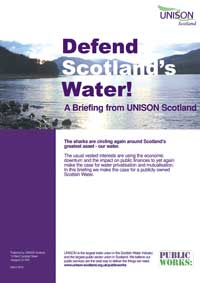 |
| Defend Scotland's Water: briefing on the case for public ownership. Click here for pdf |
Date: Thu 29 July 2010
UNISON has called on the Scottish Government to reject the proposal to effectively privatise Scottish Water contained in the Independent Budget Review.
Gerry Crawley, Regional Organiser, said:
"The proposal to privatise Scottish Water by stealth is not acceptable - and is certainly not in the public interest. We call on the Scottish Government to reject this unwise proposal.
"The pro-privatisation sharks have been circling around Scottish Water, first proposing a different funding mechanism, then a supposedly mutual model. The latest disguise is what they call a 'public interest company' similar to Welsh Water. These are all attempts to privatise by stealth.
Gerry Crawley said:
"We certainly do not want follow the Welsh Water model as a mutual or 'public interest company'. In the capital intensive water industry, bodies like these are effectively controlled by the private financial institutions. They would insist that their risk is minimised by transferring services and jobs to English and European private water companies. That is what is happening at Welsh Water."
"Any move away from democratic control and towards private funding - including under the guise of a 'public interest company' - would actually cost us all more. The people of Scotland do not want to see profiteering from such an essential public service. It is simply not in the public interest."
Gerry Crawley said:
“Scottish Water belongs to the people. It is owned by the Scottish government for the Scottish people. This issue has already been settled by a referendum. UNISON is 100% certain that the Scottish people will reject any attempt to remove Scottish Water from democratic control."
ends
Note for Editors:
1. UNISON’s recent briefing Defend Scotland’s Water has highlighted how the pro-privatisation sharks are circling around Scottish Water; why these vested interests want it sold off at a knock-down price; and how private finance would lead to private control. Defend Scotland’s Water is available on the UNISONScotland website at http://www.unison-scotland.org.uk/water/defendscotlandswater_mar2010.pdf
2. UNISON, along with the STUC and the other unions involved in the water industry all believe that we should join with the worldwide movement in favour of democratisation of water. The unions have produced a discussion paper It’s Scotland’s Water outlining ways to greater accountability for Scottish Water. It is available on the UNISON website at http://www.unison-scotland.org.uk/water/scotland's_water.pdf
For Further Information Please Contact:
Gerry Crawley, Regional Organiser 07958 121 805 (m)
Fiona Montgomery, Communications Officer 0141 342 2877 (o) 07908 672 890 (m)
Malcolm Burns, Communications Officer 0141 342 2877 (o) 07958 063 182 (m)
.
UNISON rejects unwise prescription for assault on public services – initial response to IBR
UNISON today rejected the prescription of the Independent Budget Review for an assault on Scotland’s public services and privatising Scottish Water.
Scottish Organiser Glyn Hawker said that the report trots out the same tired old dogma that ordinary people need to pay the price for a financial crisis they did not create.
Glyn added: “Crawford Beveridge said in March that we faced Sophie’s Choice and there is no way to implement these cuts without causing great pain. These proposals are unwise, will cause great pain and we think the people of Scotland will reject this approach.
“UNISON Scotland believes there is an alternative that politicians should be fighting for – an alternative that looks at what public services the Scottish people want in a decent society.
“We can afford quality services. We should not be hitting ordinary people with cuts to services they rely on, with cuts to pay and jobs and family income when bankers still pick up huge bonuses and don’t pay their fair share towards services we all rely on.
“These proposals will create a more unequal society. Crawford Beveridge said there are no silver bullets and the report says that we need to do more with less but we can’t. It will be less with less. And the end result is that the rich will be able to pay for services but middle and low income families will be hardest hit.”
Notes to Editors:
1. Glyn Hawker and other UNISON representatives are available for comment and reaction to the Independent Budget Review report.
2. A detailed response to the report will be issued later this afternoon.
3. UNISON responses to the report will be posted on our frequently updated blog here at: http://unison-scotland.blogspot.com/
4. UNISON’s alternative budget is at: www.unison.org.uk/acrobat/18887.pdf
5. UNISON’s submission to the Independent Budget Review is at: http://www.unison-scotland.org.uk/response/UNISONResponse_IndependentBudgetReviewApril2010.pdf
6. Our news release ‘Removal of Scottish Water from democratic control would be unwise’ is at: www.unison-scotland.org.uk/news/2010/julyaug/2307a.htm
For Further Information Please Contact:
Glyn Hawker, Scottish Organiser (Bargaining & Equal Pay) 07876 441 237
Fiona Montgomery, Communications Officer 0141 342 2877 (o) 07908 672 890 (m)
Malcolm Burns, Communications Officer 0141 342 2877 (o) 07958 063 182 (m)
.
Glyn Hawker on BBC: There is an alternative. We don't need to be making these cuts.
July 29
UNISON Scottish Organiser Glyn Hawker today argued on BBC Radio Scotland's Good Morning Scotland programme that there is an alternative to the current cuts and privatisation agenda.
Speaking in advance of today's Independend Budget Review report, she said: "There is an alternative. We don't need to be making these cuts.
"The alternatives are about generating income, about making sure we collect the tax currently not being collected, that we look at those people who do have more making a bigger contribution rather than taking away from those at the bottom end."
The so-called Tax Payers Alliance were also interviewed. UNISON has highlighted the fact that the TPA is an unrepresentative right wing body keen to promote massive cuts in public sector spending. UNISON is a democratic organisation made up of tax payers and could make far more claim to the name. The TPA is made up of right wing ideologues and non-dom millionaires.
For some interesting facts about the TPA, check out the website of The Other Taxpayers Alliance. www.taxpayersalliance.org/
Listen to Good Morning Scotland here The interview starts at about 1 hour 9 mins into the recording.
.
UNISON Scottish Organiser Glyn Hawker today argued on BBC Radio Scotland's Good Morning Scotland programme that there is an alternative to the current cuts and privatisation agenda.
Speaking in advance of today's Independend Budget Review report, she said: "There is an alternative. We don't need to be making these cuts.
"The alternatives are about generating income, about making sure we collect the tax currently not being collected, that we look at those people who do have more making a bigger contribution rather than taking away from those at the bottom end."
The so-called Tax Payers Alliance were also interviewed. UNISON has highlighted the fact that the TPA is an unrepresentative right wing body keen to promote massive cuts in public sector spending. UNISON is a democratic organisation made up of tax payers and could make far more claim to the name. The TPA is made up of right wing ideologues and non-dom millionaires.
For some interesting facts about the TPA, check out the website of The Other Taxpayers Alliance. www.taxpayersalliance.org/
Listen to Good Morning Scotland here The interview starts at about 1 hour 9 mins into the recording.
.
Subscribe to:
Posts (Atom)