Date: Thurs 12 November 2009
UNISON, the UK's largest public sector union, has today (12 November) accused councils of fuelling suspicion and undermining public confidence in social workers, by barring them from speaking out in the media.
On the anniversary of the verdict of those involved in the tragic death of Baby Peter, the union is calling on councils to get the public to back social workers, by shining a light on their day-to-day work.
To restore confidence in social workers, the public needs to be given the facts.
Social workers deal with around 568,000 child referrals in the UK every year. Setting up a child protection plan requires intensive investigation and work with the child, the family and other agencies, including police and the health service. Since the Baby Peter case, UNISON branches report a 25% to 50% increase in the number of calls from the public and agencies, reporting suspicions about child abuse or neglect. This creates severe pressures on understaffed departments.
Helga Pile, UNISON National Officer for Social Workers, said: "Social workers have nothing to hide. Of course they observe client confidentiality, but they should be allowed to play their part in helping the public understand wheat they do and the pressures they work under. But they are gagged from doing so by many councils. That drives a wedge of suspicion between them and the public. They work with some of the most vulnerable and troubled people in our society - people who don't have a voice, and it's sad that the professionals who work with them are prevented from having one too.
"Councils could make a real difference by letting the public see what front-line social workers achieve every day. "
Commenting on the impact of the Baby P case, Social worker A - a UNISON steward and children's social worker, said: "Despite the difficulties the profession faces I continue to call myself a social worker with great pride. Why? - because I can see the positive impact of my work on the lives of the people I work with, many of whom are some of the most vulnerable members of society. I also witness the commitment and skilfulness of my colleagues as they go about their work implementing interventions that change people's lives for the better.
"For me the biggest impact of the baby P case was the very public devaluing of social work generally as a profession. This left many social workers, including myself, feeling dispirited, vulnerable and annoyed at the way the work of so many dedicated and skilled practitioners was rendered invisible. This has created a less than positive atmosphere to work in and has led to more children being taken into care."
Social worker B, UNISON social work convenor in a county council and a social worker said:
"Child protection and family support social workers were condemned nationally at the time, but had no direct way to respond other than to remain committed and dedicated to their jobs. There has been a significant increase in referrals, the general public are more aware of their responsibilities and partner agencies are sharing information at an earlier stage. This in turn has an impact on caseloads, personal stress and professional anxiety.
"As a workforce, social workers cannot publicise their successes but as a profession they have remained dedicated and committed in the face of the rising tide of referrals of an increasingly serious and complex nature. As a workforce we need to be proud of what we do achieve, recognise how much good work we are doing and how important it is to work with other agencies to support and protect vulnerable children."
Ends
.

UNISON. Scotland's biggest and liveliest trade union, representing members delivering public and related services.
Thursday, 12 November 2009


Monday, 9 November 2009
Lobby of college graduation ceremony in campaign against nursery closure
Date: Mon 9 November 2009
UNISON, the education union, today announced that its members would lobby the graduation ceremony of Glasgow College of Nautical Studies tonight (Mon 9 November 2009) in its continuing campaign to reverse the college plans to close its Thistle Street nursery.
The lobby will take place at Glasgow Concert Hall, tonight (9 November) at 6.30 pm. It is not planned to interfere with the functioning of the ceremony.
Scott Donohoe, Assistant Secretary for UNISON's Glasgow city branch said "We are using this public event to draw attention to the appalling decision by the college to close its nursery and withdraw a childcare service from students and staff.
"The college has always intended to close the nursery despite the constructive views & input of UNISON, the staff, MSP's, parents etc. It is clear that this service cut has been driven by the prospective merger of city colleges, and it shows that this merger does not have any affordable childcare arrangements for staff and students. A major reduction in standards in the current economic climate. In the 21st century, parents with children should have a right to support to help them continue with their studies."
UNISON has called for an Equality Impact Assessment, required under Gender Equality legislation, and which has not been carried out the union says. They have also demanded other information on the decision making process of the college and the other merger partners through a Freedom of Information request.
Scott Donohoe also points out that the union has not ruled out further industrial action.
"Members have already demonstrated their commitment to action in defending this service," he said, "and we give notice that UNISON will resist compulsory redundancies with all means at our disposal."
The union called off industrial action on 20 August this year in return for a commitment to a joint review of nursery provision by both the college and UNISON.
The union is also writing to the Secretary of State for Education and Lifelong learning to raise the issue.
ENDS
Note for editors: Thistle Street nursery, run by Glasgow College of Nautical Studies, is set to close in July, 2010, with the loss of 54 places for children, and 19 jobs. Nine places from the nursery have already been lost with the closure of the baby room in September this year.
Stay in touch with UNISON Scotland's latest news releases on our website http://www.unison-scotland.org.uk/news/index.html and frequent updates on our blog http://unison-scotland.blogspot.com/
.
Friday, 30 October 2009
UNISON says - education support staff need investment, not cuts
Date: Fri 30 Oct 2009
The leader of UNISON, Scotland’s public service union today said that education support staff were crucial in the drive to bring the country out of recession.
He criticised business leaders, right wing politicians and media commentators who have called for finance cuts in education, as ‘risking a further recession’.
Addressing a conference in Edinburgh today (30 Oct), Matt Smith, Scottish Secretary of UNISON, said “Education is one of the key supports for economic infrastructure. When big business accuses public service of being a drain on the economy, they conveniently forget the role of public education in providing them with an educated workforce. This is just one of the reasons why public service investment must be kept high. To cut spending on education and other public services at this crucial time could condemn the Scottish economy to further recession.”
Matt also stressed the key role of education support staff in delivering Scottish education. “Too often, politicians and the media focus on teachers and lecturers, and ignore the rest of the education team.”
He said, “From classroom assistants to school meals staff, and from early years workers to librarians, they ensure our kids get a high standard of education. However, as in other parts of the public sector, support staff in education tend to be the lowest paid and least valued, and it is no coincidence that many of them are women.
“Politicians must become aware that support staff are no longer prepared to play a secondary role. They need to be valued and consulted in the development of Scotland’s education.”
The conference for Education Support Staff is also being addressed by the Minister for Schools and Skills, Keith Brown MSP, and representatives from CoSLA and the SQA. It is taking place in the Barcelo Carlton Hotel, North Bridge, Edinburgh).
.
Monday, 19 October 2009
Cuts will damage hygiene at Stirling University - UNISON
Date: Monday 19 October 2009
UNISON, Scotland’s education union, today called on the court of Stirling University to restore staffing levels at the university to avoid cuts in numbers that will dramatically reduce standards of cleanliness and hygiene. At a lobby of the court meeting in the university today, the union also outlined concerns for the training of future nurses.
The lobby was organised by the joint unions to protest about the loss of 174 jobs at the university.
Marion Adamson, Regional Organiser for UNISON said:
“We are very concerned that the massive cuts in important areas will mean a drop in standards of cleanliness. For example – in student residence kitchens the level of cleaning is being halved because of the numbers cut. This could have a serious impact on student health.
“And we also have a concern for the standards of teaching for student nurses at a time when their numbers should be increased – not reduced. If numbers of teachers leave, then either the numbers of nurses being trained will decline, or a drop in teaching standards may result. This could impact on future care to patients at a time when we need really well trained newcomers as the experienced staff of the post war baby boom are mostly retiring now.”
ENDS
Note for editors:
The lobby is being organised jointly by the UCU, Unite the union, and UNISON. It is taking place from 1.00pm today on the Cottrell lawn. There is also an online petition to oppose these draconian cuts at www.ucu.org.uk/stirlingcuts
For Further Information Please Contact:
Janette MacConachie (Stirling University UNISON Br Secretary) 01786 449471 (o)
Marion Adamson (Regional Officer) 0131 226 0067(o) 07904 326 812 (m)
.
Saturday, 17 October 2009
‘If we don’t take care of our elderly then we are not a civilised society’
 ‘If we don’t take care of our elderly then we are not a civilised society’ - Herald Scotland:
17 Oct 2009
"The Herald’s campaign to highlight the plight of the elderly in Scotland this week has too often exposed a society that appears past caring. Our exclusive reports have revealed that complaints of abuse against the elderly are on the rise and that councils are increasingly being forced to place elderly people on at-risk registers."
Key public figures giving their views on The Herald’s campaign include Stephen Smellie, Chair of UNISON Scotland’s social work issues group.
Stephen Smellie's full statement to The Herald:
“The care of Scotland’s older people is one indicator of how civilized our society is. The problems highlighted by the Herald are an indication that something is significantly wrong with the way that care is delivered.
“Pressures for outsourcing and privatisation all too often mean that services are pushed out to tender and contracts granted – not on the basis of the quality of the service - but purely on its cheapness. This is not the best value for care for our older people but risks the kind of treatment highlighted.
“Even when the service is kept in house, cost pressures often mean cuts in time and resources to visit and look after clients. When services are provided under contract, voluntary providers are often told to provide services on less than the in-house service would receive. When you then factor in the private sector’s need for a profit, the kind of problems that have been highlighted are put into context.
“Now we face even greater pressure, and real fears of cuts in public funding in coming years. This will only lead to the problems becoming worse rather than better. At a time of increasing demand, levels of service should be better resourced – not cut. Properly trained, and resourced staff with the time to deal with our older people in a civilized way – whether employed directly by the authority, or in our voluntary organisations - are the only way to deliver the service they deserve. We owe it to them to deliver no less.”
.
Thursday, 15 October 2009
Racism shown the red card by UNISON Perth and Kinross Branch

Racism Shown the Red Card in Perth and Kinross
Perth & Kinross branch of UNISON has teamed up with St Johnstone FC, the Community Safety Partnership and the Perth and Kinross Council to sponsor St Johnstone squad posters, as part of the “Show Racism the Red Card Fortnight of Action.”
See story on Branch website: www.unisonpk.org.uk/SRTRC09.htm
.
Wednesday, 14 October 2009
Glasgow college nursery closure back on as management break promises
Date: Wed 14 Oct 2009
UNISON, the education union, today accused the management of Glasgow College of Nautical Studies of bad faith and breaking promises as it emerged that the college plans to close its Thistle Street nursery in July 2010, with the loss of 54 places and 19 jobs – using compulsory redundancies. A further 9 places have already gone with the closure of the Baby Room on 24 September. The union called off industrial action on 20 August this year in return for a commitment to a joint review of nursery provision by both the college and UNISON.
Scott Donohoe, Assistant Secretary for UNISON’s Glasgow city branch said:
“The promises of management, the commitment to a joint review and the whole consultation process in this exercise has been a complete sham. Members called off planned industrial action in good faith, with a college commitment that UNISON would be involved in a joint review of the nursery provision and the nursery would remain open until July 2010 at least. Despite a number of business plans being forwarded that predicted a balanced budget, this commitment was blatantly abandoned by the college.
"It is now quite clear that the college always intended to close the nursery despite the constructive views & input of UNISON, the staff, MSP’s, parents etc. It is also clear that this service cut has always been driven by the prospective merger of city colleges, and this demonstrates the lack of commitment in these merger plans to the provision of affordable childcare arrangements for staff and students given the current economic climate.
“Members have already demonstrated their commitment to action in defending this service, and we give notice that UNISON will resist compulsory redundancies with all means at our disposal."
The union is also writing to the Secretary of State for Education and Lifelong learning to raise the issue.
.
Thursday, 8 October 2009
UNISON calls for action to reduce violent assaults on staff at work
Date: Thu 8 Oct 2009
UNISON Scotland today called for decisive action from public sector employers and the Scottish Parliament to reduce violent assaults on members in the course of their work.
A UNISON report on ‘Violent Assaults on Public Service Staff in Scotland’, which will be presented to the union’s annual Health and Safety conference in Stirling tomorrow, has found that more than 25,000 assaults on staff were recorded for the year 2008/09.
The figures were obtained through Freedom of Information requests from employers of UNISON members. Although the total is down on the previous year, UNISON is concerned that the overall number of assaults on staff remains stubbornly high, and completely unacceptable.
In particular, the total for local government has increased, although in health and other sectors, some reductions have been recorded.
Dave Watson, UNISON Scottish Organiser said: “A reduction in the headline figure on violence against staff is welcome – but any act of violence on a member of staff going about their business of providing vital public services is completely unacceptable. To have over 25,000 in a year is shocking. And we are concerned at the continuing increased level of attacks on local government workers.
“It is clear that where rigorous monitoring and active preventative measures are in place, this has resulted in improvements for the health and safety of our members. But some employers are clearly failing to monitor violent assaults effectively, and as a result are failing to do enough to protect their staff.”
The Centre for Healthy Working Lives has established a Task Group to develop best practice guidelines for reporting of assault statistics for local government. The group, including representatives from CoSLA, some individual local authorities, STUC and UNISON Scotland, expects to report soon.
UNISON’s local government branches and safety representatives will then seek negotiations in each authority on how the proposals are to be implemented.
UNISON Scotland is also campaigning for further legislation to protect public service workers from violent assault. Dave Watson said: “We campaigned successfully for extensions to the provisions of the Emergency Workers Act 2006, which resulted in community health and mental health nurses being included. But more needs to be done. We want a broadening of the scope of the law to include other public facing staff, such as social workers, housing staff and traffic wardens.
“UNISON Scotland will be working with Hugh Henry MSP, whose proposed Proposed Workers (Aggravated Offences)(Scotland) Bill was published in June. The Bill aims to build on the Emergency Workers Act but to widen it to more public sector workers and to include private sector workers who provide a service to the public, such as shop workers.”
ENDS
Notes to editors:
1. The UNISON Scotland report ‘Violent Assaults on Public Service Staff in Scotland’ is based on a Freedom of Information survey of 27 local authorities and 10 health boards in Scotland, and other public sector areas in which UNISON organises, including police, universities and colleges, NDPBs. The total number of assaults recorded over the year was 25,046, a drop of 7,221 over the previous year’s total of 32,267. If the figures for health and local government are taken into account, then assaults have decreased by 2,560 from 26,814 to 23,164 over the year.
The largest single decrease is however, in Strathclyde Police where their numbers of assaults have fallen from 4,547 to 921, the majority of these to police officers. The report will be presented at UNISON Scotland’s annual Health and Safety Conference in Stirling tomorrow, Friday 9 October 2009.
2. Proposed Workers (Aggravated Offences) (Scotland) Bill In June, 2009, Hugh Henry, MSP published a Public Consultation on his proposed Private Members Bill, Workers (Aggravated Offences) (Scotland) Bill http://www.scottish.parliament.uk/s3/bills/MembersBills/documents/20090713 FinalConsultationdocument revised.pdf to which UNISON made a response at the end of September 2009 http://www.unison-scotland.org.uk/response/WorkersAggravatedOffencesScotlandBillOc.pdf
See also UNISONScotand's Violent Assaults on Public Service Staff in Scotland Follow up Survey 2009 (pdf)
.
Follow Falkirk Council UNISON Branch online

You can now follow the Falkirk Council UNISON Branch online.
The branch web site address is:
www.falkirkcouncilunison.org.uk
The branch are now also using Facebook and Twitter:
Facebook:
www.facebook.com/search/?q=falkirk+council+unison&init=quick#/group.php?gid=155011715333&ref=nf
Twitter:
www.twitter.com/FalkirkUNISON
.
Voluntary work with children threatened as government cuts disclosure agency
Date: Thursday 8 October 2009
Staff at a body set up after the Dunblane massacre face the sack as government funding is to be cut to less than half that needed, UNISON said today.
Staff at the Central Registered Body in Scotland (CRBS), set up by the Scottish Government on a recommendation by Lord Cullen's report on the massacre, were told on Monday that they have until Friday (9 October) to opt for voluntary redundancy or face compulsory redundancies.
The body, which is run by Volunteer Development Scotland (VDS) and funded directly by the Scottish Government enables voluntary organisations that work with children to register and get disclosure checks on volunteers and employees, free.
UNISON said that they had been told by the Chief Executive, George Thomson, that government funding had been dramatically cut - leaving the body £115,000 short for 2009/10.
James Douglas, Stirling Branch Secretary of UNISON, who represent the staff at CRBS said:- "This is a disgraceful cut by the Scottish Government, which will hit both dedicated staff and valuable services to our kids. Providing such a vital agency with less than half of their required funding threatens most of the staff with either voluntary or compulsory redundancy. If this happens the work of CRBS will immediately start to pile up, and eventually voluntary organisations - especially small ones - working with children will be unable to get volunteers or staff checked, they won't be able to use them, and in many cases will have to close."
The union is also questioning the management of the crisis by VDS. James Douglas said "To pressure staff to take decisions on their whole future in less than five days, to impose a pay freezes whilst still engaging expensive consultants shows the wrong priorities. Before rushing headlong into compulsory redundancies CRBS and VDS need to point out to government the implications of their cuts, and to talk to staff unions about alternatives."
ENDS
Note for editors:
The Central Registered Body in Scotland (CRBS), is run by Volunteer Development Scotland, and directly funded by the Scottish Government. It provides a service to voluntary sector bodies by processing free checks on volunteers and employees to Disclosure Scotland, allowing these bodies to avoid expensive charges, maintaining a register of organisations too small to register direct with Disclosure Scotland, and providing advice and assistance. They have 29 staff based in Stirling.
.
Friday, 25 September 2009
Plinther praises public services during tribute to mother
Date: Fri 25 Sept 2009
A Scottish plinther will pay tribute to the public service that helped his dying mother during his hour on the Fourth Plinth in Trafalgar Square on Monday (28 September).
Kevin O’Neil, who works as an area organiser for UNISONScotland, will hold up speech bubbles featuring messages from the UK’s largest public sector union’s Million Voices campaign and its Scottish arm – Public Works - as part of Antony Gormley’s One & Other project.
The campaign is close to the 40-year-old’s heart, as the NHS helped his mother when she suffered a brain tumour.
Mr O’Neil, who started off working as a postman, has been working for the union for six years. He has also completed a number of sponsorship activities for various charities, including running and abseiling, to raise in excess of £17,000.
Mr O’Neil, who lives in Inverkeithing, Fife, said:
“I wanted to say something in memory of my mother, who died seven years ago of a brain tumour. The NHS is an amazing institution and gave her endless support. It is a shining example of how vital public services are, especially during a financial crisis, and I cannot praise the dedication of its staff enough and I know my mother felt the same.
“This is exactly the principles espoused by UNISON’s Public Works campaign and I am proud to be able to support this and add to our Million Voices from the plinth.
“I have always admired Anthony Gormley’s work and think it is fantastic that everyone can be involved in creating a piece of art. After watching the launch of One & Other on television I turned round to my wife and told her I needed to apply and I feel lucky to have been chosen.”
Ends
Notes for editors:
Kevin O’Neil will be appearing on the Plinth in Trafalgar Square, between 4pm and 5pm, on 28 September. UNISON members have been texting, tweeting and logging on to www.unison.org.uk to add their voice to the campaign and a selection of their messages will be read out by Kevin.
The union, which has more than 1.3 million members, is using the Million Voices campaign and Public Works – its Scottish arm, to call for social justice, good jobs and quality public services. The campaign was launched in the UK at UNISON’s Annual Conference and the Scottish launch was yesterday (Thursday 24). This will be taken to all the party conferences during this autumn – including the SNP conference in Inverness where Scottish Convenor, Mike Kirby will address a fringe meeting run jointly with APSE (the Association of Public Sector Excellence).
Kevin’s oneandother page is at http://www.oneandother.co.uk/participants/Inverkev;
the Public Works site is at www.unison-scotland.org.uk/publicworks/adayinthelife.pdf
See also www.unison-scotland.org.uk/comms/diary.html
.
Thursday, 24 September 2009
UNISON car parking campaign gains huge public support
Date: Thurs 24 Sept 2009
UNISON, Scotland’s healthcare union, today welcomed unprecedented support for their campaign on car parking charges, and urged MSPs to back a private member’s bill to ditch them.
The campaign calls on MSP’s to support Paul Martin as he attempts to introduce a bill in the Scottish Parliament which will tackle the charges which still exist in some hospital car parks and require NHS Boards to have managed car parking schemes.
The campaign has already generated over 2,000 emails and 5,000 postcards to MSPs.
UNISON Regional Organiser Matt McLaughlin said:
“UNISON is right behind this bill and so are our members and the general public. It is a scandal that NHS staff are being forced to park in back alleys and side streets putting themselves at risk of criminal harm through fear of incurring a charge for coming to work.”
UNISON emailed 9,000 members asking them to email their MSP and to date 2,000 emails have been generated via the unions web link. However, some MSPs are refusing to back the bill meaning it is at risk of falling.
UNISON is reacting angrily to the response received by some members.
Matt said:
“Not surprisingly Tory MSPs have refused to support NHS workers. But it is also obvious from the responses from SNP MSPs that they are merely toeing a central party line, and refusing to back staff and patients on this issue. This do-nothing approach from the SNP will be a surprise to many people – after all their party was very vocal in the opposition to parking charges when they were in opposition.”
And Matt called on MSPs from other parties to back Paul Martin’s bill:
“With over 5,000 signatures gathered in less than 3 weeks on this issue it is clear that staff and public are not convinced the current measurers are working and think further action is required. UNISON calls on all the major parties not to let them down and to back this bill, ensuring that staff and patients get a fair deal from their NHS.”
.
Public service cuts will increase costs for ordinary families and delay recovery - UNISON
Date: Thurs 24 Sept 2009
A headlong rush to cut and privatise public services will lead to delays in coming out of recession, said the public service union UNISON today.
'Public Works', the Scottish arm of the union's 'Million Voices for change' campaign, is launched today with a leaflet demonstrating the importance of public services to everyone's lives and pointing to the huge costs that would fall on people if public services were not available.
Matt Smith - UNISON's Scottish Secretary, said:
"'A day in the life...' follows an average woman through her day and points out our dependence on public services - from water and sewerage, through environmental health and refuse collection, to education and health care, it is not only the disadvantaged who rely on public services, but all of us."
"If these services are cut back or privatised the increased costs of paying for them individually can only increase the cost burden on hard-pressed families. We estimate the average household gets more than £10,000 a year in benefits and public services. Public delivery provides value for money through economies of scale and stopping shareholders taking profits out of the pot. A year's domestic waste collection sourced privately would cost around £2,500, and the average cost of a year's education outside the public sector in Scotland is around £8,200."
UNISON is today (Thursday) briefing activists at meetings in Scotland, and will be campaigning to sign up members and non-members to back Scotland's public services at a time when they are under sustained attack from big business.
UNISON points out that cuts in public sector jobs, pay and pensions will only lead to less money being spent to stimulate the economy, and if public services were cut they would order and contract less with the private sector.
Matt Smith said:
"Far from being the drain on the economy argued by those who created the economic crisis, the public sector contracts for supplies and services from the private sector - especially important when private industry faces reduced order books.
"In addition money spent in the economy by public service staff will not be there if we accept the advice of the right wing think tanks to cut jobs, pay and pensions. Now is the time to build a fairer society based on social justice, good jobs and quality public services."
ENDS
Notes for editors:
The union's 'Million Voices' campaign was launched in the UK at UNISON's Annual Conference and will be taken to all the party conferences during this autumn - including the SNP conference in Inverness where Scottish Convenor, Mike Kirby will address a fringe meeting run jointly with APSE (the Association of Public Sector Excellence).
Click here for a pdf of the 'A day in the life...'
.
Tuesday, 22 September 2009
Water industry must prioritise new climate obligations, says SCCS

MEDIA STATEMENT
Attn: Newsdesks, political & environment correspondents
Immediate release
Tuesday 22 September 2009
Attn: Newsdesks, political & environment correspondents
Immediate release
Tuesday 22 September 2009
Water industry must prioritise new climate obligations
Climate change campaigners today urged Scotland’s water industry regulator to ensure that it and Scottish Water prioritise complying with new climate change legislation.
The call is a response to the Water Industry Commission for Scotland’s consultation on its draft determination (proposal), which sets price limits on water charges. The Stop Climate Chaos Scotland (SCCS) coalition is concerned that the resulting current investment plan for Scottish Water, one of the country’s biggest electricity consumers, would only finance climate change objectives ‘if possible’.
The draft determination for 2010-2014 concentrates on Priority 1 objectives set by the Scottish Government, while climate change is Priority 2.
Yet all public bodies will soon have new duties under the world-leading Climate Change (Scotland) Act to contribute to greenhouse gas emission reduction targets and to plans to adapt to deal with flooding and other problems caused by global warming.
SCCS, which includes unions, environmental and international development organisations, said that excluding action on climate change objectives from the business plan that runs halfway to 2020 makes no sense when urgent early action is required to achieve the Act’s interim target of 42% emission cuts by 2020.
SCCS Chair Mike Robinson said: “The Scottish Government and wider public sector should be leading by example to help meet the important 42% target.
“It is extremely disappointing that Ministers set climate change as only a Priority 2 objective for Scottish Water, while limiting charge rises in a way that severely restricts options for spending on Priority 2 objectives.
“We have written to the Water Industry Commission for Scotland urging it to make funds available to Scottish Water so it can meet climate change objectives and new duties under the Act in this investment cycle.”
Lloyd Austin, Head of Policy, RSPB Scotland, said: "As one of the biggest electricity consumers, Scottish Water has the potential to make huge energy savings which will help reduce the long term costs to consumers.
"Early action on climate change adaptation and mitigation will not only help achieve statutory requirements but also ensure the long-term future and viability of the water industry."
Dave Watson, Scottish Organiser, UNISON, said: "There is a lesson here for all public bodies as their new climate change duties will come into force in less than 18 months.
"In planning ahead and preparing budgets, they should be ensuring they can comply with the new duties.
“At Scottish Water there is potential for huge savings in energy costs and this requires strategic planning and prioritisation of investment that the regulator must allow for. The overall objective is to protect the planet for future generations. People expect the public sector to take a lead on this crucial issue."
ENDS
Notes to Editors
1. The deadline for commenting on the WICS Draft Determination is Wed 23 Sep. The Draft Determination is at www.watercommission.co.uk/view_Determination.aspx
2. Sir Ian Byatt, WICS Chairman, is giving evidence on the Draft Determination today (Tuesday 22) to the Transport, Infrastructure and Climate Change Committee at the Scottish Parliament.
3. SCCS believes that the Ministerial objectives on climate change as already given to Scottish Water are essential in fulfilling the new duties but without investment they risk not being achieved. Obviously objectives which are required by European Law must be met, and we have no argument with including, for example, Drinking Water Quality as a Priority 1. To reduce electricity consumption, investment is needed to help reduce leaks and encourage consumers to use water more wisely, thereby avoiding pumping water unncecessarily. Scottish Water’s energy demand is currently rising by one and two per cent each year. See www.scottishwater.co.uk/portal/page/portal/SWE_PGP_ABOUT_US/SWE_PGE_ABOUT_US/FIND_ABT_CLIM
4. Information on the new public bodies Climate Change Duties is at www.scotland.gov.uk/Topics/Environment/climatechange/scotlands-action/climatechangeact/publicsector
5. The Wave - Scotland’s biggest ever demonstration in support of action on climate change – takes place in Glasgow on Saturday 5 December 2009, timed to coincide with the crucial UN climate summit in Copenhagen. Tens of thousands of people will gather in Glasgow and London. The Wave is organised by Stop Climate Chaos Scotland. www.stopclimatechaos.org/thewavescotland
6. Stop Climate Chaos Scotland (SCCS) is a diverse, growing coalition of organisations campaigning on climate change. The SCCS Coalition has 60 Scottish members, representing more than 2 million supporters (40% of the Scottish population), ranging from environment and development groups to faith organisations, trade unions, student societies, care providers and many more. SCCS was instrumental in securing a strong climate act for Scotland. For full details visit http://www.stopclimatechaos.org/scotland
Thursday, 17 September 2009
Government must support public services in crisis caused by market madness
Date: Thu 17 Sept 2009
Public services union UNISON Scotland today challenged the Scottish Government to protect jobs and services following John Swinney's Budget statement in Parliament.
Matt Smith, Scottish Secretary of UNISON, said:
"The public will not support a budget which asks them to bear the brunt of cuts in the middle of this crisis caused by free market madness and bonus grabbing bankers.
"And make no mistake about it - what John Swinney is offering is cuts to public services.
"What we need in this recession with unemployment continuing to rise is support for the public sector to provide essential jobs and services – not cuts."
UNISON questioned the sustainability of Mr Swinney's announcement of a third year of council tax freeze given the additional funding pressures the recession is placing on local government.
Matt Smith said:
"The Finance Secretary makes the usual pledge to protect frontline services. But there are no expendable jobs. The false distinction between "front line" and "back office" is a mask for cuts which will impact on vital public services.
"We face real cuts in local government and a third year of a council tax freeze is regrettably not viable.
"Health boards also face a spending squeeze because of growing pressures on limited resources. And we are now seeing the resurrection of Private Finance in the Scottish NHS through the hub initiative, based on English Local Improvement Finance Trust PPPs.
"And the hard-pressed voluntary sector, which delivers vital services, will face even further constraints."
Matt Smith called for funding settlements to local government, health boards and the voluntary sector to sustain jobs and services and support the economy in the face of the recession.
.
Britain’s unions commit to a mass boycott movement of Israeli goods
Date: 17 September 2009
In a landmark decision, Britain’s trade unions have voted overwhelmingly to commit to build a mass boycott movement, disinvestment and sanctions on Israel for a negotiated settlement based on justice for Palestinians.
The motion was passed at the 2009 TUC Annual Congress in Liverpool today (17 September), by unions representing 6.5 million workers across the UK.
Hugh Lanning, chair of the Palestine Solidarity Campaign, said: ‘This motion is the culmination of a wave of motions passed at union conferences this year, following outrage at Israel’s brutal war on Gaza, and reflects the massive growth in support for Palestinian rights. We will be working with the TUC to develop a mass campaign to boycott Israeli goods, especially agricultural products that have been produced in illegal Israeli settlements in the Palestinian West Bank.’
The motion additionally called for the TUC General Council to put pressure on the British government to end all arms trading with Israel and support moves to suspend the EU-Israel trade agreement. Unions are also encouraged to disinvest from companies which profit from Israel’s illegal 42-year occupation of Gaza and the West Bank.
The motion was tabled by the Fire Brigades Union. The biggest unions in the UK including UNISON voted in favour of the motion.
UNISON Scottish Convenor Mike Kirby, who recently returned from a Scottish Trade Union Congress fact-finding mission to Israel and Palestine, spoke in the debate.
"The delegation questioned the officials on Israel's failure to comply with UN security council resolutions, on the high number of civilian deaths and casualties, the political timing of the attacks on Gaza and Israel allowing the ceasefire with Hamas to expire. We did not receive any satisfactory answers to these questions", he said
"We need a campaign of focused and selective action against arms sales to Israel, against the illegal settlements and for a targeted consumer boycott. We need to get as many people involved as possible. Our aim is not to put jobs at risk, but to build political support and awareness. This is our generation's responsibility."
The motion also condemned the Israeli trade union Histadrut’s statement supporting Israel’s war on Gaza, which killed 1,450 Palestinians in three weeks, and called for a review of the TUC’s relationship with Histadrut. Britain’s trade unions join those of South Africa and Ireland in voting to use a mass boycott campaign as a tool to bring Israel into line with international law, and pressure it to comply with UN resolutions that encourage justice and equality for the Palestinian people.
Notes to Editors
• Media contact: Palestine Solidarity Campaign 020 7700 6192
• The full motion passed on 17 September can be viewed at: http://www.congressvoices.org/2009/76-palestine/
• The Palestine Solidarity Campaign is the largest solidarity movement with Palestinians in Britain – and is supported by thousands of individual members alongside 18 national trade union and hundreds of local trade union affiliates.
For more information: http://www.palestinecampaign.org
• The Boycott, Divestment and Sanctions movement aims to pressure Israel into complying with international law. http://www.bdsmovement.net/
.
Saturday, 12 September 2009
A million voices for change on the plinth
 |
 |
UNISON Scotland's Kevin O'Neil will promote UNISON's Million Voices For Change on Trafalgar Square's fourth plinth on 28 Sept.
He will be taking part in Anthony Gormley’s One and Other on Monday 28th September. He will be on Trafalgar Square's Fourth Plinth from 16:00 to 17:00 to promote UNISON’s “A Million Voice for Change” campaign.
He has attached his “plinther” profile, please check it out and if you’re in London on Monday 28th September, then please come along and support him.
If not, then please watch on line and please leave a comment on the One and Other web site for Kevin.
http://www.facebook.com/l/9a590;www.oneandother.co.uk/participants/Inverkev
Thursday, 10 September 2009
BBC Scotland: Private prison victory for union
Private prison victory for union
Page last updated at 09:08 GMT, Thursday, 10 September 2009 10:08 UK
Scotland's Information Commissioner has ordered the release of key financial data from a £50m PFI contract for Kilmarnock jail.
The Scottish Prison Service (SPS) and the private jail's operator had resisted giving the information to the union Unison.
They argued it would substantially prejudice the contractor's commercial interests.
Unison said it was "a major victory for the public's right to know". ...
Wednesday, 9 September 2009
Information Commissioner orders release of key data from PFI prison contract
Date: Wed 9 Sept 2009
Scotland’s Information Commissioner has ordered the release of key financial data from a controversial £50m Private Finance Initiative prison contract.
The Scottish Prison Service (SPS) and Kilmarnock Prison Services Ltd (owned by Serco) had strongly resisted providing the contract’s financial model to UNISON Scotland, arguing it would substantially prejudice the contractor’s commercial interests.
UNISON’s Scottish Organiser Dave Watson today welcomed the decision by the Commissioner, Kevin Dunion, describing it as “a major victory for the public’s right to know”.
Mr Dunion ruled that, at the time of UNISON’s initial request in 2006, the significance of the information would have diminished substantially since the 25 year contract was signed in November 1997.
Dave said: “UNISON has long argued that there is excessive secrecy around PFI and Public Private Partnership (PPP) contracts. Too often the public is denied information about the costs of hospital, school and prison contracts on the grounds of commercial prejudice or commercial confidentiality.
“This decision is extremely important and should help pave the way for greater access to information about all PFI/PPP contracts.”
UNISON had also requested the Full Business Case (FBC) for the Kilmarnock Prison, but Mr Dunion accepted this was not held. Scottish Ministers informed him that in the early days of PFI/PPP projects, FBCs were not always prepared.
Dave added: “The fact that there is no Full Business Case for the prison speaks volumes about the way public funding has been wasted on PFI/PPP. The public was always told these projects would deliver value for money but has seen these claims unravel spectacularly over the years. The figures have frequently been manipulated, or withheld, or in this case, were not even calculated beforehand in any meaningful way.
“Mr Dunion’s decision will help shine a light on this contract and, hopefully, on others so the real costs to taxpayers can be assessed.”
NOTES TO EDITORS
1. Full details of ‘Decision 104/2009 UNISON Scotland and the Scottish Prison Service’ are on the website of the Scottish Information Commissioner at: www.itspublicknowledge.info/applicationsanddecisions/Decisions/2009/200701446.asp (This details that a range of other information on this and the Addiewell prison contract was also withheld initially but later published voluntarily by the SPS during the investigation by the Scottish Information Commissioner.)
2. The Kilmarnock Prison Contract, with redactions, is on the SPS website at: www.sps.gov.uk/MultimediaGallery/c141a308-7050-4e3e-a061-295c1a5c8942.pdf
3. Mr Dunion has called for the extension of the Freedom of Information (Scotland) Act 2002 to cover private companies carrying out public contracts (and other relevant bodies) and the Scottish Government is currently considering this.
4. The UNISON Scotland At What Cost report on the aggregate costs of PFI/PPP projects in Scotland is at: www.unison-scotland.org.uk/comms/atwhatcostoct07.pdf
.
Wednesday, 2 September 2009
UNISON Scotland slams privatising panic
Date: Wed 2 Sep 2009
UNISON, Scotland’s leading public sector trade union, today slammed a proposal for privatisation of huge swathes of public services - including health and education - "from the people who brought you the economic collapse".
UNISON Scottish Organiser Dave Watson said that a speech proposing "major reform" of Scottish public services with "health and education opened up to competition from the private sector" by the Chief Executive of Edinburgh Chamber of Commerce Ron Hewitt was an attempt to create a panic reponse to current economic problems.
Dave Watson said:
"It is pretty incredible that leading representatives of big private business interests should be demanding more control over our public services. This comes from the people who brought you the economic collapse.
"We see this idea from the Edinburgh Chamber of Commerce as yet another attempt by private interests to create a panic reponse to current economic problems - which have in fact been brought on by the private sector itself, with the big banks being the main culprits.
"In the frantic calls for still more privatisation I am reminded of a gambler who imagines that one last throw of the dice will solve everything.
"In reality, it is the public sector which has stood up to the economic crisis. We need to see more support for our public services from government, and not less. That is what the public wants too."
An Ipsos Mori poll conducted for UNISON in August showed that support for public service remains strong. In particular it showed that increased private involvement in running public services such as the NHS attracts little support. The poll found that over three quarters of the British public (78%) believe "health services should be run by the Government and public organisations, rather than by private companies".
ends
For Further Information Please Contact:
Dave Watson(Scottish Organiser) 07958 122 409(m)
Malcolm Burns (Information Development Officer) 0141 342 2811
.
Thursday, 27 August 2009
UNISON warns CoSLA ‘ Back off on pay freeze’
Date: Thursday 27 August 2009
In advance of discussions by council leaders at CoSLA tomorrow (Friday), UNISON, the largest union representing Scottish local council workers, warned council bosses not to threaten a five year pay cut, and to enter pay negotiations with an open mind.
Leaked discussion documents have suggested that up to a five year pay freeze will be on the table as council leaders sit down behind closed doors to discuss their response to the current recession.
Matt Smith, UNISON’s Scottish Secretary said:
"CoSLA leaders would be well advised to back off from any decision to freeze pay at all, far less for five years. Leaked papers suggest that CoSLA recognise the serious problem of low pay in local councils. Any freeze would increase that problem, de-motivate the workforce, impact negatively on services and damage communities.
"Knee jerk reaction to financial difficulties is no way to run local government. It is completely unfair that low-paid cooks, cleaners, care workers and clerical staff should be told that they are to pay the price of the financial incompetence of well-heeled bankers and financiers. Council leaders should talk to staff trade unions about funding, council tax and business rates rather than threatening their staff."
Dougie Black, UNISON Regional Organiser and lead negotiator said:
"It is disgraceful that CoSLA could think it is acceptable to threaten pay cuts to staff that deliver our services. There are appropriate bargaining arrangements to discuss pay. Why doesn’t CoSLA use these rather than leaking material to the media?
"Despite the persistent claims of the private sector, council staff are not well-paid, and have had below inflation pay increases in four out of the last five years. To suggest that it is acceptable for them to continue to have their pay cut for the next five years seems to indicate a macho, bullying attitude that CoSLA would do well to avoid, unless they are keen to provoke a dispute."
The previous pay agreement of a two-year deal ended with the award of 2.5% in April this year.
Negotiations for future years pay increases are scheduled to start in the autumn.
ENDS
For further information please contact:
Matt Smith, Scottish Secretary 07771 548 997(m)
Dougie Black, Regional Officer – Secretary, TU negotiators 07958 121 851(m)
Chris Bartter, Communications Officer 07715 583 729(m)
.
Wednesday, 19 August 2009
Social work union welcomes Brandon Muir reports
Wednesday 19 August 2009
UNISON, the union representing Scotland’s social work staff, today welcomed the two reports into the Brandon Muir case in Dundee.
Rory Malone, Dundee UNISON Branch Secretary said;
"At a time when some press and politicians appear to queue up to blame social work staff each time a family tragedy like this occurs, we welcome the findings of these independent and authoritative reports that no blame falls on members in Social Work.
"Dundee’s social care staff work very hard, often in difficult circumstances, to try and protect our children and all feel tragedies like this deeply. It is simply not possible to eradicate all risks, but UNISON has gone on record to identify a range of steps that can be taken to improve the position of social work staff and reduce that risk."*
UNISON has already started work with Dundee City Council to address some of the issues in the social work and will continue to discuss ways to implement recommendations in the report.
ENDS
Note for editors:
*Helping people change their lives - UNISON/BASW manifesto for Scotland’s Social Work, outlines 10 issues that need to be tackled to improve the position of social work staff and the services they provide. http://www.unison-scotland.org.uk/socialwork/swmanifesto25june2009.pdf
For Further Information Please Contact:
Rory Malone (Dundee UNISON Branch Secretary) 07595 893067 (m)
Chris Bartter (Communications Officer) 0771 558 3729(m)
.
Tuesday, 11 August 2009
Tories' privatisation agenda out of touch: UNISON
Tuesday 11 August 2009
Publicly funded hospitals and schools are still vote clinchers, and the Tories' privatisation agenda is out of touch with voters, according to a survey conducted for UNISON.
Despite worries about the economy, how the Government runs our hospitals is still at the top of people’s lists in deciding how to vote at the next general election. The results of the survey show the Tories latest plans for the public services are out of touch with public opinion. Their so-called “reform” of public services is nothing but thinly-disguised “privatisation”.
In an Ipsos MORI survey conducted for UNISON, 96% say the NHS will be an important factor in deciding how they vote at the next general election. This compares to the economy (important for 93%), crime (92%), public services (85%), schools (85%) and Britain’s relationship with Europe (70%).
The NHS is highly prized by the public with 76% believing it is crucial to British society and “we must do everything to maintain it”. Only 22% think that it “was a great project, but we probably can’t maintain it in its current form”.
Three-quarters of the public (75%) believe the NHS should be “run by the public sector to encourage a joined-up service”, with little support (21%) for it to be “run by the private sector to encourage competition” 78% believe that the health service should be run by the Government and public organisations, rather than by private companies and 73% agreed that people who provide health services should be employed by the NHS rather than by private companies.
UNISON General Secretary, Dave Prentis, said: “Although the economy is clearly a worry for many people, this polling shows the massive support that our NHS and public services have amongst the public. They don’t want them privatised, there is no appetite for competition in the services nor for profit-chasing. People have shown what we have always argued that most want good local schools and hospitals provide by dedicated public servants.
“The Tories are completely out of kilter with public opinion. Shadow Chancellor Osborne’s claims to have “progressive” ideas are nothing but cheap window-dressing.
“The Government should take note. If it is to have any chance of re-election next year, it must listen to what the people want.”
Ipsos MORI interviewed a sample of 1,001 British adults, plus a booster of 251 public sector workers, all age 18 and over by telephone between 12-14 June 2009. Data are weighted to the profile of the adult population 18+, and include a weight for public vs. private sector workers. The final weighted data indicate that 17% belong to a trade union.
The survey found that public sector workers have similar views to the general population.
Factors which will be important for public sector workers in deciding how to vote in the next general election are: the NHS (important for 96%); the economy (95%); crime (92%); public services (90%); schools (90%); Britain’s relationship with Europe (73%). 77% believe the NHS is crucial to British society; 81% believe it should be run by the public sector to encourage a joined-up service; 86% think that the NHS should be run by the Government not private companies and 79% agree that people providing health services should be employed by the NHS rather than by private companies.
.
Thursday, 6 August 2009
New Children’s Hearing system will increase risk to vulnerable children – UNISON
Date: Thurs 6 August 2009
UNISON – the union that represents workers staffing Scotland’s Children’s Panel system, and social care staff protecting vulnerable children – has submitted responses to the Scottish Government strongly criticising their proposed reorganisation of Children’s Hearings (CH).
Both UNISON’s Scottish Children’s Reporters’ Administration (SCRA) Branch and the Scottish Council of the union have submitted responses which point out that the proposals remove protections for children that are currently in place, that they set up a whole new bureaucracy which could add confusion and increase paperwork, and that they move decision-making power away from Children’s Hearings and towards the courts.
The union, which represents social work staff working in local authorities is concerned that the reforms could undermine existing protections.
Kate Ramsden, from UNISON’s Scottish Social Work Issues Group said “We are seriously concerned that the Bill actually removes current protections from children who could be at risk in an abusive household, and also that children will only be referred for voluntary advice and assistance if they have already been subject to compulsory supervision. These are just some of many examples of the draft bill concentrating on the civil rights of adults at the expense of the rights of the children to be protected.”
The establishment of a new quango is likely to lead to a dual administration, meaning increased potential for confusion, and increased bureaucracy.
Yvonne Stewart, UNISON SCRA branch secretary said “The creation of a Scottish Children’s Hearing Tribunal (SCHT) and the split in the administration of the children’s hearing system can only lead to increased bureaucracy and a greater possibility of confusion and error. This will lead to a more complex system for children, families and other professionals to engage with, and increased cost while also increasing the risk to children.”
John Stevenson, from UNISON’s Scottish Social Work Issues Group agrees “The double bureaucracy proposed here is likely to add to, rather than reduce, the amount of paperwork social workers have to fill in. This is despite all the evidence that shows the level of form-filling is a major factor reducing the time social workers can spend with looked-after children.”
UNISON is also concerned about a shift of powers towards the courts.
John Stevenson said "The ability of a court to completely rehear a case decided by a Children’s Hearing and other changes means cases are more likely to be decided in an adversarial atmosphere of a court of law, rather than the hearing setting of all parties discussing the best option for a child.”
"We understand that some changes are needed to comply with the European Convention on Human Rights but those changes have already been made. UNISON believes the welfare principle of Scotland's world-leading Children's Hearing system is worth defending. We are worried that this draft bill is less child-centred than the existing ground-breaking legislation."
The vast majority of cases Children's Hearings deal with are about the care and protection of children - 40,000 out of 50,000 referrals last year - rather than offences.
UNISON will be seeking a meeting with ministers to urge them to redraft the bill to ensure that the welfare principle becomes the centre of any new legislation.
ENDS
Notes for editors: UNISON’s responses can be found on the Scottish website at www.unison-scotland.org.uk/response/childrenshearing.pdf and www.unison-scotland.org.uk/response/SCRAUNISONchildrenshearingresponse.pdf
More information at www.unison-scotland.org.uk/socialwork
.
Wednesday, 5 August 2009
Royal Assent for Scotland's world leading climate legislation

Attn: News Desks
Immediate Release
5th August 2009
QUEEN APPROVES SCOTLAND’S WORLD-LEADING
CLIMATE CHANGE LEGISLATION
Her Majesty Queen Elizabeth II today made history by giving Royal Assent to The Scottish Climate Change Bill, the strongest piece of climate change legislation in the world.
The world-leading Act sets vital international precedents and an example for other wealthy nations to follow ahead of the UN’s climate change talks in Copenhagen in December, which will agree a replacement to the Kyoto Protocol.
The new legislation enshrines in law Scotland’s obligation to reduce the country’s greenhouse gas emissions by at least 42 per cent by 2020 and 80 per cent by 2050. Other rich countries need to adopt similar cuts to their emissions if catastrophic climate change is to be averted.
Queen Elizabeth signed the historic Act during a visit to her estate in Balmoral in Scotland. The Climate Change (Scotland) Bill was unanimously voted through the Scottish Parliament on 24th June this year.
Leading elements of the Scottish Act include:
· At least a 42% cut in greenhouse gas emissions by 2020 (based on 1990 levels)
· At least an 80% cut in greenhouse gas emissions by 2050 (based on 1990 levels)
· Emissions from international aviation & shipping included from the start;
· Commitment to report annually on consumption-based emissions;
· Strong duty across the public sector to play a full part in tackling Scotland’s greenhouse gas emissions.
Cardinal Keith O’Brien, Scotland’s most senior Catholic clergyman and climate change campaigner said:
“Scotland is setting a crucial example to the rich countries of the world in efforts to prevent the unnecessary suffering of millions of innocent people through ever-worsening climate change. The scientific consensus is clear; unless rich nations make early and deep cuts to their emissions, as Scotland has agreed to do, the situation will get much worse.
“Wealthy countries have an unequivocal moral duty to reduce their own emissions and help developing countries who are already suffering the consequences of our profligate use of fossil fuels for economic gain.
“Scotland has had the courage to set a vital international precedent with its Climate Change (Scotland) Act. Others must follow this lead now if we are to have a long, safe, and prosperous future for humanity on earth.”
Stewart Stevenson, Minister for Climate Change in the Scottish Government, said:
“The Scottish Government recognises that climate change will have far reaching effects on Scotland's economy, its people and its environment and is determined to play its part in rising to this challenge.
“The world-leading legislation introduces targets to reduce emissions by at least 80 per cent by 2050, and will drive new thinking, new solutions and new technologies putting Scotland at the forefront of building a sustainable low carbon economy.”
Mike Robinson, chair of the Stop Climate Chaos Scotland coalition, which includes Oxfam, Christian Aid, SCIAF, WWF, Friends of the Earth, as well faith organisations and trade unions, said:
“It is now enshrined in law that Scotland will do its fair share to tackle the causes of climate change. The world-leading emissions reduction targets provide a vital lead to other wealthy nations ahead of the UN’s climate talks in Copenhagen in December. Other rich countries must now follow Scotland’s lead and match the commitment to cut their emissions. I hope they will sit up and take notice.
“The scientific consensus is clear: unless developed nations reduce their greenhouse gas emissions by at least 42 per cent by 2020 and 80 per cent by 2050 the problem of dangerous climate change will become irreversible.”
Ends
Notes to editors:
Stop Climate Chaos Scotland (SCCS) is a diverse, growing coalition of organisations campaigning on climate change. The SCCS Coalition has 60 Scottish members, representing more than 2 million supporters (40% of the Scottish population), ranging from environment and development groups to faith organisations, trade unions, student societies, care providers and many more. SCCS was instrumental in securing a strong climate act for Scotland. For full details visit http://www.stopclimatechaos.org/scotland
In December world leaders will gather in Copenhagen to agree a new UN international climate deal that will come into force when the first phase of the Kyoto treaty expires in 2012. For more info see http://en.cop15.dk/
For more info on how the Scottish Act can make a difference in Copenhagen, see http://www.stopclimatechaos.org/scotland
On Saturday December 5, tens of thousands of people will gather in Glasgow and London to call for action on climate change. For more info see http://www.stopclimatechaos.org/scotland
---------------------------------------------------------------------------------------------
NB: UNISON Scotland is a member of Stop Climate Chaos Scotland. For further information on UNISON's climate change and environment work see the Green Workplace pages on our website. www.unison-scotland.org.uk/greenworkplace
.
.
.
Monday, 3 August 2009
Union 90% vote approves Single Status deal
Date: Monday 3 August 2009
UNISON, Dumfries & Galloway's largest public service trade union, and partner unions UNITE & GMB today announced that their members working for the local authority, have all voted overwhelmingly to accept a negotiated Single Status deal.
UNISON members delivered a majority of 89.6% in favour of the package of proposals with 10.4% of members rejecting. The turnout was 75%.
UNITE & GMB members also voted to accept the offer in a high turnout with majorities of, - Unite 94% and GMB 93%
Speaking shortly after the votes were independently counted Marion Stewart, Dumfries & Galloway UNISON branch secretary said; "I am pleased that our members have voted to accept this deal. The joint trade unions believed it was the best available through negotiation.
"It has been a long, often very difficult process, which started back in 1999. Recently, Trades Unions and the Council formed an effective joint project board, led by retired Chief Executive, Phil Jones.
"This is a prime example of what can be achieved by good joint working and we are pleased the Council has recognised and invested in our equality demands. The package has been subjected to three external independent checks and has resulted in fairer pay for many previously undervalued and under paid female groups."
This is believed to be only the second negotiated settlement to be achieved between unions and their employers in Scotland's 32 local authorities. The Single Status agreement affects 6500 Council employees and seeks to eradicate current inequalities that exist in local government pay and conditions.
Ann Patterson, Branch Chair for Unite the Union said after the ballot "I am pleased to announce that Unite members have voted to accept the Council's proposals within Dumfries and Galloway.
"The Joint Trade Unions believed that the Council's proposals were the best that could be achieved via negotiation but recognise that a number of members will be subject to pay protection. We remain assured by the Council's commitment to pay equality for all staff and both sides recognise that this is just the beginning of an ongoing process to eradicate pay inequality."
Marion Stewart continued: "The result of the ballot marks a significant milestone. The focus of our work now will be to help colleagues who want to appeal their grading, to work to improve the position of those groups of staff who are subject to pay protection and to continue UNISON's ongoing support for members who have lodged equal pay claims."
As part of the Single Status agreement those groups of staff who are Pay Protected will be included in an exercise between the Joint Trade Unions and the Council to seek to establish "job redesign or job enlargement" which could potentially remove detriment.
.
Tuesday, 28 July 2009
Nursery closure attempt at Glasgow College prompts strike action ballot
Date: Tuesday 28 July 2009
UNISON, the education union, is balloting around 80 members in Glasgow College of Nautical Studies for strike action, in response to management proposals to cut 5 jobs by closing the baby room in the college's Thistle Street Nursery. Ballot papers will go out to staff this Wednesday (29 July).
Jim Snell, Assistant Service Conditions Officer for Glasgow City Branch of UNISON said "This is the first stage in managements plan to close the Thistle Street nursery completely by July 2010, closing an important service and losing a total of 20 jobs.
"This is exactly the sort of cut that UNISON is convinced is resulting from the city centre college merger proposals. UNISON's college membership in Glasgow have already expressed their opposition to the proposals and will continue to fight the cuts as they become more damaging."
If the ballot for strike action is successful, the first day of action will be Thursday 20 August, coinciding with a major staff conference planned by the college management. Further days of action will be called if necessary and after consultation with members.
UNISON is continuing to meet with college management to try and persuade them to change their direction and will continue to raise questions on the different options that they have looked at.
Jim Snell said "Management have failed to share any information with UNISON on the background to the decision to close the nursery. We are urging members at the college to deliver a resounding YES vote, and demonstrate the strength of opposition to management's cuts."
The Ballot closes on 13 August.
.
Thursday, 23 July 2009
Executive pension report - UNISON reaction
23/07/09
UNISON, the UK’s largest public sector union, is welcoming the Lane Clark & Peacock report findings, which expose an apartheid that exists between those at the top and low paid workers.
Glyn Jenkins, UNISON’s Head of Pensions:
“We hear a lot about gold plated public sector pensions, but the real apartheid is between boardroom fat cats and low paid workers."
See full release at:
http://www.unison.org.uk/asppresspack/pressrelease_view.asp?id=1513
.
UNISON accuses Tory leader of letting rhetoric cloud his judgement
23/07/09
UNISON UK General Secretary Dave Prentis:
"David Cameron is wrong if he thinks he can make swingeing cuts without harming front-line services. Public sector workers have gone through efficiency drive after efficiency drive, and Independent studies have shown that you cannot extract any more without damaging services.”
See full release at:
http://www.unison.org.uk/asppresspack/pressrelease_view.asp?id=1514
.
Monday, 20 July 2009
UNISON condemns Quarriers threat to sack 2,000 staff
Date: Monday July 20 2009
Care sector union, UNISON, today condemned Scottish charity, Quarriers', threat to dismiss all their 2,000 staff unless the union agrees to cuts in wages and conditions. Quarriers' - one of Scotlands biggest charitable organisations providing services for vulnerable children, homeless young people and adults with disabilities - threatened on Friday to issue redundancy notices to all its 2000 staff.
This follows the charity's management proposal -tabled in May - to cut staff night shift payments, and payments for public holidays. Most drastically, the charity wants to cut sick pay by a quarter for any worker with less than 5 years service.
Instead of continuing negotiations with UNISON Quarriers' Branch - a meeting was scheduled for Friday 10th July but was cancelled by the employers with no explanation - Quarriers' wrote to UNISON officially notifying them that unless UNISON agrees to their proposal they will make everyone redundant and re-engage them on new terms and conditions.
Stephen Brown, Branch Secretary, of UNISON Quarriers' Branch said, “Like many staff in Quarriers I am on holiday this week and I was horrified by this move by Quarriers. UNISON recognises Quarriers' is feeling the financial pinch and were prepared to meet Quarriers' in order to negotiate properly. I’m therefore disappointed that Quarriers have decided to fall back on gun boat diplomacy by threatening our members with the sack.”
He added, “Our members work very hard for the charity and provide an excellent service to some of the most vulnerable in society. Quarriers' continually say that they value their staff but this threat shows how much they really value us. Quarriers' should withdraw this notice immediately and sit around the table and negotiate with us in a meaningful way.”
.
Tuesday, 14 July 2009
Surveys point to concerns re social work cover, warns UNISON
Date: Tue 14 July 2009
UNISON, Scotland's social care workers union, today highlighted their concern about increasing pressure and stress on social care workers, highlighted by a survey released by the BBC today (based on a Freedom of Information request showing very high caseloads per social worker in some authorities.)
UNISON's own Freedom of Information survey (released last month) done across all local authorities in the UK showed vacancy rates with a UK average of 12%. In Scotland, six councils exceeded the UK average. In Scottish Borders, almost a quarter (24.06%) of social work posts are vacant. This is followed by Inverclyde (20.8%), West Dunbartonshire (19.6%), Falkirk (15%), Highland (13.1%) and West Lothian (12%).
Ronnie Stevenson, UNISON Convenor of social work tewards in the largest local authority and a children and families social worker, says:
“What all these surveys are saying is that social workers are battling against the odds to protect our young children and vulnerable adults. The figures themselves are bad, but they only point to the real problem - if there are too few social workers and too many cases, the crucial element of time spent on any one child is squeezed - especially if this is exacerbated by high levels of paper work. This situation is no good for social workers and it’s no good for their clients who desperately need help."
Colin Turbett, UNISON North Ayrshire Branch Chair and a social worker says:
"What we do know is that few employers operate effective workload management systems, with the result that social workers commmonly work excessive overtime just to keep their heads above water. Frontline managers are under constant pressure to ensure reports are done timeously with score sheets comparing performance across and between authorities, and that cases are not 'unallocated'. A comprehensive integrated assessment (such as a report for a Children's Hearing) for a child now takes some 10-12 hours of work."
And UNISON points out that referral rates are rising all the time, without increasing resources.
The union along with the social work professional organisation - BASW - has recently released a manifesto for Scottish Social Work. It demands urgent action to address the issues affecting their social work members attract new staff into social work and to stem the stream of workers leaving the profession by making working conditions more bearable.
This means that councils must ensure that they not only fill vacancies but reassess the number of staff needed to cover the high volume of work. Without such measures the union is warning that there is a very real possibility of another tragedy like Brandon Muir.
ends
Notes for Editors:
1. UNISON Scotland and the BASW's Social Work Manifesto Helping people change their lives calls for a ten point plan:
2. The ten points it wants addressed are:
- Introduction of effective workload management
- Reduction in meaningless bureaucracy
- Guideline for appropriate staffing levels
- Access to good quality support and supervision
- Ensuring employers are accountable to staff and service users
- Providing an effective reporting mechanism for problems
- A clear career path allowing experienced practitioners to remain in practice
- A universal service as ‘accessible as the NHS’ with welcoming buildings
- Social work professionals being able to practice their skills in the community
- An end to cuts and threats to budgets.
The manifesto is on the UNISON Scotland website at www.unison-scotland.org.uk/socialwork
.
Thursday, 9 July 2009
Extra cash for Forth Valley College highlights job cuts by diktat
Date: Thu 9 July 2009
Over half a million pounds extra cash awarded to Forth valley College today (Thu 9 July) serves to highlight the poor decisions by college management to impose job cuts according to Education union UNISONScotland.
The cash has come from the Scottish Funding Council. It is part of Scottish Government money awarded to help colleges deal with to the needs of individuals and businesses during the economic downturn.
However, the college announced they were to cut 12 full time posts just before the semester ended. Loss of the 12 full time equivalent posts which are under threat, would mean 17 staff losing their jobs.
Helen Craig, UNISON rep in Forth Valley College said “It is ironic that this welcome cash is being awarded to allow the college to assist people in the recession, while the College management is proposing cutting staff in Learning Services especially community support – who deliver precisely this type of service. It is also poor management as it includes Learning Innovation, an area where the College can ill afford to lose any more staff. We call on the management to use this money to provide a better service to individuals hit by recession and reverse these cuts.”
ends
Notes for editors:
1. The total amount awarded to colleges across Scotland this year will be £7.7m. Forth Valley College will receive £562,000 – the third largest amount of any college
2. UNISON has already held one successful demonstration against compulsory redundancies and to defend jobs and education at the Falkirk campus of Forth Valley College last Friday 2.
UNISON Scotland is the main union for support staff working in Scottish further education colleges. Our members working in FE include learning support staff, librarians, IT specialists, technicians, professional staff, administrative and business support staff, cleaners, canteen staff and estate management staff.
.
Wednesday, 8 July 2009
Glasgow council worker elected senior vice president of UNISON
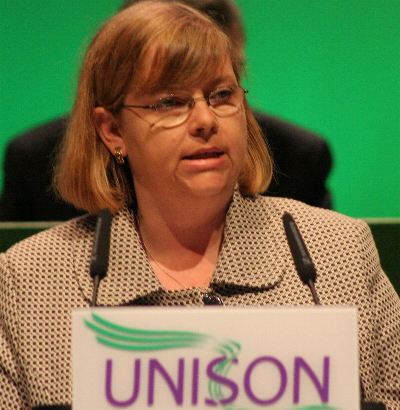
Angela Lynes
Date: Wed 8 July 2009
Angela Lynes, a 40-year-old administrative officer living in Ayrshire and working for Glasgow City Council, has been elected senior vice-president of UNISON, the UK's largest public sector trade union.
She is the union's second youngest senior vice president, and will hold the position for the coming year.
Angela was elected to the NEC, the union's governing body, in Jan 2001, and has chaired the union's Industrial Action Committee for the last eight years. She is also on the staffing committee and vice chair of the international committee.
Angela is particularly proud of UNISON's strong record of international work.
After leaving school, Angela chose to work in the local government because of her belief in the importance of public services in creating a fairer, more equal society. She has worked as an admin. officer and PA in Glasgow City Council ever since.
Commenting on her goals as senior-vice president, Angela said:
"I will be continuing to work on the issues which affect all of our members whether they live in Scotland, England, Ireland or Wales. I know there are many devolved issues, but we share important common goals and they keep us stronger united.
"I am also keen to promote our young members. At 32 I was UNISON's youngest NEC member and hope my election shows that our young members can progress through our union".
Angela lives with her husband John and two children, Jack, 13, and Rachel, 12 in Ayrshire. She was born in Glasgow.
.
Friday, 3 July 2009
UNISON in Day of Action at Forth Valley College over job cuts by diktat
Fri 3 July
UNISON members will take to the street in Falkirk today (Fri 3 July) to protest about job cuts which are being imposed at Forth Valley College.
The staff will be seeking to mobilise support from local people and elected representatives to persuade College directors to reconsider the job cuts. Loss of the 12 full time equivalent posts which are under threat, would mean 17 staff losing their jobs.
Pam Robertson, UNISON Clackmannanshire Branch Secretary, said: "These redundancies were sprung on staff at short notice, just as the semester ended. We have asked Forth Valley College management for meaningful talks so that we can avoid compulsory redundancies. Yet the directors seem set to impose these cuts by diktat."
"Management have offered the minimum statutory redundancy payments, regardless of length of service, they have refused to give 90 days notice of the job cuts and they want people out in the minimum time under law, before the next semester starts. We want dialogue, not dictatorship."
Staff from the three Forth Valley College campuses, in Falkirk, Stirling and Alloa, will join the demonstration, which will form part of a UK wide Day of Protest at FE colleges to "Defend Jobs, Defend Education".
Derek Keenan, UNISON rep at Forth Valley's Falkirk campus, said:
"These job cuts affect the campuses in Falkirk, Stirling and Alloa. We have held mass meetings of members in all three, at which members have expressed anger and dismay at the actions of the directors. The timing of this decision, at the end of the semester with staff and students leaving for holidays, has caused a lot of anger. UNISON does not intend to accept compulsory redundancies and we intend to fight this.
"We want the people of the communities which the College serves and our elected representatives to join our campaign to defend jobs and defend education at Forth Valley College."
ends
Notes for editors:
1. The UNISON demonstration against compulsory redundancies and to defend jobs and education will take place outside the Falkirk campus of Forth Valley College, Grangemouth Road, Falkirk FK2 9AD from 12 noon on Friday 3 July.
2. For more on the UK-wide "Defend Jobs, Defend Education" Day of Action in FE Colleges on Friday 3 July, see UNISON UK press Release " No to redundancies" (29 June 2009) http://www.unison.org.uk/news/news_view.asp?did=5494 and UNISON UK's College Protests page http://www.unison.org.uk/education/pages_view.asp?did=9015
3. UNISON Scotland is the main union for support staff working in Scottish further education colleges. Our members working in FE include learning support staff, librarians, IT specialists, technicians, professional staff, administrative and business support staff, cleaners, canteen staff and estate management staff.
.
Subscribe to:
Posts (Atom)