Date: Thursday 27 August 2009
In advance of discussions by council leaders at CoSLA tomorrow (Friday), UNISON, the largest union representing Scottish local council workers, warned council bosses not to threaten a five year pay cut, and to enter pay negotiations with an open mind.
Leaked discussion documents have suggested that up to a five year pay freeze will be on the table as council leaders sit down behind closed doors to discuss their response to the current recession.
Matt Smith, UNISON’s Scottish Secretary said:
"CoSLA leaders would be well advised to back off from any decision to freeze pay at all, far less for five years. Leaked papers suggest that CoSLA recognise the serious problem of low pay in local councils. Any freeze would increase that problem, de-motivate the workforce, impact negatively on services and damage communities.
"Knee jerk reaction to financial difficulties is no way to run local government. It is completely unfair that low-paid cooks, cleaners, care workers and clerical staff should be told that they are to pay the price of the financial incompetence of well-heeled bankers and financiers. Council leaders should talk to staff trade unions about funding, council tax and business rates rather than threatening their staff."
Dougie Black, UNISON Regional Organiser and lead negotiator said:
"It is disgraceful that CoSLA could think it is acceptable to threaten pay cuts to staff that deliver our services. There are appropriate bargaining arrangements to discuss pay. Why doesn’t CoSLA use these rather than leaking material to the media?
"Despite the persistent claims of the private sector, council staff are not well-paid, and have had below inflation pay increases in four out of the last five years. To suggest that it is acceptable for them to continue to have their pay cut for the next five years seems to indicate a macho, bullying attitude that CoSLA would do well to avoid, unless they are keen to provoke a dispute."
The previous pay agreement of a two-year deal ended with the award of 2.5% in April this year.
Negotiations for future years pay increases are scheduled to start in the autumn.
ENDS
For further information please contact:
Matt Smith, Scottish Secretary 07771 548 997(m)
Dougie Black, Regional Officer – Secretary, TU negotiators 07958 121 851(m)
Chris Bartter, Communications Officer 07715 583 729(m)
.

UNISON. Scotland's biggest and liveliest trade union, representing members delivering public and related services.
Thursday, 27 August 2009


Wednesday, 19 August 2009
Social work union welcomes Brandon Muir reports
Wednesday 19 August 2009
UNISON, the union representing Scotland’s social work staff, today welcomed the two reports into the Brandon Muir case in Dundee.
Rory Malone, Dundee UNISON Branch Secretary said;
"At a time when some press and politicians appear to queue up to blame social work staff each time a family tragedy like this occurs, we welcome the findings of these independent and authoritative reports that no blame falls on members in Social Work.
"Dundee’s social care staff work very hard, often in difficult circumstances, to try and protect our children and all feel tragedies like this deeply. It is simply not possible to eradicate all risks, but UNISON has gone on record to identify a range of steps that can be taken to improve the position of social work staff and reduce that risk."*
UNISON has already started work with Dundee City Council to address some of the issues in the social work and will continue to discuss ways to implement recommendations in the report.
ENDS
Note for editors:
*Helping people change their lives - UNISON/BASW manifesto for Scotland’s Social Work, outlines 10 issues that need to be tackled to improve the position of social work staff and the services they provide. http://www.unison-scotland.org.uk/socialwork/swmanifesto25june2009.pdf
For Further Information Please Contact:
Rory Malone (Dundee UNISON Branch Secretary) 07595 893067 (m)
Chris Bartter (Communications Officer) 0771 558 3729(m)
.
UNISON, the union representing Scotland’s social work staff, today welcomed the two reports into the Brandon Muir case in Dundee.
Rory Malone, Dundee UNISON Branch Secretary said;
"At a time when some press and politicians appear to queue up to blame social work staff each time a family tragedy like this occurs, we welcome the findings of these independent and authoritative reports that no blame falls on members in Social Work.
"Dundee’s social care staff work very hard, often in difficult circumstances, to try and protect our children and all feel tragedies like this deeply. It is simply not possible to eradicate all risks, but UNISON has gone on record to identify a range of steps that can be taken to improve the position of social work staff and reduce that risk."*
UNISON has already started work with Dundee City Council to address some of the issues in the social work and will continue to discuss ways to implement recommendations in the report.
ENDS
Note for editors:
*Helping people change their lives - UNISON/BASW manifesto for Scotland’s Social Work, outlines 10 issues that need to be tackled to improve the position of social work staff and the services they provide. http://www.unison-scotland.org.uk/socialwork/swmanifesto25june2009.pdf
For Further Information Please Contact:
Rory Malone (Dundee UNISON Branch Secretary) 07595 893067 (m)
Chris Bartter (Communications Officer) 0771 558 3729(m)
.
Tuesday, 11 August 2009
Tories' privatisation agenda out of touch: UNISON
Tuesday 11 August 2009
Publicly funded hospitals and schools are still vote clinchers, and the Tories' privatisation agenda is out of touch with voters, according to a survey conducted for UNISON.
Despite worries about the economy, how the Government runs our hospitals is still at the top of people’s lists in deciding how to vote at the next general election. The results of the survey show the Tories latest plans for the public services are out of touch with public opinion. Their so-called “reform” of public services is nothing but thinly-disguised “privatisation”.
In an Ipsos MORI survey conducted for UNISON, 96% say the NHS will be an important factor in deciding how they vote at the next general election. This compares to the economy (important for 93%), crime (92%), public services (85%), schools (85%) and Britain’s relationship with Europe (70%).
The NHS is highly prized by the public with 76% believing it is crucial to British society and “we must do everything to maintain it”. Only 22% think that it “was a great project, but we probably can’t maintain it in its current form”.
Three-quarters of the public (75%) believe the NHS should be “run by the public sector to encourage a joined-up service”, with little support (21%) for it to be “run by the private sector to encourage competition” 78% believe that the health service should be run by the Government and public organisations, rather than by private companies and 73% agreed that people who provide health services should be employed by the NHS rather than by private companies.
UNISON General Secretary, Dave Prentis, said: “Although the economy is clearly a worry for many people, this polling shows the massive support that our NHS and public services have amongst the public. They don’t want them privatised, there is no appetite for competition in the services nor for profit-chasing. People have shown what we have always argued that most want good local schools and hospitals provide by dedicated public servants.
“The Tories are completely out of kilter with public opinion. Shadow Chancellor Osborne’s claims to have “progressive” ideas are nothing but cheap window-dressing.
“The Government should take note. If it is to have any chance of re-election next year, it must listen to what the people want.”
Ipsos MORI interviewed a sample of 1,001 British adults, plus a booster of 251 public sector workers, all age 18 and over by telephone between 12-14 June 2009. Data are weighted to the profile of the adult population 18+, and include a weight for public vs. private sector workers. The final weighted data indicate that 17% belong to a trade union.
The survey found that public sector workers have similar views to the general population.
Factors which will be important for public sector workers in deciding how to vote in the next general election are: the NHS (important for 96%); the economy (95%); crime (92%); public services (90%); schools (90%); Britain’s relationship with Europe (73%). 77% believe the NHS is crucial to British society; 81% believe it should be run by the public sector to encourage a joined-up service; 86% think that the NHS should be run by the Government not private companies and 79% agree that people providing health services should be employed by the NHS rather than by private companies.
.
Publicly funded hospitals and schools are still vote clinchers, and the Tories' privatisation agenda is out of touch with voters, according to a survey conducted for UNISON.
Despite worries about the economy, how the Government runs our hospitals is still at the top of people’s lists in deciding how to vote at the next general election. The results of the survey show the Tories latest plans for the public services are out of touch with public opinion. Their so-called “reform” of public services is nothing but thinly-disguised “privatisation”.
In an Ipsos MORI survey conducted for UNISON, 96% say the NHS will be an important factor in deciding how they vote at the next general election. This compares to the economy (important for 93%), crime (92%), public services (85%), schools (85%) and Britain’s relationship with Europe (70%).
The NHS is highly prized by the public with 76% believing it is crucial to British society and “we must do everything to maintain it”. Only 22% think that it “was a great project, but we probably can’t maintain it in its current form”.
Three-quarters of the public (75%) believe the NHS should be “run by the public sector to encourage a joined-up service”, with little support (21%) for it to be “run by the private sector to encourage competition” 78% believe that the health service should be run by the Government and public organisations, rather than by private companies and 73% agreed that people who provide health services should be employed by the NHS rather than by private companies.
UNISON General Secretary, Dave Prentis, said: “Although the economy is clearly a worry for many people, this polling shows the massive support that our NHS and public services have amongst the public. They don’t want them privatised, there is no appetite for competition in the services nor for profit-chasing. People have shown what we have always argued that most want good local schools and hospitals provide by dedicated public servants.
“The Tories are completely out of kilter with public opinion. Shadow Chancellor Osborne’s claims to have “progressive” ideas are nothing but cheap window-dressing.
“The Government should take note. If it is to have any chance of re-election next year, it must listen to what the people want.”
Ipsos MORI interviewed a sample of 1,001 British adults, plus a booster of 251 public sector workers, all age 18 and over by telephone between 12-14 June 2009. Data are weighted to the profile of the adult population 18+, and include a weight for public vs. private sector workers. The final weighted data indicate that 17% belong to a trade union.
The survey found that public sector workers have similar views to the general population.
Factors which will be important for public sector workers in deciding how to vote in the next general election are: the NHS (important for 96%); the economy (95%); crime (92%); public services (90%); schools (90%); Britain’s relationship with Europe (73%). 77% believe the NHS is crucial to British society; 81% believe it should be run by the public sector to encourage a joined-up service; 86% think that the NHS should be run by the Government not private companies and 79% agree that people providing health services should be employed by the NHS rather than by private companies.
.
Thursday, 6 August 2009
New Children’s Hearing system will increase risk to vulnerable children – UNISON
Date: Thurs 6 August 2009
UNISON – the union that represents workers staffing Scotland’s Children’s Panel system, and social care staff protecting vulnerable children – has submitted responses to the Scottish Government strongly criticising their proposed reorganisation of Children’s Hearings (CH).
Both UNISON’s Scottish Children’s Reporters’ Administration (SCRA) Branch and the Scottish Council of the union have submitted responses which point out that the proposals remove protections for children that are currently in place, that they set up a whole new bureaucracy which could add confusion and increase paperwork, and that they move decision-making power away from Children’s Hearings and towards the courts.
The union, which represents social work staff working in local authorities is concerned that the reforms could undermine existing protections.
Kate Ramsden, from UNISON’s Scottish Social Work Issues Group said “We are seriously concerned that the Bill actually removes current protections from children who could be at risk in an abusive household, and also that children will only be referred for voluntary advice and assistance if they have already been subject to compulsory supervision. These are just some of many examples of the draft bill concentrating on the civil rights of adults at the expense of the rights of the children to be protected.”
The establishment of a new quango is likely to lead to a dual administration, meaning increased potential for confusion, and increased bureaucracy.
Yvonne Stewart, UNISON SCRA branch secretary said “The creation of a Scottish Children’s Hearing Tribunal (SCHT) and the split in the administration of the children’s hearing system can only lead to increased bureaucracy and a greater possibility of confusion and error. This will lead to a more complex system for children, families and other professionals to engage with, and increased cost while also increasing the risk to children.”
John Stevenson, from UNISON’s Scottish Social Work Issues Group agrees “The double bureaucracy proposed here is likely to add to, rather than reduce, the amount of paperwork social workers have to fill in. This is despite all the evidence that shows the level of form-filling is a major factor reducing the time social workers can spend with looked-after children.”
UNISON is also concerned about a shift of powers towards the courts.
John Stevenson said "The ability of a court to completely rehear a case decided by a Children’s Hearing and other changes means cases are more likely to be decided in an adversarial atmosphere of a court of law, rather than the hearing setting of all parties discussing the best option for a child.”
"We understand that some changes are needed to comply with the European Convention on Human Rights but those changes have already been made. UNISON believes the welfare principle of Scotland's world-leading Children's Hearing system is worth defending. We are worried that this draft bill is less child-centred than the existing ground-breaking legislation."
The vast majority of cases Children's Hearings deal with are about the care and protection of children - 40,000 out of 50,000 referrals last year - rather than offences.
UNISON will be seeking a meeting with ministers to urge them to redraft the bill to ensure that the welfare principle becomes the centre of any new legislation.
ENDS
Notes for editors: UNISON’s responses can be found on the Scottish website at www.unison-scotland.org.uk/response/childrenshearing.pdf and www.unison-scotland.org.uk/response/SCRAUNISONchildrenshearingresponse.pdf
More information at www.unison-scotland.org.uk/socialwork
.
UNISON – the union that represents workers staffing Scotland’s Children’s Panel system, and social care staff protecting vulnerable children – has submitted responses to the Scottish Government strongly criticising their proposed reorganisation of Children’s Hearings (CH).
Both UNISON’s Scottish Children’s Reporters’ Administration (SCRA) Branch and the Scottish Council of the union have submitted responses which point out that the proposals remove protections for children that are currently in place, that they set up a whole new bureaucracy which could add confusion and increase paperwork, and that they move decision-making power away from Children’s Hearings and towards the courts.
The union, which represents social work staff working in local authorities is concerned that the reforms could undermine existing protections.
Kate Ramsden, from UNISON’s Scottish Social Work Issues Group said “We are seriously concerned that the Bill actually removes current protections from children who could be at risk in an abusive household, and also that children will only be referred for voluntary advice and assistance if they have already been subject to compulsory supervision. These are just some of many examples of the draft bill concentrating on the civil rights of adults at the expense of the rights of the children to be protected.”
The establishment of a new quango is likely to lead to a dual administration, meaning increased potential for confusion, and increased bureaucracy.
Yvonne Stewart, UNISON SCRA branch secretary said “The creation of a Scottish Children’s Hearing Tribunal (SCHT) and the split in the administration of the children’s hearing system can only lead to increased bureaucracy and a greater possibility of confusion and error. This will lead to a more complex system for children, families and other professionals to engage with, and increased cost while also increasing the risk to children.”
John Stevenson, from UNISON’s Scottish Social Work Issues Group agrees “The double bureaucracy proposed here is likely to add to, rather than reduce, the amount of paperwork social workers have to fill in. This is despite all the evidence that shows the level of form-filling is a major factor reducing the time social workers can spend with looked-after children.”
UNISON is also concerned about a shift of powers towards the courts.
John Stevenson said "The ability of a court to completely rehear a case decided by a Children’s Hearing and other changes means cases are more likely to be decided in an adversarial atmosphere of a court of law, rather than the hearing setting of all parties discussing the best option for a child.”
"We understand that some changes are needed to comply with the European Convention on Human Rights but those changes have already been made. UNISON believes the welfare principle of Scotland's world-leading Children's Hearing system is worth defending. We are worried that this draft bill is less child-centred than the existing ground-breaking legislation."
The vast majority of cases Children's Hearings deal with are about the care and protection of children - 40,000 out of 50,000 referrals last year - rather than offences.
UNISON will be seeking a meeting with ministers to urge them to redraft the bill to ensure that the welfare principle becomes the centre of any new legislation.
ENDS
Notes for editors: UNISON’s responses can be found on the Scottish website at www.unison-scotland.org.uk/response/childrenshearing.pdf and www.unison-scotland.org.uk/response/SCRAUNISONchildrenshearingresponse.pdf
More information at www.unison-scotland.org.uk/socialwork
.
Wednesday, 5 August 2009
Royal Assent for Scotland's world leading climate legislation

Attn: News Desks
Immediate Release
5th August 2009
QUEEN APPROVES SCOTLAND’S WORLD-LEADING
CLIMATE CHANGE LEGISLATION
Her Majesty Queen Elizabeth II today made history by giving Royal Assent to The Scottish Climate Change Bill, the strongest piece of climate change legislation in the world.
The world-leading Act sets vital international precedents and an example for other wealthy nations to follow ahead of the UN’s climate change talks in Copenhagen in December, which will agree a replacement to the Kyoto Protocol.
The new legislation enshrines in law Scotland’s obligation to reduce the country’s greenhouse gas emissions by at least 42 per cent by 2020 and 80 per cent by 2050. Other rich countries need to adopt similar cuts to their emissions if catastrophic climate change is to be averted.
Queen Elizabeth signed the historic Act during a visit to her estate in Balmoral in Scotland. The Climate Change (Scotland) Bill was unanimously voted through the Scottish Parliament on 24th June this year.
Immediate Release
5th August 2009
QUEEN APPROVES SCOTLAND’S WORLD-LEADING
CLIMATE CHANGE LEGISLATION
Her Majesty Queen Elizabeth II today made history by giving Royal Assent to The Scottish Climate Change Bill, the strongest piece of climate change legislation in the world.
The world-leading Act sets vital international precedents and an example for other wealthy nations to follow ahead of the UN’s climate change talks in Copenhagen in December, which will agree a replacement to the Kyoto Protocol.
The new legislation enshrines in law Scotland’s obligation to reduce the country’s greenhouse gas emissions by at least 42 per cent by 2020 and 80 per cent by 2050. Other rich countries need to adopt similar cuts to their emissions if catastrophic climate change is to be averted.
Queen Elizabeth signed the historic Act during a visit to her estate in Balmoral in Scotland. The Climate Change (Scotland) Bill was unanimously voted through the Scottish Parliament on 24th June this year.
Leading elements of the Scottish Act include:
· At least a 42% cut in greenhouse gas emissions by 2020 (based on 1990 levels)
· At least an 80% cut in greenhouse gas emissions by 2050 (based on 1990 levels)
· Emissions from international aviation & shipping included from the start;
· Commitment to report annually on consumption-based emissions;
· Strong duty across the public sector to play a full part in tackling Scotland’s greenhouse gas emissions.
Cardinal Keith O’Brien, Scotland’s most senior Catholic clergyman and climate change campaigner said:
“Scotland is setting a crucial example to the rich countries of the world in efforts to prevent the unnecessary suffering of millions of innocent people through ever-worsening climate change. The scientific consensus is clear; unless rich nations make early and deep cuts to their emissions, as Scotland has agreed to do, the situation will get much worse.
“Wealthy countries have an unequivocal moral duty to reduce their own emissions and help developing countries who are already suffering the consequences of our profligate use of fossil fuels for economic gain.
· At least a 42% cut in greenhouse gas emissions by 2020 (based on 1990 levels)
· At least an 80% cut in greenhouse gas emissions by 2050 (based on 1990 levels)
· Emissions from international aviation & shipping included from the start;
· Commitment to report annually on consumption-based emissions;
· Strong duty across the public sector to play a full part in tackling Scotland’s greenhouse gas emissions.
Cardinal Keith O’Brien, Scotland’s most senior Catholic clergyman and climate change campaigner said:
“Scotland is setting a crucial example to the rich countries of the world in efforts to prevent the unnecessary suffering of millions of innocent people through ever-worsening climate change. The scientific consensus is clear; unless rich nations make early and deep cuts to their emissions, as Scotland has agreed to do, the situation will get much worse.
“Wealthy countries have an unequivocal moral duty to reduce their own emissions and help developing countries who are already suffering the consequences of our profligate use of fossil fuels for economic gain.
“Scotland has had the courage to set a vital international precedent with its Climate Change (Scotland) Act. Others must follow this lead now if we are to have a long, safe, and prosperous future for humanity on earth.”
Stewart Stevenson, Minister for Climate Change in the Scottish Government, said:
“The Scottish Government recognises that climate change will have far reaching effects on Scotland's economy, its people and its environment and is determined to play its part in rising to this challenge.
“The world-leading legislation introduces targets to reduce emissions by at least 80 per cent by 2050, and will drive new thinking, new solutions and new technologies putting Scotland at the forefront of building a sustainable low carbon economy.”
Mike Robinson, chair of the Stop Climate Chaos Scotland coalition, which includes Oxfam, Christian Aid, SCIAF, WWF, Friends of the Earth, as well faith organisations and trade unions, said:
“It is now enshrined in law that Scotland will do its fair share to tackle the causes of climate change. The world-leading emissions reduction targets provide a vital lead to other wealthy nations ahead of the UN’s climate talks in Copenhagen in December. Other rich countries must now follow Scotland’s lead and match the commitment to cut their emissions. I hope they will sit up and take notice.
“The scientific consensus is clear: unless developed nations reduce their greenhouse gas emissions by at least 42 per cent by 2020 and 80 per cent by 2050 the problem of dangerous climate change will become irreversible.”
Ends
Notes to editors:
Stewart Stevenson, Minister for Climate Change in the Scottish Government, said:
“The Scottish Government recognises that climate change will have far reaching effects on Scotland's economy, its people and its environment and is determined to play its part in rising to this challenge.
“The world-leading legislation introduces targets to reduce emissions by at least 80 per cent by 2050, and will drive new thinking, new solutions and new technologies putting Scotland at the forefront of building a sustainable low carbon economy.”
Mike Robinson, chair of the Stop Climate Chaos Scotland coalition, which includes Oxfam, Christian Aid, SCIAF, WWF, Friends of the Earth, as well faith organisations and trade unions, said:
“It is now enshrined in law that Scotland will do its fair share to tackle the causes of climate change. The world-leading emissions reduction targets provide a vital lead to other wealthy nations ahead of the UN’s climate talks in Copenhagen in December. Other rich countries must now follow Scotland’s lead and match the commitment to cut their emissions. I hope they will sit up and take notice.
“The scientific consensus is clear: unless developed nations reduce their greenhouse gas emissions by at least 42 per cent by 2020 and 80 per cent by 2050 the problem of dangerous climate change will become irreversible.”
Ends
Notes to editors:
Stop Climate Chaos Scotland (SCCS) is a diverse, growing coalition of organisations campaigning on climate change. The SCCS Coalition has 60 Scottish members, representing more than 2 million supporters (40% of the Scottish population), ranging from environment and development groups to faith organisations, trade unions, student societies, care providers and many more. SCCS was instrumental in securing a strong climate act for Scotland. For full details visit http://www.stopclimatechaos.org/scotland
In December world leaders will gather in Copenhagen to agree a new UN international climate deal that will come into force when the first phase of the Kyoto treaty expires in 2012. For more info see http://en.cop15.dk/
For more info on how the Scottish Act can make a difference in Copenhagen, see http://www.stopclimatechaos.org/scotland
On Saturday December 5, tens of thousands of people will gather in Glasgow and London to call for action on climate change. For more info see http://www.stopclimatechaos.org/scotland
---------------------------------------------------------------------------------------------
NB: UNISON Scotland is a member of Stop Climate Chaos Scotland. For further information on UNISON's climate change and environment work see the Green Workplace pages on our website. www.unison-scotland.org.uk/greenworkplace
.
.
.
Monday, 3 August 2009
Union 90% vote approves Single Status deal
Date: Monday 3 August 2009
UNISON, Dumfries & Galloway's largest public service trade union, and partner unions UNITE & GMB today announced that their members working for the local authority, have all voted overwhelmingly to accept a negotiated Single Status deal.
UNISON members delivered a majority of 89.6% in favour of the package of proposals with 10.4% of members rejecting. The turnout was 75%.
UNITE & GMB members also voted to accept the offer in a high turnout with majorities of, - Unite 94% and GMB 93%
Speaking shortly after the votes were independently counted Marion Stewart, Dumfries & Galloway UNISON branch secretary said; "I am pleased that our members have voted to accept this deal. The joint trade unions believed it was the best available through negotiation.
"It has been a long, often very difficult process, which started back in 1999. Recently, Trades Unions and the Council formed an effective joint project board, led by retired Chief Executive, Phil Jones.
"This is a prime example of what can be achieved by good joint working and we are pleased the Council has recognised and invested in our equality demands. The package has been subjected to three external independent checks and has resulted in fairer pay for many previously undervalued and under paid female groups."
This is believed to be only the second negotiated settlement to be achieved between unions and their employers in Scotland's 32 local authorities. The Single Status agreement affects 6500 Council employees and seeks to eradicate current inequalities that exist in local government pay and conditions.
Ann Patterson, Branch Chair for Unite the Union said after the ballot "I am pleased to announce that Unite members have voted to accept the Council's proposals within Dumfries and Galloway.
"The Joint Trade Unions believed that the Council's proposals were the best that could be achieved via negotiation but recognise that a number of members will be subject to pay protection. We remain assured by the Council's commitment to pay equality for all staff and both sides recognise that this is just the beginning of an ongoing process to eradicate pay inequality."
Marion Stewart continued: "The result of the ballot marks a significant milestone. The focus of our work now will be to help colleagues who want to appeal their grading, to work to improve the position of those groups of staff who are subject to pay protection and to continue UNISON's ongoing support for members who have lodged equal pay claims."
As part of the Single Status agreement those groups of staff who are Pay Protected will be included in an exercise between the Joint Trade Unions and the Council to seek to establish "job redesign or job enlargement" which could potentially remove detriment.
.
UNISON, Dumfries & Galloway's largest public service trade union, and partner unions UNITE & GMB today announced that their members working for the local authority, have all voted overwhelmingly to accept a negotiated Single Status deal.
UNISON members delivered a majority of 89.6% in favour of the package of proposals with 10.4% of members rejecting. The turnout was 75%.
UNITE & GMB members also voted to accept the offer in a high turnout with majorities of, - Unite 94% and GMB 93%
Speaking shortly after the votes were independently counted Marion Stewart, Dumfries & Galloway UNISON branch secretary said; "I am pleased that our members have voted to accept this deal. The joint trade unions believed it was the best available through negotiation.
"It has been a long, often very difficult process, which started back in 1999. Recently, Trades Unions and the Council formed an effective joint project board, led by retired Chief Executive, Phil Jones.
"This is a prime example of what can be achieved by good joint working and we are pleased the Council has recognised and invested in our equality demands. The package has been subjected to three external independent checks and has resulted in fairer pay for many previously undervalued and under paid female groups."
This is believed to be only the second negotiated settlement to be achieved between unions and their employers in Scotland's 32 local authorities. The Single Status agreement affects 6500 Council employees and seeks to eradicate current inequalities that exist in local government pay and conditions.
Ann Patterson, Branch Chair for Unite the Union said after the ballot "I am pleased to announce that Unite members have voted to accept the Council's proposals within Dumfries and Galloway.
"The Joint Trade Unions believed that the Council's proposals were the best that could be achieved via negotiation but recognise that a number of members will be subject to pay protection. We remain assured by the Council's commitment to pay equality for all staff and both sides recognise that this is just the beginning of an ongoing process to eradicate pay inequality."
Marion Stewart continued: "The result of the ballot marks a significant milestone. The focus of our work now will be to help colleagues who want to appeal their grading, to work to improve the position of those groups of staff who are subject to pay protection and to continue UNISON's ongoing support for members who have lodged equal pay claims."
As part of the Single Status agreement those groups of staff who are Pay Protected will be included in an exercise between the Joint Trade Unions and the Council to seek to establish "job redesign or job enlargement" which could potentially remove detriment.
.
Tuesday, 28 July 2009
Nursery closure attempt at Glasgow College prompts strike action ballot
Date: Tuesday 28 July 2009
UNISON, the education union, is balloting around 80 members in Glasgow College of Nautical Studies for strike action, in response to management proposals to cut 5 jobs by closing the baby room in the college's Thistle Street Nursery. Ballot papers will go out to staff this Wednesday (29 July).
Jim Snell, Assistant Service Conditions Officer for Glasgow City Branch of UNISON said "This is the first stage in managements plan to close the Thistle Street nursery completely by July 2010, closing an important service and losing a total of 20 jobs.
"This is exactly the sort of cut that UNISON is convinced is resulting from the city centre college merger proposals. UNISON's college membership in Glasgow have already expressed their opposition to the proposals and will continue to fight the cuts as they become more damaging."
If the ballot for strike action is successful, the first day of action will be Thursday 20 August, coinciding with a major staff conference planned by the college management. Further days of action will be called if necessary and after consultation with members.
UNISON is continuing to meet with college management to try and persuade them to change their direction and will continue to raise questions on the different options that they have looked at.
Jim Snell said "Management have failed to share any information with UNISON on the background to the decision to close the nursery. We are urging members at the college to deliver a resounding YES vote, and demonstrate the strength of opposition to management's cuts."
The Ballot closes on 13 August.
.
Thursday, 23 July 2009
Executive pension report - UNISON reaction
23/07/09
UNISON, the UK’s largest public sector union, is welcoming the Lane Clark & Peacock report findings, which expose an apartheid that exists between those at the top and low paid workers.
Glyn Jenkins, UNISON’s Head of Pensions:
“We hear a lot about gold plated public sector pensions, but the real apartheid is between boardroom fat cats and low paid workers."
See full release at:
http://www.unison.org.uk/asppresspack/pressrelease_view.asp?id=1513
.
UNISON, the UK’s largest public sector union, is welcoming the Lane Clark & Peacock report findings, which expose an apartheid that exists between those at the top and low paid workers.
Glyn Jenkins, UNISON’s Head of Pensions:
“We hear a lot about gold plated public sector pensions, but the real apartheid is between boardroom fat cats and low paid workers."
See full release at:
http://www.unison.org.uk/asppresspack/pressrelease_view.asp?id=1513
.
UNISON accuses Tory leader of letting rhetoric cloud his judgement
23/07/09
UNISON UK General Secretary Dave Prentis:
"David Cameron is wrong if he thinks he can make swingeing cuts without harming front-line services. Public sector workers have gone through efficiency drive after efficiency drive, and Independent studies have shown that you cannot extract any more without damaging services.”
See full release at:
http://www.unison.org.uk/asppresspack/pressrelease_view.asp?id=1514
.
UNISON UK General Secretary Dave Prentis:
"David Cameron is wrong if he thinks he can make swingeing cuts without harming front-line services. Public sector workers have gone through efficiency drive after efficiency drive, and Independent studies have shown that you cannot extract any more without damaging services.”
See full release at:
http://www.unison.org.uk/asppresspack/pressrelease_view.asp?id=1514
.
Monday, 20 July 2009
UNISON condemns Quarriers threat to sack 2,000 staff
Date: Monday July 20 2009
Care sector union, UNISON, today condemned Scottish charity, Quarriers', threat to dismiss all their 2,000 staff unless the union agrees to cuts in wages and conditions. Quarriers' - one of Scotlands biggest charitable organisations providing services for vulnerable children, homeless young people and adults with disabilities - threatened on Friday to issue redundancy notices to all its 2000 staff.
This follows the charity's management proposal -tabled in May - to cut staff night shift payments, and payments for public holidays. Most drastically, the charity wants to cut sick pay by a quarter for any worker with less than 5 years service.
Instead of continuing negotiations with UNISON Quarriers' Branch - a meeting was scheduled for Friday 10th July but was cancelled by the employers with no explanation - Quarriers' wrote to UNISON officially notifying them that unless UNISON agrees to their proposal they will make everyone redundant and re-engage them on new terms and conditions.
Stephen Brown, Branch Secretary, of UNISON Quarriers' Branch said, “Like many staff in Quarriers I am on holiday this week and I was horrified by this move by Quarriers. UNISON recognises Quarriers' is feeling the financial pinch and were prepared to meet Quarriers' in order to negotiate properly. I’m therefore disappointed that Quarriers have decided to fall back on gun boat diplomacy by threatening our members with the sack.”
He added, “Our members work very hard for the charity and provide an excellent service to some of the most vulnerable in society. Quarriers' continually say that they value their staff but this threat shows how much they really value us. Quarriers' should withdraw this notice immediately and sit around the table and negotiate with us in a meaningful way.”
.
Tuesday, 14 July 2009
Surveys point to concerns re social work cover, warns UNISON
Date: Tue 14 July 2009
UNISON, Scotland's social care workers union, today highlighted their concern about increasing pressure and stress on social care workers, highlighted by a survey released by the BBC today (based on a Freedom of Information request showing very high caseloads per social worker in some authorities.)
UNISON's own Freedom of Information survey (released last month) done across all local authorities in the UK showed vacancy rates with a UK average of 12%. In Scotland, six councils exceeded the UK average. In Scottish Borders, almost a quarter (24.06%) of social work posts are vacant. This is followed by Inverclyde (20.8%), West Dunbartonshire (19.6%), Falkirk (15%), Highland (13.1%) and West Lothian (12%).
Ronnie Stevenson, UNISON Convenor of social work tewards in the largest local authority and a children and families social worker, says:
“What all these surveys are saying is that social workers are battling against the odds to protect our young children and vulnerable adults. The figures themselves are bad, but they only point to the real problem - if there are too few social workers and too many cases, the crucial element of time spent on any one child is squeezed - especially if this is exacerbated by high levels of paper work. This situation is no good for social workers and it’s no good for their clients who desperately need help."
Colin Turbett, UNISON North Ayrshire Branch Chair and a social worker says:
"What we do know is that few employers operate effective workload management systems, with the result that social workers commmonly work excessive overtime just to keep their heads above water. Frontline managers are under constant pressure to ensure reports are done timeously with score sheets comparing performance across and between authorities, and that cases are not 'unallocated'. A comprehensive integrated assessment (such as a report for a Children's Hearing) for a child now takes some 10-12 hours of work."
And UNISON points out that referral rates are rising all the time, without increasing resources.
The union along with the social work professional organisation - BASW - has recently released a manifesto for Scottish Social Work. It demands urgent action to address the issues affecting their social work members attract new staff into social work and to stem the stream of workers leaving the profession by making working conditions more bearable.
This means that councils must ensure that they not only fill vacancies but reassess the number of staff needed to cover the high volume of work. Without such measures the union is warning that there is a very real possibility of another tragedy like Brandon Muir.
ends
Notes for Editors:
1. UNISON Scotland and the BASW's Social Work Manifesto Helping people change their lives calls for a ten point plan:
2. The ten points it wants addressed are:
- Introduction of effective workload management
- Reduction in meaningless bureaucracy
- Guideline for appropriate staffing levels
- Access to good quality support and supervision
- Ensuring employers are accountable to staff and service users
- Providing an effective reporting mechanism for problems
- A clear career path allowing experienced practitioners to remain in practice
- A universal service as ‘accessible as the NHS’ with welcoming buildings
- Social work professionals being able to practice their skills in the community
- An end to cuts and threats to budgets.
The manifesto is on the UNISON Scotland website at www.unison-scotland.org.uk/socialwork
.
UNISON, Scotland's social care workers union, today highlighted their concern about increasing pressure and stress on social care workers, highlighted by a survey released by the BBC today (based on a Freedom of Information request showing very high caseloads per social worker in some authorities.)
UNISON's own Freedom of Information survey (released last month) done across all local authorities in the UK showed vacancy rates with a UK average of 12%. In Scotland, six councils exceeded the UK average. In Scottish Borders, almost a quarter (24.06%) of social work posts are vacant. This is followed by Inverclyde (20.8%), West Dunbartonshire (19.6%), Falkirk (15%), Highland (13.1%) and West Lothian (12%).
Ronnie Stevenson, UNISON Convenor of social work tewards in the largest local authority and a children and families social worker, says:
“What all these surveys are saying is that social workers are battling against the odds to protect our young children and vulnerable adults. The figures themselves are bad, but they only point to the real problem - if there are too few social workers and too many cases, the crucial element of time spent on any one child is squeezed - especially if this is exacerbated by high levels of paper work. This situation is no good for social workers and it’s no good for their clients who desperately need help."
Colin Turbett, UNISON North Ayrshire Branch Chair and a social worker says:
"What we do know is that few employers operate effective workload management systems, with the result that social workers commmonly work excessive overtime just to keep their heads above water. Frontline managers are under constant pressure to ensure reports are done timeously with score sheets comparing performance across and between authorities, and that cases are not 'unallocated'. A comprehensive integrated assessment (such as a report for a Children's Hearing) for a child now takes some 10-12 hours of work."
And UNISON points out that referral rates are rising all the time, without increasing resources.
The union along with the social work professional organisation - BASW - has recently released a manifesto for Scottish Social Work. It demands urgent action to address the issues affecting their social work members attract new staff into social work and to stem the stream of workers leaving the profession by making working conditions more bearable.
This means that councils must ensure that they not only fill vacancies but reassess the number of staff needed to cover the high volume of work. Without such measures the union is warning that there is a very real possibility of another tragedy like Brandon Muir.
ends
Notes for Editors:
1. UNISON Scotland and the BASW's Social Work Manifesto Helping people change their lives calls for a ten point plan:
2. The ten points it wants addressed are:
- Introduction of effective workload management
- Reduction in meaningless bureaucracy
- Guideline for appropriate staffing levels
- Access to good quality support and supervision
- Ensuring employers are accountable to staff and service users
- Providing an effective reporting mechanism for problems
- A clear career path allowing experienced practitioners to remain in practice
- A universal service as ‘accessible as the NHS’ with welcoming buildings
- Social work professionals being able to practice their skills in the community
- An end to cuts and threats to budgets.
The manifesto is on the UNISON Scotland website at www.unison-scotland.org.uk/socialwork
.
Thursday, 9 July 2009
Extra cash for Forth Valley College highlights job cuts by diktat
Date: Thu 9 July 2009
Over half a million pounds extra cash awarded to Forth valley College today (Thu 9 July) serves to highlight the poor decisions by college management to impose job cuts according to Education union UNISONScotland.
The cash has come from the Scottish Funding Council. It is part of Scottish Government money awarded to help colleges deal with to the needs of individuals and businesses during the economic downturn.
However, the college announced they were to cut 12 full time posts just before the semester ended. Loss of the 12 full time equivalent posts which are under threat, would mean 17 staff losing their jobs.
Helen Craig, UNISON rep in Forth Valley College said “It is ironic that this welcome cash is being awarded to allow the college to assist people in the recession, while the College management is proposing cutting staff in Learning Services especially community support – who deliver precisely this type of service. It is also poor management as it includes Learning Innovation, an area where the College can ill afford to lose any more staff. We call on the management to use this money to provide a better service to individuals hit by recession and reverse these cuts.”
ends
Notes for editors:
1. The total amount awarded to colleges across Scotland this year will be £7.7m. Forth Valley College will receive £562,000 – the third largest amount of any college
2. UNISON has already held one successful demonstration against compulsory redundancies and to defend jobs and education at the Falkirk campus of Forth Valley College last Friday 2.
UNISON Scotland is the main union for support staff working in Scottish further education colleges. Our members working in FE include learning support staff, librarians, IT specialists, technicians, professional staff, administrative and business support staff, cleaners, canteen staff and estate management staff.
.
Over half a million pounds extra cash awarded to Forth valley College today (Thu 9 July) serves to highlight the poor decisions by college management to impose job cuts according to Education union UNISONScotland.
The cash has come from the Scottish Funding Council. It is part of Scottish Government money awarded to help colleges deal with to the needs of individuals and businesses during the economic downturn.
However, the college announced they were to cut 12 full time posts just before the semester ended. Loss of the 12 full time equivalent posts which are under threat, would mean 17 staff losing their jobs.
Helen Craig, UNISON rep in Forth Valley College said “It is ironic that this welcome cash is being awarded to allow the college to assist people in the recession, while the College management is proposing cutting staff in Learning Services especially community support – who deliver precisely this type of service. It is also poor management as it includes Learning Innovation, an area where the College can ill afford to lose any more staff. We call on the management to use this money to provide a better service to individuals hit by recession and reverse these cuts.”
ends
Notes for editors:
1. The total amount awarded to colleges across Scotland this year will be £7.7m. Forth Valley College will receive £562,000 – the third largest amount of any college
2. UNISON has already held one successful demonstration against compulsory redundancies and to defend jobs and education at the Falkirk campus of Forth Valley College last Friday 2.
UNISON Scotland is the main union for support staff working in Scottish further education colleges. Our members working in FE include learning support staff, librarians, IT specialists, technicians, professional staff, administrative and business support staff, cleaners, canteen staff and estate management staff.
.
Wednesday, 8 July 2009
Glasgow council worker elected senior vice president of UNISON
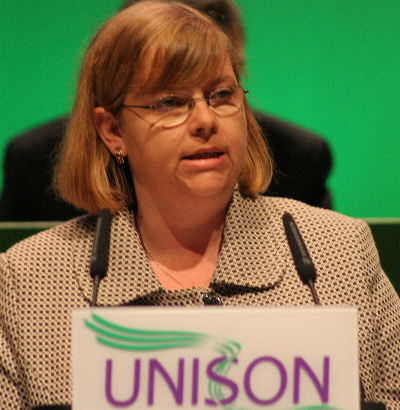
Angela Lynes
Date: Wed 8 July 2009
Angela Lynes, a 40-year-old administrative officer living in Ayrshire and working for Glasgow City Council, has been elected senior vice-president of UNISON, the UK's largest public sector trade union.
She is the union's second youngest senior vice president, and will hold the position for the coming year.
Angela was elected to the NEC, the union's governing body, in Jan 2001, and has chaired the union's Industrial Action Committee for the last eight years. She is also on the staffing committee and vice chair of the international committee.
Angela is particularly proud of UNISON's strong record of international work.
After leaving school, Angela chose to work in the local government because of her belief in the importance of public services in creating a fairer, more equal society. She has worked as an admin. officer and PA in Glasgow City Council ever since.
Commenting on her goals as senior-vice president, Angela said:
"I will be continuing to work on the issues which affect all of our members whether they live in Scotland, England, Ireland or Wales. I know there are many devolved issues, but we share important common goals and they keep us stronger united.
"I am also keen to promote our young members. At 32 I was UNISON's youngest NEC member and hope my election shows that our young members can progress through our union".
Angela lives with her husband John and two children, Jack, 13, and Rachel, 12 in Ayrshire. She was born in Glasgow.
.
Friday, 3 July 2009
UNISON in Day of Action at Forth Valley College over job cuts by diktat
Fri 3 July
UNISON members will take to the street in Falkirk today (Fri 3 July) to protest about job cuts which are being imposed at Forth Valley College.
The staff will be seeking to mobilise support from local people and elected representatives to persuade College directors to reconsider the job cuts. Loss of the 12 full time equivalent posts which are under threat, would mean 17 staff losing their jobs.
Pam Robertson, UNISON Clackmannanshire Branch Secretary, said: "These redundancies were sprung on staff at short notice, just as the semester ended. We have asked Forth Valley College management for meaningful talks so that we can avoid compulsory redundancies. Yet the directors seem set to impose these cuts by diktat."
"Management have offered the minimum statutory redundancy payments, regardless of length of service, they have refused to give 90 days notice of the job cuts and they want people out in the minimum time under law, before the next semester starts. We want dialogue, not dictatorship."
Staff from the three Forth Valley College campuses, in Falkirk, Stirling and Alloa, will join the demonstration, which will form part of a UK wide Day of Protest at FE colleges to "Defend Jobs, Defend Education".
Derek Keenan, UNISON rep at Forth Valley's Falkirk campus, said:
"These job cuts affect the campuses in Falkirk, Stirling and Alloa. We have held mass meetings of members in all three, at which members have expressed anger and dismay at the actions of the directors. The timing of this decision, at the end of the semester with staff and students leaving for holidays, has caused a lot of anger. UNISON does not intend to accept compulsory redundancies and we intend to fight this.
"We want the people of the communities which the College serves and our elected representatives to join our campaign to defend jobs and defend education at Forth Valley College."
ends
Notes for editors:
1. The UNISON demonstration against compulsory redundancies and to defend jobs and education will take place outside the Falkirk campus of Forth Valley College, Grangemouth Road, Falkirk FK2 9AD from 12 noon on Friday 3 July.
2. For more on the UK-wide "Defend Jobs, Defend Education" Day of Action in FE Colleges on Friday 3 July, see UNISON UK press Release " No to redundancies" (29 June 2009) http://www.unison.org.uk/news/news_view.asp?did=5494 and UNISON UK's College Protests page http://www.unison.org.uk/education/pages_view.asp?did=9015
3. UNISON Scotland is the main union for support staff working in Scottish further education colleges. Our members working in FE include learning support staff, librarians, IT specialists, technicians, professional staff, administrative and business support staff, cleaners, canteen staff and estate management staff.
.
Friday, 26 June 2009
Who cares for the carers?

UNISON Scotland's Simon Macfarlane, Robert Rae and Janet Stewart at Glasgow City Chambers on Wednesday 24 June 2009, handing in the care workers' petition calling for Minimum Wage to be paid for "sleepovers".
See press release from Wed 24 June
http://unison-scotland.blogspot.com/2009/06/no-bed-of-roses-unison-care-workers.html
.
UNISON welcomes government acceptance of union concerns on community nursing
UNISON, the union for nursing staff in the community, today welcomed the government’s decision not to proceed with the project started in 2006 to develop a new post of ‘Community Health Nurse’ which would absorb the jobs of District Nurse, Health Visitor, Public Health Nurse, Family Health Nurse and School Nurse
After prolonged and sustained opposition by UNISON to the threatened generic community nurse over the last three years, Cabinet Secretary, Nicola Sturgeon MSP has now agreed that it is not the way forward.
In a letter to the unions today, Ms Sturgeon confirmed, that she wishes to retain and reinforce the contribution made by existing community-based nurses in the future.
The changes to the community based roles were heralded in the Review of Nursing in the Community at the end of 2006 by the then Chief Nurse for Scotland and have been being trialled in development projects in NHS Borders, Tayside, Lothian and Highland health Board Areas until 2008. From April 2008 the changes began to be implemented, but were then reduced back to pilot projects in the original four areas.
UNISON members and members of other unions were consistently concerned that the dilution of specific skills into a generic ‘Community Health Nurse’ endangered the quality of care given to Scottish people in their own homes and jeopardised the high standard of care offered by health visitors and school nurses in health promotion and child protection.
Bridget Hunter, UNISONScotland’s Lead Officer for Nursing, said:
‘This is a major triumph for our members in community nursing. After almost three years of resistance our concerns have been eventually accepted as valid. Generic community nursing was from day one, deeply unpopular with staff who genuinely believed that it diluted specialist jobs and reduced the service the community was likely to receive. It was seen as aiming low to avoid disappointment, rather than aiming high in our endeavour to achieve excellence, and enhance skills.’
UNISON will now continue discussions with the government and the NHS to modernise community nursing services within a team setting.
Ends
Note for Editors:
A briefing from UNISON on the detailed concerns of nursing staffs on the ‘Community Health Nurse’ proposals can be found on the UNISONScotland website at www.unison-scotland.org.uk/healthcare/nursing/index.html
.
After prolonged and sustained opposition by UNISON to the threatened generic community nurse over the last three years, Cabinet Secretary, Nicola Sturgeon MSP has now agreed that it is not the way forward.
In a letter to the unions today, Ms Sturgeon confirmed, that she wishes to retain and reinforce the contribution made by existing community-based nurses in the future.
The changes to the community based roles were heralded in the Review of Nursing in the Community at the end of 2006 by the then Chief Nurse for Scotland and have been being trialled in development projects in NHS Borders, Tayside, Lothian and Highland health Board Areas until 2008. From April 2008 the changes began to be implemented, but were then reduced back to pilot projects in the original four areas.
UNISON members and members of other unions were consistently concerned that the dilution of specific skills into a generic ‘Community Health Nurse’ endangered the quality of care given to Scottish people in their own homes and jeopardised the high standard of care offered by health visitors and school nurses in health promotion and child protection.
Bridget Hunter, UNISONScotland’s Lead Officer for Nursing, said:
‘This is a major triumph for our members in community nursing. After almost three years of resistance our concerns have been eventually accepted as valid. Generic community nursing was from day one, deeply unpopular with staff who genuinely believed that it diluted specialist jobs and reduced the service the community was likely to receive. It was seen as aiming low to avoid disappointment, rather than aiming high in our endeavour to achieve excellence, and enhance skills.’
UNISON will now continue discussions with the government and the NHS to modernise community nursing services within a team setting.
Ends
Note for Editors:
A briefing from UNISON on the detailed concerns of nursing staffs on the ‘Community Health Nurse’ proposals can be found on the UNISONScotland website at www.unison-scotland.org.uk/healthcare/nursing/index.html
.
Thursday, 25 June 2009
Scottish social care workers come together to issue ten-point plan to rescue social work
 Thu 25 June 2009
The two organisations representing social care staff in Scotland today published a joint manifesto in Glasgow containing ten demands that need to be addressed to resolve key problems affecting social work in Scotland.
Social care staff trade union, UNISON and social work professional body - the British Association of Social Workers (BASW) have issued the manifesto - entitled Helping People Change their Lives - after a series of surveys indicating that severe staffing shortages continue in the sector.
At the launch in Glasgow, Stephen Smellie, chair of UNISONScotland’s Social Work Issues Group (SWIG), said:
 "As UNISON’s survey of staffing revealed last week, the problems of social work stem from an increase in demand across the whole range of services; and increase that is not matched by any corresponding increase in resources.
"This is leading to increasing stress and burnout in dedicated and enthusiastic staff. If this is not addressed we could be seeing more tragic stories like Brandon Muir and Baby P."
The union survey was yesterday backed up by official government staffing statistics, which also revealed overall vacancy levels running at around 7% in Scotland. This is similar to UNISON’s findings, but the union also points to councils that have much higher numbers of vacancies. In Scottish Borders, almost a quarter (24.06%) of social work posts are vacant. This is followed by Inverclyde (20.8%), West Dunbartonshire (19.6%), Falkirk (15%), Highland (13.1%) and West Lothian (12%).
Hilton Dawson, Chief Executive of BASW, also backed the demands in the manifesto:
"No government or local authority which seriously purports to serve people well can do so without the aid of well qualified, skilled and experienced social workers." He said, "It is now time that politicians of all parties and policy makers across all agencies recognise the value of our work.
"It is now time for Social Workers to stand up for Social Work and campaign for nothing less than the fundamental transformation of the standing and status of our profession."
Both organisations will now be raising the ten points with employers and politicians, demanding that they each be addressed so that staff can maintain and surpass the high standards they set themselves.
(Pic: Hilton Dawson (Chief Executive, BASW); Ruth Stark (Scottish Professional Officer, BASW); Stephen Smellie (UNISON Scotland. Photo by Alan Wylie)
ENDS
Notes for editors:
1) the manifesto is available from the UNISONScotland website
www.unison-scotland.org.uk/socialwork/index.html
2) The ten points it wants addressed are:
- Introduction of effective workload management
- Reduction in meaningless bureaucracy
- Guideline for appropriate staffing levels
- Access to good quality support and supervision
- Ensuring employers are accountable to staff and service users
- Providing an effective reporting mechanism for problems
- A clear career path allowing experienced practitioners to remain in practice
- A universal service as ‘accessible as the NHS’ with welcoming buildings
- Social work professionals being able to practice their skills in the community
- An end to cuts and threats to budgets.
.
The Herald: MPs back target to reduce emissions by 42%
Robbie Dinwoodie, Chief Scottish Political Correspondent
Date: 25 June 2009
Scotland yesterday made itself a world leader in the battle against global warming, as MSPs gave unanimous backing to a bill enshrining a 42% cut in carbon emissions by the year 2020.
It means that abroadScotland will be lauded as the most forward-looking nation in the world in the run-up to the Copenhagen environmental summit later this year. But behind the rhetoric at Holyrood it was accepted that there were many caveats to the commitment.
Green MSP Patrick Harvie said the climate change legislation was a good thing, and a victory for campaign groups. "Without this overwhelming pressure from outside parliament, we would not have made the progress that we've made, as we've seen this bill develop in the last few months," he said.
But He conceded that a degree of "posturing" had taken place across political parties and added: He added: "My message on where we go from here is primarily to the campaigners, to the activists, because its their work that will continue to be vital if we're going to make the commitments we've made a reality."...
Wednesday, 24 June 2009
Scotland leads the world in fight against climate change, says SCCS
MEDIA STATEMENT
Wednesday 24th June 2009
SCOTLAND “LEADS THE WORLD” IN FIGHT AGAINST CLIMATE CHANGE
Scotland today laid down a challenge to the rest of the world, including the UK Government, by passing the most ambitious climate change targets in the industrialised world.
The Scottish Parliament unanimously agreed to cut the country’s emissions by 42% by 2020, and at least 80% by 2050, setting the benchmark for the rest of the world at this year’s UN Climate Change summit at Copenhagen.
The outcome represents a huge victory for the Stop Climate Chaos Scotland coalition, a diverse coalition of 70 organisations campaigning on climate change and representing around 40% of Scotland’s population.
Mike Robinson, Chair of Stop Climate Chaos Scotland said:
“This is a truly momentous day. The Scottish Parliament has voted for legislation that will be held up as an example to the world ahead of climate talks in Copenhagen in December.
“At a vital time ahead of the UN’s talks to put in place an agreement to replace the Kyoto Protocol in Copenhagen, world governments have been set an example by Scotland which we would urge them to follow if we are to avoid catastrophic climate change.”
“In particular, this presents a challenge to the UK Government. By supporting this bill, Labour MSPs at Holyrood have been much more ambitious than their government colleagues at Westminster. If the Labour Party believe it is the right thing for Scotland, it must surely be the right thing for the UK as a whole.
“Uniquely, Scotland’s targets are guided by science as opposed to political expediency. They are based on what we have to do, rather than what we feel we can do. This is a positive and rational response to a global challenge, and we are calling on governments across the world to follow suit.”
Leading elements of the bill include:
• At least a 42% cut in greenhouse gas emissions by 2020 (based on 1990 levels)
• At least an 80% cut in greenhouse gas emissions by 2050 (based on 1990 levels)
• Emissions from international aviation & shipping to be included from the start
• Strong duty across the public sector to play a full part in tackling Scotland’s greenhouse gas emission.
• Commitment to report annually on consumption-based emissions – note 1
Ends
1 – Consumption-based emissions are those that arise from a country’s consumption patterns, as opposed to the actual amount of greenhouse gas arising in the particular country. This means reporting will therefore include emissions relating to imported goods & services.
Notes to editors:
- Stop Climate Chaos Scotland (SCCS) is a diverse, growing coalition of organisations campaigning on climate change. The SCCS Coalition has 60 Scottish members, representing more than 2 million supporters (40% of the Scottish population), ranging from environment and development groups to faith organisations, trade unions, student societies, care providers and many more. For full details visit www.stopclimatechaos.org/scotland
- In December world leaders will gather in Copenhagen to agree a new UN international climate deal that will come into force when the first phase of the Kyoto treaty expires in 2012
No bed of roses: UNISON care workers demand minimum wage for sleepovers
Wed 24 June 2009
Voluntary sector care workers in Glasgow will demand an end to illegal poverty pay for sleepovers in a petition to be handed to the City Council tomorrow (Thursday 25 June).
UNISON Scotland, the union which represents the care workers, accuses voluntary sector employers of breaking the spirit of minimum wage legislation by using an averaging approach to undercut workers' pay. UNISON wants Glasgow City Council, which contracts the care services, to hold employers to their requirement in law to pay the National Minimum Wage for every hour worked on a sleepover.
Simon Macfarlane, UNISON Scotland Regional Organiser for the voluntary sector, said:
"Sleepovers are no bed of roses. When staff are required to sleep over to care for clients, they are working. They can't leave the premises; they are on instant call, and they are often disturbed many times during the night to support vulnerable clients. They often have to deal with volatile situations. Yet employers continue to pay less than the minimum wage."
The petition of over 400 signatures has been gathered mainly from UNISON care workers in the city's voluntary sector. It will be handed to Glasgow City Council tomorrow (Thursday 25 June).
The petition calls directly on voluntary sector employers to pay the National Minimum Wage rate for sleepovers. It also calls on Glasgow City Council to insist, as part of its anti-poverty strategy, that all organisations it contracts with to provide care services should pay the legal rate for sleepovers, and fund this accordingly.
Simon Macfarlane added:
"Our members provide care and support with commitment, professionalism and dedication to some of the most vulnerable in the city, yet they are rewarded with poverty pay. It's time for the employers and the City Council to care for the carers."
ends
.
Voluntary sector care workers in Glasgow will demand an end to illegal poverty pay for sleepovers in a petition to be handed to the City Council tomorrow (Thursday 25 June).
UNISON Scotland, the union which represents the care workers, accuses voluntary sector employers of breaking the spirit of minimum wage legislation by using an averaging approach to undercut workers' pay. UNISON wants Glasgow City Council, which contracts the care services, to hold employers to their requirement in law to pay the National Minimum Wage for every hour worked on a sleepover.
Simon Macfarlane, UNISON Scotland Regional Organiser for the voluntary sector, said:
"Sleepovers are no bed of roses. When staff are required to sleep over to care for clients, they are working. They can't leave the premises; they are on instant call, and they are often disturbed many times during the night to support vulnerable clients. They often have to deal with volatile situations. Yet employers continue to pay less than the minimum wage."
The petition of over 400 signatures has been gathered mainly from UNISON care workers in the city's voluntary sector. It will be handed to Glasgow City Council tomorrow (Thursday 25 June).
The petition calls directly on voluntary sector employers to pay the National Minimum Wage rate for sleepovers. It also calls on Glasgow City Council to insist, as part of its anti-poverty strategy, that all organisations it contracts with to provide care services should pay the legal rate for sleepovers, and fund this accordingly.
Simon Macfarlane added:
"Our members provide care and support with commitment, professionalism and dedication to some of the most vulnerable in the city, yet they are rewarded with poverty pay. It's time for the employers and the City Council to care for the carers."
ends
.
Subscribe to:
Posts (Atom)