
UNISON. Scotland's biggest and liveliest trade union, representing members delivering public and related services.
Wednesday, 30 March 2011
‘No funding, no future’ says UNISON Scotland as colleges protest against cuts
30 March 2011
No funding – no future’ that’s the message from UNISON Scotland today as college staff across the country take to the streets to protest against the cuts.
Colleges throughout Scotland will take part in a day of action today (Wednesday, March 30) to raise public awareness of the extent of Government’s cuts to further education.
Scotland’s colleges face a 10.4% cut in their funding from the Scottish Funding Council, which will have a devastating impact on staff, students and entire communities.
College bosses have already indicated that this will lead to a loss of courses, a loss of staff and, in turn, a loss of educational opportunities for students.
Karen Dawson, chair of UNISON’s further education committee, said:
“These cuts will have a devastating impact on both colleges and communities and the worst of it is that these are just the tip of the iceberg.
“These cuts will not only destroy our colleges, it will steal the future of an entire generation of students.”
Emma Phillips, regional organiser with UNISON, said:
“The Government must rethink its savage cuts or thousands of Scotland’s students will be left facing a bleak future.
“It is vital that Scotland has an educated and skilled workforce and to achieve this we need to invest in education, not cut it.”
ENDS
.
Tuesday, 29 March 2011
UNISON considers legal action over transfer of 300 staff on critical ScottishPower contract
29 March 2011
UNISON, the union for power industry staff, is considering legal action over the proposed transfer this Friday of 300 vital IT staff who provide support to critical IT systems for ScottishPower.
The union has urged ScottishPower and its owners, Spanish conglomerate Iberdrola, to reconsider its shock announcement terminating their IT support contract with major supplier Accenture with effect from Friday 1st April - just 12 months after signing a 10 year deal – and award the contract to IBM without consultation.
Dave Watson, UNISON Scottish Organiser said:
“Not only does this impact on the 307 workers - but the practicalities of transferring the support of critical national infrastructure from one employer to another in just three days could put major systems at risk, threatening the operations of a major national energy supplier.
“UNISON will be taking all necessary steps to urge decision makers to reconsider the timetable for the transfer. We want to ensure that the continuity of energy supply and the future of critical IT support workers are not subject to risk in a contractual spat between suppliers.”
UNISON represents the majority of the 307 workers employed by Accenture to carry out the IT support contract at East Kilbride in Scotland and at Queensferry in North Wales. UNISON reps at both sites expressed astonishment on being told that Accenture has not been granted any extension by ScottishPower to carry out its legal obligations under TUPE to consult the workforce on the transfer to new supplier IBM.
ENDS
Note to editors
ScottishPower, which is owned by Spanish company Iberdrola, signed a 10 year contract with Accenture 12 months ago covering the IT support contract. Around 200 work on this contract at East Kilbride in Scotland and around 100 work at Queensferry in North Wales. In November 2010, a proposal to cut large numbers of staff on the Accenture contract was withdrawn after months of negotiations between trade unions, Accenture, ScottishPower and parent company Iberdrola.
.
.
Monday, 28 March 2011
Dave Prentis speech at 26 March Hyde Park rally
For those who missed it - the powerful call to action of UNISON's General Secretary on video http://www.youtube.com/watch?v=rhKhkkXAIok
Sunday, 27 March 2011
Dangers of privatisation
The Sunday Herald has today published damning evidence of the dangers of handing over public services to private firms.
FoI requests show that the taxpayer is spending £4.8bn for sewage plants that cost £600m to build. And they don't even work properly. They have been plagued by a series of mechanical failures, leaks and bad smells. Their performances have been so poor that Scottish Water has imposed financial penalties totalling £7.5m on PFI operators.
The irony is that these plants are run by the very same multi-national companies who want to take over Scottish Water.
FoI requests show that the taxpayer is spending £4.8bn for sewage plants that cost £600m to build. And they don't even work properly. They have been plagued by a series of mechanical failures, leaks and bad smells. Their performances have been so poor that Scottish Water has imposed financial penalties totalling £7.5m on PFI operators.
The irony is that these plants are run by the very same multi-national companies who want to take over Scottish Water.
Saturday, 26 March 2011
26 March: Together we can achieve anything

Many travelled overnight with trains and buses arriving in London early to join the march. Banners from across Scotlan were part of a ribbon of green and purple that snaked past the iconic sights of London to make one simple point - there is an alternative to cuts and to the smashing of our welfare state.
See an 'on march' report from the unofficial UNISONActive blog here.
See UNISON UK live updates here.
More UNISON Scotland pics at http://www.unison-scotland.org.uk/publicworks/26march2011.html
We're here (most of us)
A host of overnight buses from Scotland have arrived in London for the demo. The trains are nearly here. Check http://www.unison.org.uk/ for live updates throughout the day.
Friday, 25 March 2011
Sea of purple and green to snake through London on Saturday

A carnival atmosphere, with brass bands, dragonfly stilt walkers, 4000 trumpets and tattoos, all decked out in green and purple, will snake its way through London’s streets on Saturday (26 March).
UNISON, the UK’s largest union, will form the biggest group of people marching against the cuts, as tens of thousands of nurses, midwives, social workers, teaching assistants, blood transfusion staff and healthcare assistants make their way from all corners of the country, by train, plane, tube, boat and coach.
From even further afield, union representatives from France, Italy, the Netherlands, Portugal, Spain and Sweden, will show their support for an alternative, fairer global approach to the economic crisis. The union leaders will take part in a round table discussion on Friday (25 March), highlighting the different approaches their countries have taken to the downturn.
The UNISON group will assemble from 11.00 am outside Embankment tube, with the march heading off to Hyde Park at 12 o’clock midday. UNISON, at the front of the trade union section, will be lead by giant purple inflatable’s and national banners.
Dave Prentis, UNISON General Secretary, said:
“Marching to the sound of a choir, brass bands, drummers, trumpets, rattles and whistles, a sea of purple and green ponchos, hats, t-shirts and flags will make its way through London on Saturday.
“Millions of lives have already, or will shortly be, touched by the Tory’s reckless plans. Tens of thousands of dedicated public service workers will vote with their feet, marching with family and friends to show their support for an alternative economic approach.
“We know the government has other choices – but the Tories are ideologically wedded to cutting back on vital local services and public sector jobs. This is not only a disaster strategy for our society – it is already hitting our chances of recovery. Instead of making cuts that close children’s centres, connexions offices and cut hospital beds, the Tory-led coalition should impose a Robin Hood Tax on banks, and make taxation fairer.”
Why UNISON members are marching
The Government’s own forecasts expect a total of 330,000 public service jobs to go because of the cuts – some economists estimate the toll will be much higher. This includes 50,000 job cuts from NHS trusts in England, and 140,000 jobs from councils in England.
Not only will this destroy our society, with vital services that provide a safety net for the poor, the sick and the vulnerable closing down, it will wreak havoc on our economy – hitting our chances of recovery.
At 2.5m unemployment is already at a 17 year high, and will keep on rising, inflation has hit a two-year high, and business and consumer confidence are already low. We do not accept the government’s mantra that cuts are the only way – this is a political choice and there is an alternative.
Instead of making cuts that are stretching the gap between the rich and poor, the government should use taxation and measures against the banks, including a Robin Hood tax, to spread the burden of the crisis, fairly.
Keeping up public spending on vital services would help us to recover from the recession, and help communities to pick up the pieces.
UNISON UK Press release 25 March 2011
http://www.unison.org.uk/asppresspack/pressrelease_view.asp?id=2235
,
Thursday, 24 March 2011
Pensions rip off
The Pensions Increase Order has been laid before the UK Parliament. This confirms that public service pensions will increase by 3.1%, in line with the Consumer Price Index (CPI), as at last September.
If the increase had been in line with the Retail Price Increase (RPI), as it has traditionally been, pensioners would have had an increase of 4.6%.
At a stroke of the pen the UK Government has just robbed public service pensioners of 1.5% of their pension at a time when real inflation is over 5%, VAT going up etc.
If the increase had been in line with the Retail Price Increase (RPI), as it has traditionally been, pensioners would have had an increase of 4.6%.
At a stroke of the pen the UK Government has just robbed public service pensioners of 1.5% of their pension at a time when real inflation is over 5%, VAT going up etc.
Wednesday, 23 March 2011
Tax cuts for rich businesses isn’t much of a strategy – UNISON Scotland budget response
UNISON Scotland has slammed Osborne’s decision to cut corporation tax for rich businesses, claiming the focus should be on collecting taxes not cutting them.
The union branded Osborne’s ‘no budge budget’ as a missed opportunity to right Tory economic wrongs.
By passing up the chance to scale back the savage public spending cuts, the Tories are condemning the economy to long-term low growth and high unemployment.
UNISON’s Scottish Secretary, Mike Kirby, said: “Tax cuts for rich businesses that don’t pay their taxes at the moment isn’t much of a strategy.
“Each year, billions of pounds are lost to the economy due to tax avoidance by rich businesses. Our members already pay their taxes through PAYE and the Chancellor should be focussing on collecting the taxes of those who don’t.
“In order to build a fairer, more sustainable society we need fair taxation and tough measures in place to combat tax avoidance. However, this budget will see the most vulnerable in our society paying the price for the bankers’ mistakes as they watch the public services they rely on disappear.”
UNISON is calling for a change of direction and a budget for growth including a Robin Hood Tax. This tax on the banks would add £20 billion to the public purse – twenty times the measures the Chancellor announced today to close tax loopholes.
Twenty billion would save local services from shut down, keep children’s nurseries open, stop hospital’s shedding jobs and save adult day centres from closure.
ENDS
Notes to editors
1.UNISON is Scotland’s largest union. For more information on our campaign to protect public services visit: www.unison-scotland.org.uk/publicworks .
The union branded Osborne’s ‘no budge budget’ as a missed opportunity to right Tory economic wrongs.
By passing up the chance to scale back the savage public spending cuts, the Tories are condemning the economy to long-term low growth and high unemployment.
UNISON’s Scottish Secretary, Mike Kirby, said: “Tax cuts for rich businesses that don’t pay their taxes at the moment isn’t much of a strategy.
“Each year, billions of pounds are lost to the economy due to tax avoidance by rich businesses. Our members already pay their taxes through PAYE and the Chancellor should be focussing on collecting the taxes of those who don’t.
“In order to build a fairer, more sustainable society we need fair taxation and tough measures in place to combat tax avoidance. However, this budget will see the most vulnerable in our society paying the price for the bankers’ mistakes as they watch the public services they rely on disappear.”
UNISON is calling for a change of direction and a budget for growth including a Robin Hood Tax. This tax on the banks would add £20 billion to the public purse – twenty times the measures the Chancellor announced today to close tax loopholes.
Twenty billion would save local services from shut down, keep children’s nurseries open, stop hospital’s shedding jobs and save adult day centres from closure.
ENDS
Notes to editors
1.UNISON is Scotland’s largest union. For more information on our campaign to protect public services visit: www.unison-scotland.org.uk/publicworks .
Tuesday, 22 March 2011
World Water Day - EPSU calls for implementation of UN resolution
On World Water Day, 22 March 2011, the European Federation of Public Services Unions (EPSU) calls on the European Union and Member States to implement the United Nations resolution on the Right to Water and Sanitation without delay.
The UN General Assembly voted on 28 July 2010 for this resolution which declares that access to water and sanitation services is a fundamental human right. Although this resolution has no binding authority, it expresses global consensus. Shamefully several EU Member States abstained. That is why EPSU calls upon the EU again to put in place this right for Europe’s citizens.
It is imperative that governments dedicate the necessary resources to ensure universal access to water and sanitation at an affordable price. Most governments can afford to do this, yet choose not to. This is a political problem, not a market problem. It is up to workers and trade unions, in alliance with civil society and other progressive forces to impose the necessary political pressure.
EPSU repeats its support for the European Parliament declaration to keep the management of water resources not subject to internal market rules. It also states its support for public ownership and management of water and water utilities. Privatisation has induced inequalities and exclusion and has often led to steep water-rate hikes, water-service disruptions and unaccountable management. A recent trend is a return to public management of water services. Local governments’ awareness of market failures in public services is increasing.
We believe that water and sanitation services are a fundamental responsibility of governments and must not be outsourced for private profit. These are essential Quality Public Services that our families and communities depend on. Water is life.
The UN General Assembly voted on 28 July 2010 for this resolution which declares that access to water and sanitation services is a fundamental human right. Although this resolution has no binding authority, it expresses global consensus. Shamefully several EU Member States abstained. That is why EPSU calls upon the EU again to put in place this right for Europe’s citizens.
It is imperative that governments dedicate the necessary resources to ensure universal access to water and sanitation at an affordable price. Most governments can afford to do this, yet choose not to. This is a political problem, not a market problem. It is up to workers and trade unions, in alliance with civil society and other progressive forces to impose the necessary political pressure.
EPSU repeats its support for the European Parliament declaration to keep the management of water resources not subject to internal market rules. It also states its support for public ownership and management of water and water utilities. Privatisation has induced inequalities and exclusion and has often led to steep water-rate hikes, water-service disruptions and unaccountable management. A recent trend is a return to public management of water services. Local governments’ awareness of market failures in public services is increasing.
We believe that water and sanitation services are a fundamental responsibility of governments and must not be outsourced for private profit. These are essential Quality Public Services that our families and communities depend on. Water is life.
Monday, 21 March 2011
UNISON launches safety guide for social workers

The guide has been written by social workers for social workers and examines some of the key issues faced by staff in their day-to-day working lives.
The launch, organised by UNISON Scotland in conjunction with the Scottish Association of Social Workers (SASW), will include a presentation on the new guide and the principles behind it.
Kate Ramsden, a member of UNISON’s Social Work Issues Group, said: “There is no doubt that social work staff work in an increasingly difficult climate with rising demands not always matched with an increase in available resources. This group of staff are constantly overstretched and this can lead to stress, ill-health and burnout.
“This guide aims to help social work practitioners to keep themselves safe in the workplace; to recognise when they are becoming stressed or overloaded, and how to seek the necessary help from their employer or trade union.”
Stephen Smellie, chair of UNISON’s Social Work Issues Group, said: “People are essential to the quality of service provided and it is vital that we support the staff who deliver services. We need to ensure they are trained, supported and properly resourced in order to undertake the often difficult tasks required by our service users.”
ENDS
Notes for editors
1. Photo opportunity You are invited to send a reporter, photographer and/or crew to the Keeping Safe in the Workplace launch. It will be held on Monday, March 21, at 10.30am at Discovery Point, Discovery Quay, Dundee (www.rrsdiscovery.com for location details.)
2. UNISON is Scotland’s largest union representing social workers and social care staff. We represent staff in all areas including residential workers, social care workers, occupational therapists, home care staff and professional, admin and clerical support staff. See www.unison-scotland.org.uk/socialwork
3. Click here for a PDF of the Keeping Safe in the Workplace guide
4. For further information contact Mandy McDowall, regional organiser for UNISON, on 0141 342 2804 or 07903 846 427. For further information on UNISON visit our website at http://www.unison-scotland.org.uk/
‘Just Transition’ is key part of climate election campaign

UNISON Scotland has a guest blog featuring ‘Just Transition’ on the Stop Climate Chaos Scotland elections online website this week.
Fiona Montgomery, from the Policy & Information team, is highlighting the Just Transition ‘ask’ in the SCCS 2011 election manifesto.
Just Transition policies aim to ensure that the costs and benefits of switching to a low carbon economy are shared equally across society.
The blog is part of the SCCS elections online campaign which also features the Climate Day Election Debate at 7.30pm on Wednesday 13 April. Do show your support by 'liking' this on Facebook and taking part in the blog debates there or following SCCS on Twitter.
Trade unionists, environment groups and others around the world have helped make Just Transition part of the negotiating text during United Nations climate change talks in recent years.
The STUC built it into the climate change communiqué that it agreed with the Scottish Government in 2009.
For more information on Just Transition, see the TUC Touchstone publication A Green and Fair Future.
.
Tuesday, 15 March 2011
UNISON extends sympathy to Japanese people
UNISON has sent condolences to sister unions in Japan following the devastating earthquake and tsunami that hit the country last Friday.
Offering "whatever assistance we can", UNISON general secretary Dave Prentis said: "It is at times like these that the importance and value of public service workers is brought most sharply into focus.
"In rescuing the victims, in treating the injured, in restoring essential services and in comforting those affected, it is the members that public service unions represent who are at the forefront, putting aside their own concerns and needs in order to help others."
You can read the full letter from UNISON to JICHIRO
 here.
here.Similar letters have been sent to other sister unions, including ZENSUIDO, JHCWU, ZENSHOUKYO, JPSU and TOSHIKO
From UNISON UK News:
http://www.unison.org.uk/news/news_view.asp?did=6668
.
Thursday, 10 March 2011
UK Government will use Hutton report to raid public sector pensions
UNISON chief, Dave Prentis, is warning that the UK Government will use today’s Hutton report as a Trojan horse to raid the pensions of millions of public sector workers. The union is sending out a message to its 1.4m members
warning that industrial action is now one step closer.
Dave Prentis, said:
“Whatever the Hutton report may say about fairness, the Government will use
it as a Trojan horse to raid the pensions of hard working public sector
workers. Pensions that our members have paid into year in year out and
which are fair and affordable.
“In fact, even before the report today, the Government announced they were
increasing employee contributions by 50%.
“There is a lot of nonsense talked about public sector pensions – they are
not gold plated. The average is very low - in local government, the average
is just over £4,000, falling to £2,800 for women.
“Asking workers to work longer for less is simply not an option. We want to
talk to the Government about their response as a matter of urgency. But I
am sending out a clear message to our 1.4 million members warning them that
industrial action is now one big step closer."
There is a lot of misinformation about public sector pension schemes. The
facts are:
* The local government and NHS pension schemes were renegotiated in 2006
to make them sustainable and affordable.
* Both schemes are cash rich – more is going in than coming out.
* Last year, the NHS scheme received £2billion more in contributions than it
paid out and this money went straight to the Treasury.
* The average pension in public service pension schemes is very low, for
example in local government, the average is just over £4,000, falling to
£2,800 for women.
* If these people didn’t save for their retirement, they would have to rely
on *means-tested benefits paid for by the taxpayer.
* Pensioners are already being hit with the move from RPI to CPI to
calculate annual inflation increases - this will reduce their value by 15%.
* When the NHS scheme was renegotiated, protection was built in for current
members to retain their retirement age of 60. New members have a retirement
age of 65. If that agreement is broken, industrial action could follow.
* Government cuts to local government employers grants mean that the
shortfall in pension contributions has to be made up by employees. They may
have to pay between 50% and 100% more for a reduced pension. This is
effectively a tax on low paid workers.
* Studies have shown that if the contributions rise too much, workers will
desert the local government scheme and it could collapse.
* The local government scheme invests more than £100billion in the UK
economy. If the scheme collapsed, it would have a devastating impact on the
economy.
warning that industrial action is now one step closer.
Dave Prentis, said:
“Whatever the Hutton report may say about fairness, the Government will use
it as a Trojan horse to raid the pensions of hard working public sector
workers. Pensions that our members have paid into year in year out and
which are fair and affordable.
“In fact, even before the report today, the Government announced they were
increasing employee contributions by 50%.
“There is a lot of nonsense talked about public sector pensions – they are
not gold plated. The average is very low - in local government, the average
is just over £4,000, falling to £2,800 for women.
“Asking workers to work longer for less is simply not an option. We want to
talk to the Government about their response as a matter of urgency. But I
am sending out a clear message to our 1.4 million members warning them that
industrial action is now one big step closer."
There is a lot of misinformation about public sector pension schemes. The
facts are:
* The local government and NHS pension schemes were renegotiated in 2006
to make them sustainable and affordable.
* Both schemes are cash rich – more is going in than coming out.
* Last year, the NHS scheme received £2billion more in contributions than it
paid out and this money went straight to the Treasury.
* The average pension in public service pension schemes is very low, for
example in local government, the average is just over £4,000, falling to
£2,800 for women.
* If these people didn’t save for their retirement, they would have to rely
on *means-tested benefits paid for by the taxpayer.
* Pensioners are already being hit with the move from RPI to CPI to
calculate annual inflation increases - this will reduce their value by 15%.
* When the NHS scheme was renegotiated, protection was built in for current
members to retain their retirement age of 60. New members have a retirement
age of 65. If that agreement is broken, industrial action could follow.
* Government cuts to local government employers grants mean that the
shortfall in pension contributions has to be made up by employees. They may
have to pay between 50% and 100% more for a reduced pension. This is
effectively a tax on low paid workers.
* Studies have shown that if the contributions rise too much, workers will
desert the local government scheme and it could collapse.
* The local government scheme invests more than £100billion in the UK
economy. If the scheme collapsed, it would have a devastating impact on the
economy.
Hutton pensions report brings industrial action closer
UNISON, the UK’s largest union today warned that the Hutton report will bring the threat of industrial action closer, as the union’s members reel from pay freezes and job cuts.
Once again, the UK Government is expecting public sector workers to pay the price of the excesses of the bankers who caused the deficit, said the union’s general secretary Dave Prentis.
And he called on the Government to enter into urgent, meaningful talks on the substance of the Hutton report, rather than rushing to make cuts.
Dave Prentis said:
“This will be just one more attack on innocent public sector workers who are being expected to pay the price of the deficit, while the bankers who caused it continue to enjoy bumper pay and bonuses.
“On top of a pay freeze, and the threat of redundancy, they now face a pensions raid. This brings the threat of industrial action closer.
“One million of our members are in these pension schemes and I urge the Government to enter into urgent, meaningful talks on the report, rather than rushing to make cuts.
“Workers are already losing out as a result of the Government pre-empting the report, raiding the pension schemes and increasing contributions by 50%.”
There is a lot of misinformation about public sector pension schemes. The facts are:
• The local government and NHS pension schemes were renegotiated in 2006 to make them sustainable and affordable.
• Both schemes are cash rich – more is going in than coming out.
• Last year, the NHS scheme received £2billion more in contributions than it paid out and this money went straight to the Treasury.
• The average pension in public service pension schemes is very low, for example in local government, the average is just over £4,000, falling to £2,800 for women.
• If these people didn’t save for their retirement, they would have to rely on *means-tested benefits paid for by the taxpayer.
• Pensioners are already being hit with the move from RPI to CPI to calculate annual inflation increases - this will reduce their value by 15%.
• When the NHS scheme was renegotiated, protection was built in for current members to retain their retirement age of 60. New members have a retirement age of 65. If that agreement is broken, industrial action could follow.
• Government cuts to local government employers grants mean that the shortfall in pension contributions has to be made up by employees. They may have to pay between 50% and 100% more for the same pension. This is effectively a tax on low paid workers.
• Studies have shown that if the contributions rise too much, workers will desert the scheme and it could collapse.
• The local government scheme invests more than £100billion in the UK economy. If the scheme collapsed, it would have a devastating impact on the economy.
Once again, the UK Government is expecting public sector workers to pay the price of the excesses of the bankers who caused the deficit, said the union’s general secretary Dave Prentis.
And he called on the Government to enter into urgent, meaningful talks on the substance of the Hutton report, rather than rushing to make cuts.
Dave Prentis said:
“This will be just one more attack on innocent public sector workers who are being expected to pay the price of the deficit, while the bankers who caused it continue to enjoy bumper pay and bonuses.
“On top of a pay freeze, and the threat of redundancy, they now face a pensions raid. This brings the threat of industrial action closer.
“One million of our members are in these pension schemes and I urge the Government to enter into urgent, meaningful talks on the report, rather than rushing to make cuts.
“Workers are already losing out as a result of the Government pre-empting the report, raiding the pension schemes and increasing contributions by 50%.”
There is a lot of misinformation about public sector pension schemes. The facts are:
• The local government and NHS pension schemes were renegotiated in 2006 to make them sustainable and affordable.
• Both schemes are cash rich – more is going in than coming out.
• Last year, the NHS scheme received £2billion more in contributions than it paid out and this money went straight to the Treasury.
• The average pension in public service pension schemes is very low, for example in local government, the average is just over £4,000, falling to £2,800 for women.
• If these people didn’t save for their retirement, they would have to rely on *means-tested benefits paid for by the taxpayer.
• Pensioners are already being hit with the move from RPI to CPI to calculate annual inflation increases - this will reduce their value by 15%.
• When the NHS scheme was renegotiated, protection was built in for current members to retain their retirement age of 60. New members have a retirement age of 65. If that agreement is broken, industrial action could follow.
• Government cuts to local government employers grants mean that the shortfall in pension contributions has to be made up by employees. They may have to pay between 50% and 100% more for the same pension. This is effectively a tax on low paid workers.
• Studies have shown that if the contributions rise too much, workers will desert the scheme and it could collapse.
• The local government scheme invests more than £100billion in the UK economy. If the scheme collapsed, it would have a devastating impact on the economy.
Monday, 21 February 2011
CBI ‘living in a Thatcherite wonderland’ – UNISON response to CBI submission
Mon 21 February 2011
UNISON, Scotland’s largest union in public services, has criticised a submission by the CBI on the future delivery of public services claiming it is living in a Thatcherite wonderland.
The union says the CBI’s call for private companies to have a ‘right to bid’ to deliver public services would lead to a complex chain of contractual relationships with huge cost implications. It would also require an army of people to manage it, taking staffing resources away from where they are needed most – delivering frontline services.
In its submission to the Christie Commission – a group established by the Scottish Government to look at the long term pattern of public service delivery in Scotland – the CBI also talks of privatising Scottish Water, a move which would cost the taxpayer far more than keeping it in public hands.
Mike Kirby, UNISON’s Scottish Secretary, said: “Public money is for delivering public services, not lining shareholders’ pockets, and the CBI’s talk of a ‘right to bid’ for public services quite clearly shows they are living in a Thatcherite wonderland.
“The evidence on privatisation, outsourcing and shared services is not that they are cheaper and better run – quite the opposite. We have seen time and time again the huge failures of privatisation; a perfect example is the outsourcing of hospital cleaning which resulted in the number of cleaners being cut in half and hospital infections rising as a result.
“The CBI is merely bowing to the myth that privatisation will deliver savings and improvements while experience shows it breaks up integrated provision, lowers standards and costs the public twice as much.”
ends
Notes to editors:
Other examples of the massive failures of privatisation are:
1. In November last year, a leaked report revealed that British Telecom was overcharging Liverpool City Council by £10 million a year for outsourced services. The controversial report, conducted by the council itself, criticised what has been regarded as one of the UK’s flagship outsourcing projects. It highlighted that the council could save £23 million a year by cancelling the contract for IT services and a call-centre operation, and taking the work in-house.
2. Last week, it was revealed that two Scottish police forces are considering privatising cells in a bid to save money. Press reports revealed the two forces were in discussions with private security firm G4 Security to provide prison cells. UNISON condemned the plans as “crazy” and claimed it would result in another costly PFI scheme which would be bad value for money for the taxpayer. One of the police forces in England that tried this is Staffordshire. As a result of a freedom of information request from the UNISON police branch, we now know that the service costs three times more than the original cost of the in-house provision.
.
Tuesday, 15 February 2011
Police cells privatisation suggestion 'crazy' says police staffs union
Tues 15 February 2011
Police staffs union UNISON today (Tues) called apparent proposals to privatise police cells "crazy" and claimed that they would result in another costly PFI scheme which would be bad value for money for the taxpayer. The comments came after press reports that two Scottish police forces were in discussions with private security firm G4 Security to provide prison cells.
The track record of G4 in handling prisoners and running prisons does not inspire confidence.
This is the company which ran the Oakington detention centre where violence against prisoners and racial abuse against inmates was exposed in a BBC documentary at the Oakington detention centre. The Prison Ombudsman’s report described the centre as having a "subculture of nastiness". Group 4 left the security manager in charge of the centre in post.
This is the company which ran the Yarls Wood detention centre in Bedfordshire where fire caused around £35 million in damages. Group 4 had ignored the fire brigade's warnings that a sprinkler system should be installed before the centre was opened.
This is the company which ran Campsfield detention centre - scene of inmate suicides and repeated complaints of violence against detainees. It eventually burnt down.
This is the company which runs HMP Rye Hill, about which in her latest report (Jul 2009) the Chief Inspector of Prisons for England and Wales noted that against three of the four tests for a healthy prison the establishment was "still not performing sufficiently well." On safety Rye Hill was performing "reasonably well." This standard however has only been reached following three previous reports over eight years. Each time the chief inspector "raised serious concerns about safety at the establishment and expressed concern about the ability of staff to maintain order and control."
Amongst the latest findings "reception remained a poor facility and induction relied too heavily on prisoner orderlies." Staff at the prison "remained stretched" and this "limited the quantity and quality of interactions with prisoners." There remained a need for managers to be much more visible on the wings
This is the prisons company which made a 20% increase profit to £417.1 million for the financial year ended 31 December 2009.
UNISON Scotland organiser Dave Watson said:
"Privatising police cells would be crazy. If money is to be put into locking people up, that’s where it should go - not into the pockets of shareholders of a multinational security firm.
"Custody is about public safety not private profit. This is a company looking to using worries that police forces have about budgets to try and bounce them into PFI property deals which will be hugely profitable for the company but hugely expensive for the Scottish taxpayer.
"Scottish justice needs continuity and investment - not disruption at the hands of a multinational trying to fleece the taxpayer."
.
Thursday, 10 February 2011
'Don't handcuff our councils' says UNISON
10 February 2011
UNISON Scotland says Government moves to dictate how council budgets are spent is effectively ‘handcuffing’ local authorities and sounds the death knell for democracy.
Today, in the Scottish Parliament, MSPs will be debating the Local Government Finance Order which will determine the budget allocation for councils in Scotland for the financial year 2011-2012.
In November’s draft budget, the Government presented councils with a Hobson’s choice: deliver key SNP policies, such as freezing the council tax and maintaining police numbers, or face an even bigger cut in your budget allocation. The Government claimed that councils who signed up to the ‘package’ of Government priorities would face a cut of 2.6 per cent, while councils who did not would face a cut of 6.4 per cent.
UNISON has branded the move a veiled attempt to turn local government into the administrative arm of central government and is urging councils to set a needs-based budget based on local need, not government dictat.
Trade unionists, community groups and members of the public will be lobbying council meetings across Scotland today to urge their elected members to put the needs of their communities first when setting their budgets.
Mike Kirby, UNISON’s Scottish Secretary, said: “To let the government dictate how council funds are spent is absolute madness and sounds the death knell for democracy.
“Democracy is the defining difference between public and private services and it is vital local authorities are able to allocate funds based on the local needs of their communities, not political ideology.
“This move by the Government is an attempt to handcuff our councils and our elected officials need to stand up for their communities and set a needs-based budget that protects our public services.”
ENDS
Notes to editors•
• UNISON has consistently challenged the need for cuts which it says are based on politics, not economics. The union has also condemned a continued council tax freeze as it prevents councils from raising vital funds and at the same time provides a real-terms tax cut to the wealthiest homeowners at the expense of vital services.
• UNISON has branded the Government’s demands to recruit 1,000 extra police officers a “cosmetic political exercise”. Giving priority to maintaining police numbers in a declining police budget simply means that large numbers of police (civilian) staffs will be cut. This will mean fewer police on our streets as they are taken off normal duties to perform administrative and specialist tasks they are not qualified to do at a greater financial cost to the public.
.
UNISON Scotland says Government moves to dictate how council budgets are spent is effectively ‘handcuffing’ local authorities and sounds the death knell for democracy.
Today, in the Scottish Parliament, MSPs will be debating the Local Government Finance Order which will determine the budget allocation for councils in Scotland for the financial year 2011-2012.
In November’s draft budget, the Government presented councils with a Hobson’s choice: deliver key SNP policies, such as freezing the council tax and maintaining police numbers, or face an even bigger cut in your budget allocation. The Government claimed that councils who signed up to the ‘package’ of Government priorities would face a cut of 2.6 per cent, while councils who did not would face a cut of 6.4 per cent.
UNISON has branded the move a veiled attempt to turn local government into the administrative arm of central government and is urging councils to set a needs-based budget based on local need, not government dictat.
Trade unionists, community groups and members of the public will be lobbying council meetings across Scotland today to urge their elected members to put the needs of their communities first when setting their budgets.
Mike Kirby, UNISON’s Scottish Secretary, said: “To let the government dictate how council funds are spent is absolute madness and sounds the death knell for democracy.
“Democracy is the defining difference between public and private services and it is vital local authorities are able to allocate funds based on the local needs of their communities, not political ideology.
“This move by the Government is an attempt to handcuff our councils and our elected officials need to stand up for their communities and set a needs-based budget that protects our public services.”
ENDS
Notes to editors•
• UNISON has consistently challenged the need for cuts which it says are based on politics, not economics. The union has also condemned a continued council tax freeze as it prevents councils from raising vital funds and at the same time provides a real-terms tax cut to the wealthiest homeowners at the expense of vital services.
• UNISON has branded the Government’s demands to recruit 1,000 extra police officers a “cosmetic political exercise”. Giving priority to maintaining police numbers in a declining police budget simply means that large numbers of police (civilian) staffs will be cut. This will mean fewer police on our streets as they are taken off normal duties to perform administrative and specialist tasks they are not qualified to do at a greater financial cost to the public.
.
Tuesday, 8 February 2011
UNISON urges Christie Commission to put users at the heart of public services
UNISON, Scotland’s largest trade union in public services, has called for a ‘bottom-up’ approach in the future delivery of public services.
In a hard-hitting submission to the Commission on the Future Delivery of Public Services, the union criticised ‘top-down’ solutions and said staff and service users must be at the heart of public service delivery – not just through consultation but by working together in genuine partnership.
The commission, chaired by the former General Secretary of the STUC Campbell Christie, was established by the Scottish Government to look at the long term pattern of public service delivery in Scotland and will report on its findings in June 2011.
UNISON has called for the commission to focus on the design and delivery of services, not just structures, and said the basis for public sector delivery should hinge on five key public service principles: democracy, investment, fairness, excellence and partnership.
The union’s submission challenges the assumptions around the drive for ever bigger and more remote service delivery and structures. It argues that refocusing delivery on the needs of service users locally is more efficient and effective than splitting services into artificial front office/back office functions.
The submission evidences this new approach with many case studies across the UK and internationally.
Mike Kirby, UNISON’s Scottish Secretary, said: “The defining difference between public and private services is democracy and it is democratic structures that will make public services responsive to the needs of those who use and pay for them.
“It’s vital that the public are able to participate in the decision making processes about the areas in which they live, and staff in the services they deliver. “High quality public services benefit us all and public bodies should have a statutory duty to work with service users as partners, not as customers, in the decision making process.”
Please find UNISON Scotland’s submission to the Christie Commission at http://www.unison-scotland.org.uk/response/UNISONChristieFeb11.pdf
In a hard-hitting submission to the Commission on the Future Delivery of Public Services, the union criticised ‘top-down’ solutions and said staff and service users must be at the heart of public service delivery – not just through consultation but by working together in genuine partnership.
The commission, chaired by the former General Secretary of the STUC Campbell Christie, was established by the Scottish Government to look at the long term pattern of public service delivery in Scotland and will report on its findings in June 2011.
UNISON has called for the commission to focus on the design and delivery of services, not just structures, and said the basis for public sector delivery should hinge on five key public service principles: democracy, investment, fairness, excellence and partnership.
The union’s submission challenges the assumptions around the drive for ever bigger and more remote service delivery and structures. It argues that refocusing delivery on the needs of service users locally is more efficient and effective than splitting services into artificial front office/back office functions.
The submission evidences this new approach with many case studies across the UK and internationally.
Mike Kirby, UNISON’s Scottish Secretary, said: “The defining difference between public and private services is democracy and it is democratic structures that will make public services responsive to the needs of those who use and pay for them.
“It’s vital that the public are able to participate in the decision making processes about the areas in which they live, and staff in the services they deliver. “High quality public services benefit us all and public bodies should have a statutory duty to work with service users as partners, not as customers, in the decision making process.”
Please find UNISON Scotland’s submission to the Christie Commission at http://www.unison-scotland.org.uk/response/UNISONChristieFeb11.pdf
Friday, 28 January 2011
‘Listen to the Scottish Government - come and talk to us’ UNISON tells Aberdeen City Council
Friday 28 January 2011
Aberdeen City UNISON has welcomed the Scottish Government’s intervention over Aberdeen City Council’s proposal to make more than 900 people compulsorily redundant. UNISON says its door is always open to the Council if it has new proposals to avoid compulsory job losses in the city.
John Swinney, Cabinet Secretary for Finance and Sustainable Growth, said today that it is "important" that Aberdeen City Council should "fully consider" the Scottish Government’s approach to avoid compulsory redundancies. Mr Swinney said he was working on a framework agreement that provides an assurance of no compulsory redundancies based on the delivery of flexibility in the workforce.
Karen Davidson, branch secretary for Aberdeen City UNISON said: "We have always been willing to talk about other ways to achieve budget efficiencies rather than sacking people. Over the last three years UNISON has co-operated with Aberdeen City Council to achieve reductions in staff numbers and cut spending.
"We have been very disappointed at the Council’s recent refusal to discuss realistic alternatives to compulsory redundancies - I hope that the Council will now listen to the Scottish Government and enter into meaningful talks with us.
"Obviously any proposals have to be acceptable to our members, who’ll be fully consulted on any new ideas that the Council comes up with to save money but also save jobs.
"UNISON wants to protect public services in Aberdeen and we need a financially stable Council – we do not think that sacking over 900 people will achieve either of these things so we’re willing to talk to our employer about alternatives."
Mike Kirby, Regional Secretary of UNISON said: "John Swinney said today that the Scottish Government’s priority is to maintain headcount as far as possible in the public sector. Throwing more than 900 hard working, dedicated council staff out of their jobs in Aberdeen flies in the face of that.
"UNISON and other unions have been working hard with the Cabinet Secretary and COSLA to reach agreement on avoiding compulsory redundancies and we’ve made good progress.
"Aberdeen City Council is very isolated at the moment in their approach to this issue but UNISON is still willing to engage positively with them. I hope that the Council will knock on our door soon with some reasonable new alternatives to compulsory job cuts."
ends
Note for editors:
What John Swinney said in Parliament
Friday 28 January 2011
In response to a question from Lewis Macdonald, MSP for Aberdeen Central, in the Scottish Parliament today, Finance Secretary John Swinney said: "I am working on the creation of a framework that will provide an assurance on the avoidance of compulsory redundancies based on the delivery of flexibility in the workforce to enable us to manage the financial constraints we face. The priority and aspiration for the agreement I am working to secure is to ensure that we can maintain headcount as far as possible in the public sector... On Mr Macdonald’s specific point about Aberdeen City Council I have of course discussed with the council the issues that have been raised publicly over the last few days. It is a matter for the Council to consider, but it is important that it fully considers the approach the Government has taken."
.
Wednesday, 26 January 2011
Cuts will hit the vulnerable - South Lanarkshire UNISON
Wednesday 26 January 2011
The impact of the government's policies will be felt hardest by older people, disabled people, children at school who have additional support needs and poor families. This is the conclusion from an analysis of South Lanarkshire Council's budget cuts package.
Of the £27.7m of cuts that the council need to make following cuts in the budget as a result of the Tory-led government's public sector cuts, 20.6% of the proposals are directly targeted at these vulnerable groups.
The analysis of the proposals has been carried out by the UNISON in South Lanarkshire.
The union's South Lanarkshire branch secretary, Stephen Smellie, said:
"Of the proposals being considered by the council, £5.7m of them are either cuts in services, increased or new charges which directly impact on older people, disabled people, children with Additional Support Needs or poor families. If these are selected by the councillors this would represent 26.3% of the total cuts package.
"This is despite the council trying to protect the most vulnerable by firstly making savings in other areas.
"The government claim that we are all in this together is shown to be a lie. Whilst the poorest and most vulnerable in South Lanarkshire are paying for the crisis they had nothing to do with causing, the bankers are still to get their bonuses and MPs debate whether to give themselves a pay rise.
"Even at this late stage we are urging the council to look again at these proposals and try to protect the most vulnerable.
However it is government policy which needs to change."
The UNISON analysis has been sent to all South Lanarkshire councillors and council directors.
Click here for South Lanarkshire cuts will hit the vulnerable - a budget analysis by UNISON - January 2011' (pdf)
.
Aberdeen: Employer has treated staff 'with contempt'
Commenting on Aberdeen City Council's announcement of 900 compulsory redundancies, UNISON Branch Secretary Karen Davidson has said: "We have already started the process for potential industrial action. There have been no negotiations. It was a political decision to demand this 5 per cent pay cut. It was either we accepted it or rejected it and our members have rejected it."
"The workforce are deeply disappointed and disillusioned by the council's decision. The employer has treated them with contempt and it looks as if we are bound for confrontation with the council." http://www.scotsman.com/news/Workers-threaten-to-bring-Aberdeen.6702250.jp
 Speaking on the BBC's Newsnight Scotland, UNISON Regional Organiser Sarah Duncan said, "We will challenge them (the council) at every opportunity on the extent and number of redundancies".
She added, "Staff are unsettled and unhappy and extremely demoralised". She stressed that this was not a blueprint for other councils which may be 'better managed' than Aberdeen and pointed out that Aberdeen had already been through previous rounds of voluntary redundancies
Commenting on the council's previous attempt to break workers' contracts of employment by abolishing increments, she said "No other council has been foolish enough to propose that. No other council has been foolish enough to ask staff to take a pay cut to pay for job cuts".
http://www.bbc.co.uk/programmes/b007rhvm
UNISON Scotland's 'Public Works' campaign challenges some of the myths put forward by David Watt of the Institute of Directors Scotland on the programme. For example...
Public service job cuts affect the whole economy
For every one job cut in the public sector at least one is lost in the private sector. (Treasury report Guardian 29 June) Cuts don’t just damage essential services, they damage the whole economy.
About 70p of each £1 a public service worker earns is spent in their own community. Pay cuts and job losses will damage local businesses and local jobs. Not just services lost but at least 900 less people in Aberdeen paying taxes and buying in the local shops.
Cuts don’t just mean job losses.
They will mean cuts in the quality of our children’s education and the standards of our health service. Cuts attack the fabric of society.
http://www.unison-scotland.org.uk/publicworks/tellapal.html
"The workforce are deeply disappointed and disillusioned by the council's decision. The employer has treated them with contempt and it looks as if we are bound for confrontation with the council." http://www.scotsman.com/news/Workers-threaten-to-bring-Aberdeen.6702250.jp

She added, "Staff are unsettled and unhappy and extremely demoralised". She stressed that this was not a blueprint for other councils which may be 'better managed' than Aberdeen and pointed out that Aberdeen had already been through previous rounds of voluntary redundancies
Commenting on the council's previous attempt to break workers' contracts of employment by abolishing increments, she said "No other council has been foolish enough to propose that. No other council has been foolish enough to ask staff to take a pay cut to pay for job cuts".
http://www.bbc.co.uk/programmes/b007rhvm
UNISON Scotland's 'Public Works' campaign challenges some of the myths put forward by David Watt of the Institute of Directors Scotland on the programme. For example...
Public service job cuts affect the whole economy
For every one job cut in the public sector at least one is lost in the private sector. (Treasury report Guardian 29 June) Cuts don’t just damage essential services, they damage the whole economy.
About 70p of each £1 a public service worker earns is spent in their own community. Pay cuts and job losses will damage local businesses and local jobs. Not just services lost but at least 900 less people in Aberdeen paying taxes and buying in the local shops.
Cuts don’t just mean job losses.
They will mean cuts in the quality of our children’s education and the standards of our health service. Cuts attack the fabric of society.
http://www.unison-scotland.org.uk/publicworks/tellapal.html
Tuesday, 25 January 2011
Anger at unnecessary 900 compulsory redundancies in Aberdeen
900 compulsory redundancies in Aberdeen: Anger from UNISON who says job losses unnecessary. See Newsnight Scotland tonight - full report tomorrow 25 Jan 2011
Monday, 24 January 2011
“Support your child’s support assistant” says Aberdeen city UNISON
Aberdeen City UNISON has launched a campaign to defend threatened Pupil Support Assistants ahead of a crucial council budget meeting on 10th of February. The branch are urging parents and citizens to write to their councillors defending the education service. The campaign also has an online petition.
Details of the campaign can be downloaded here (pdf)
Details of the campaign can be downloaded here (pdf)
Sunday, 23 January 2011
Sunday Herald: '£40m black hole will mean compulsory civilian lay-offs and fewer beat bobbies’
Why losing staff jobs will put handcuffs on police
"The Scottish Government’s plan to recruit 1000 police officers is merely a cosmetic political exercise. Police boards face a real terms cut of at least 6% and, as the government have instructed that police officer numbers have to be maintained, the cuts will fall almost entirely on police (civilian) staff. Police Boards have reported that they will have to backfill civilian posts with police officers. This means more police officers will be taken off the street to perform tasks they are unsuited or unqualified to do – at a huge additional cost to the taxpayer."
Dave Watson, Scottish Organiser, UNISON
More by Dave - plus feature article on police service cuts - at Sunday Herald site:
http://www.heraldscotland.com/news/crime-courts/police-budget-40m-black-hole-will-mean-compulsory-civilian-lay-offs-and-fewer-beat-bobbies-1.1081300
.
"The Scottish Government’s plan to recruit 1000 police officers is merely a cosmetic political exercise. Police boards face a real terms cut of at least 6% and, as the government have instructed that police officer numbers have to be maintained, the cuts will fall almost entirely on police (civilian) staff. Police Boards have reported that they will have to backfill civilian posts with police officers. This means more police officers will be taken off the street to perform tasks they are unsuited or unqualified to do – at a huge additional cost to the taxpayer."
Dave Watson, Scottish Organiser, UNISON
More by Dave - plus feature article on police service cuts - at Sunday Herald site:
http://www.heraldscotland.com/news/crime-courts/police-budget-40m-black-hole-will-mean-compulsory-civilian-lay-offs-and-fewer-beat-bobbies-1.1081300
.
Friday, 21 January 2011
UNISON condemns savage cuts being imposed on Glasgow’s colleges
Friday 21 January 2011
UNISON says the savage cuts being imposed across Glasgow’s colleges will have a devastating impact on employers, families and entire communities.
Last month the Scottish Funding Council announced that colleges across the country must reduce their budgets by more than 10 per cent this year alone. College bosses have already indicated that this will lead to a loss of courses, a loss of staff and, in turn, a loss of educational opportunities for students.
UNISON’s City of Glasgow branch says it will continue to oppose cuts and says it will not rule out industrial action if forced job cuts are imposed.
Jim Snell, of UNISON’s City of Glasgow branch, said:
“Cutting funding for higher and further education will not help to rebuild the economy. These cuts will not only affect students, it will affect employers, families and entire communities.
“We want to work with colleges to protect our services and ensure there is no need for forced job cuts, however, if compulsory redundancies are imposed we will not rule out industrial action.
“UNISON will continue to oppose cuts, as every cut affects the services we can provide to our students. Scotland’s students didn’t cause this crisis, so why should they be left to pay the price for the bankers’ mistakes?”
.
Tuesday, 18 January 2011
Where are the new jobs? says UNISON
Ahead of the monthly unemployment figures out tomorrow, new analysis by UNISON, the UK’s largest public services union, has revealed a shocking collapse in the number of new jobs available compared to three years ago. The analysis exposes a fundamental flaw in the Tory-led coalition’s economic strategy.
For every 100 vacancies available in November 2007, there were just 68 in November 2010. Some regions are hit harder still; in the East Midlands, there were just 49 vacancies in November 2010 for every 100 available in 2007. In Scotland there were just 39 vacant jobs in November 2010, again for every 100 available in November 2007.
click here for full story on UNISON UK news
For every 100 vacancies available in November 2007, there were just 68 in November 2010. Some regions are hit harder still; in the East Midlands, there were just 49 vacancies in November 2010 for every 100 available in 2007. In Scotland there were just 39 vacant jobs in November 2010, again for every 100 available in November 2007.
click here for full story on UNISON UK news
Wednesday, 12 January 2011
Monday, 10 January 2011
Thousands of workers in Scotland too low paid to afford rent
Thousands of workers in Scotland are being forced onto housing benefit by a toxic cocktail of low pay and high rents, warns UNISON, the UK’s largest union today (10 January). On average 22% of those claiming housing benefit are in work, rising to more than 32.6% in East Lothian.
The union is warning that the benefits bill is likely to soar as more people in the region lose their jobs because of Government cuts. UNISON is calling for fair pay - fair rents, to switch the burden away from taxpayers and onto employers and landlords.
The union urging the Government to take urgent action and start building much needed affordable homes.
Dave Prentis, General Secretary of UNISON, the UK’s largest union, said: “The Tories like to paint a picture of work-shy scroungers, living it up in massive mansions at the taxpayers’ expense, when the reality is very different. Their own statistics show that thousands of workers in Scotland are so low paid, they are forced onto housing benefit to keep a roof over their heads. These families will be amongst those hardest hit by the government’s changes to housing benefit.
“It is time to shift the onus onto bosses and make it clear that they cannot get away with paying poverty wages by expecting taxpayers to pick up the benefits bill. And the Government cannot turn their backs on the housing crisis that is sweeping through the country. Families are crying out for decent accommodation and instead of targeting housing benefits, the Government should be tackling the underlying problem by building affordable homes. This would stimulate the local economy, keep people in work and stop landlords from over-charging because of shortages in the rental market.
“Without urgent action the situation is set to get worse. When you add in those losing their jobs over the coming months because of Government cuts, the problem is set to add a huge burden on the taxpayer that workers can ill afford.”
The union is warning that the benefits bill is likely to soar as more people in the region lose their jobs because of Government cuts. UNISON is calling for fair pay - fair rents, to switch the burden away from taxpayers and onto employers and landlords.
The union urging the Government to take urgent action and start building much needed affordable homes.
Dave Prentis, General Secretary of UNISON, the UK’s largest union, said: “The Tories like to paint a picture of work-shy scroungers, living it up in massive mansions at the taxpayers’ expense, when the reality is very different. Their own statistics show that thousands of workers in Scotland are so low paid, they are forced onto housing benefit to keep a roof over their heads. These families will be amongst those hardest hit by the government’s changes to housing benefit.
“It is time to shift the onus onto bosses and make it clear that they cannot get away with paying poverty wages by expecting taxpayers to pick up the benefits bill. And the Government cannot turn their backs on the housing crisis that is sweeping through the country. Families are crying out for decent accommodation and instead of targeting housing benefits, the Government should be tackling the underlying problem by building affordable homes. This would stimulate the local economy, keep people in work and stop landlords from over-charging because of shortages in the rental market.
“Without urgent action the situation is set to get worse. When you add in those losing their jobs over the coming months because of Government cuts, the problem is set to add a huge burden on the taxpayer that workers can ill afford.”
Wednesday, 22 December 2010
Thanks to all who emailed MSPs to support Protection of Workers Billl
The Protection of Workers (Scotland) Bill was defeated in the Scottish Parliament today by 75 votes to 42. Thanks to all those who sents emails to their MSPs to ask them to vote for the Bill, which was promoted by Hugh Henry MSP and supported by UNISON along with other unions and the STUC.
See reports on BBC News and STV News.
Also see UNISON Scotland Health & Safety campaign page on the Bill at www.unison-scotland.org.uk/safety/protectionofworkers/ for more info including briefings and press releases.
.
See reports on BBC News and STV News.
Also see UNISON Scotland Health & Safety campaign page on the Bill at www.unison-scotland.org.uk/safety/protectionofworkers/ for more info including briefings and press releases.
.
UNISON Scotland urges MSPs to support Protection of Workers Bill
Wednesday, 22 December 2010
UNISON Scotland has called on MSPs not to turn their backs on those who face violence at work, and to support a Bill to protect them.
MSPs will debate the Protection of Workers (Scotland) Bill at stage one in Parliament today (Wednesday, December 22) and will decide whether or not the Bill should proceed to stage two.
Violent incidents at work are a major problem in Scotland. UNISON Scotland’s annual Violence at Work survey highlighted more than 30,000 recorded incidents in the public sector last year alone. However, as not all violent incidents are reported, this is only the tip of the iceberg.
Last month, the Economy Energy and Tourism Committee recommended that Parliament should oppose the Bill, claiming it would not extend the protection currently available to workers under the common law. But, as the committee recognised, there is no statistical evidence that this approach works. UNISON believes incidents involving uniformed staff may be taken more seriously than the lower level – but just as traumatic – incidents which involve thousands of our members and fall below the radar of current criminal law provisions.
UNISON believes legislation is only part of the solution and must go hand-in-hand with public awareness campaigns, workplace measures and criminal legislation.
Dave Watson, UNISON’s Scottish Organiser, said: “Each year, thousands of dedicated staff providing vital services in our communities are being assaulted at work. These people deserve stronger legal protection and better protective measures and MSPs can not turn their backs on these workers.
“While legislation on its own is not enough, it is part of the solution and sends a clear message that violence against workers is unacceptable and will not be tolerated in our society. We therefore urge MSPs to take this matter seriously and to support this Bill to protect workers from violence.”
ends
Notes to editors
1. Click here to view UNISON’s Violence at Work Survey (PDF)
2. For further details on the Bill visit www.unison-scotland.org.uk/safety/index.html
For further information contact:
Dave Watson, Scottish Organiser, on 07958 122 409
Trisha Hamilton, Communications Officer, on 0141 342 2877 / 07939 478 461
.
UNISON Scotland has called on MSPs not to turn their backs on those who face violence at work, and to support a Bill to protect them.
MSPs will debate the Protection of Workers (Scotland) Bill at stage one in Parliament today (Wednesday, December 22) and will decide whether or not the Bill should proceed to stage two.
Violent incidents at work are a major problem in Scotland. UNISON Scotland’s annual Violence at Work survey highlighted more than 30,000 recorded incidents in the public sector last year alone. However, as not all violent incidents are reported, this is only the tip of the iceberg.
Last month, the Economy Energy and Tourism Committee recommended that Parliament should oppose the Bill, claiming it would not extend the protection currently available to workers under the common law. But, as the committee recognised, there is no statistical evidence that this approach works. UNISON believes incidents involving uniformed staff may be taken more seriously than the lower level – but just as traumatic – incidents which involve thousands of our members and fall below the radar of current criminal law provisions.
UNISON believes legislation is only part of the solution and must go hand-in-hand with public awareness campaigns, workplace measures and criminal legislation.
Dave Watson, UNISON’s Scottish Organiser, said: “Each year, thousands of dedicated staff providing vital services in our communities are being assaulted at work. These people deserve stronger legal protection and better protective measures and MSPs can not turn their backs on these workers.
“While legislation on its own is not enough, it is part of the solution and sends a clear message that violence against workers is unacceptable and will not be tolerated in our society. We therefore urge MSPs to take this matter seriously and to support this Bill to protect workers from violence.”
ends
Notes to editors
1. Click here to view UNISON’s Violence at Work Survey (PDF)
2. For further details on the Bill visit www.unison-scotland.org.uk/safety/index.html
For further information contact:
Dave Watson, Scottish Organiser, on 07958 122 409
Trisha Hamilton, Communications Officer, on 0141 342 2877 / 07939 478 461
.


Monday, 20 December 2010
Take action now! Email your MSPs to support Protection of Workers Bill
Latest: Protection of Workers (Scotland) Bill will be debated on Wed 22 Dec 2010...
Click here to take action now! Email all of your MSPs for support
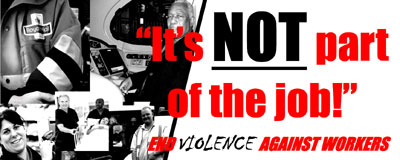
It's not part of the job - end violence against workers
UNISON Scotland wants to end violent attacks on public service workers
UNISON Scotland, along with other unions and the STUC, has supported Hugh Henry, Labour MSP for Paisley South, in promoting the Protection of Workers (Scotland) Bill. This will make it an offence for anyone to assault a public service worker carrying out their job or because of the job they do.
The Bill's first stage debate was expected to be in January 2011 but has been brought forward to Wednesday 22 December 2010 - this Wednesday - in the Scottish Parliament.
You can help by urging your MSPs (including your regional list MSPs) to support the Bill.
Send emails - click here
.
Click here to take action now! Email all of your MSPs for support
UNISON Scotland wants to end violent attacks on public service workers
UNISON Scotland, along with other unions and the STUC, has supported Hugh Henry, Labour MSP for Paisley South, in promoting the Protection of Workers (Scotland) Bill. This will make it an offence for anyone to assault a public service worker carrying out their job or because of the job they do.
The Bill's first stage debate was expected to be in January 2011 but has been brought forward to Wednesday 22 December 2010 - this Wednesday - in the Scottish Parliament.
You can help by urging your MSPs (including your regional list MSPs) to support the Bill.
Send emails - click here
.
Thursday, 9 December 2010
UNISON Scotland attacks council grant cuts
Thursday 9 December 2010
UNISON, Scotland’s largest local government trade union, today attacked the grant settlement for local government as bad for services, communities and democracy.
The settlement means a cut of 5.5% in real terms. Councils are given a classic Hobson’s choice. A cut of 2.6% if they accept the Government’s priorities, or a 6.4% cut if they don’t. If any council wanted to bridge the gap with a Council Tax rise they would need an increase of between 15% and 18%. Not a realistic political prospect for any council.
UNISON Scottish Secretary Mike Kirby said:
“This settlement will damage essential services and the local economy. It also heralds a return to ring fencing and a major attack on local democracy. Councils are being turned into the administrative arm of central government.”
The main Scottish Government priority is the Council Tax freeze. This undermines local democracy and the shortfall is increasingly being made up by charges for services. This disproportionally hits low income households who rely on council services, yet it is the wealthiest who gain most from this real terms tax cut.
Mike Kirby said:
“The Council Tax freeze is simply not viable in the current financial climate. It supports wealthy homeowners at the expense of those who rely most on local services. The Scottish Government is keen to talk up this tax cut as part of its election strategy, but less keen to identify the services that will be cut to pay for it.”
The actual financial impact on local services will be greater than this allocation implies. Councils are already planning budget cuts and job losses over and above this grant settlement due to higher inflation, reducing income, rebuilding balances and demand for services in a recession.
UNISON Scotland will be calling on councils to protect services by setting a needs budget and publishing local economic and equality impact assessments.
ends
For further information please contact:
Mike Kirby (Scottish Secretary) 07939 143355
Dave Watson (Scottish Organiser) 07958 122409
.
UNISON, Scotland’s largest local government trade union, today attacked the grant settlement for local government as bad for services, communities and democracy.
The settlement means a cut of 5.5% in real terms. Councils are given a classic Hobson’s choice. A cut of 2.6% if they accept the Government’s priorities, or a 6.4% cut if they don’t. If any council wanted to bridge the gap with a Council Tax rise they would need an increase of between 15% and 18%. Not a realistic political prospect for any council.
UNISON Scottish Secretary Mike Kirby said:
“This settlement will damage essential services and the local economy. It also heralds a return to ring fencing and a major attack on local democracy. Councils are being turned into the administrative arm of central government.”
The main Scottish Government priority is the Council Tax freeze. This undermines local democracy and the shortfall is increasingly being made up by charges for services. This disproportionally hits low income households who rely on council services, yet it is the wealthiest who gain most from this real terms tax cut.
Mike Kirby said:
“The Council Tax freeze is simply not viable in the current financial climate. It supports wealthy homeowners at the expense of those who rely most on local services. The Scottish Government is keen to talk up this tax cut as part of its election strategy, but less keen to identify the services that will be cut to pay for it.”
The actual financial impact on local services will be greater than this allocation implies. Councils are already planning budget cuts and job losses over and above this grant settlement due to higher inflation, reducing income, rebuilding balances and demand for services in a recession.
UNISON Scotland will be calling on councils to protect services by setting a needs budget and publishing local economic and equality impact assessments.
ends
For further information please contact:
Mike Kirby (Scottish Secretary) 07939 143355
Dave Watson (Scottish Organiser) 07958 122409
.
Saturday, 4 December 2010
More must be done to protect our ‘Cinderella’ services, says UNISON
UNISON’s general secretary Dave Prentis says more must be done to protect our ‘Cinderella’ services.
Dave Prentis will make the call at the meeting of UNISON’s Scottish Council – which consists of representatives from all Scottish branches covering UNISON’s 160,000 members – today (Saturday).
He will tell members: “Not everything that is valuable is popular. Not everything that transforms lives wins applause. “Will those working with young offenders be as popular as those who work in childcare? Will people supporting drug users be as voter friendly as paramedics? Who will speak up for the ‘Cinderella’ services?
“Who will champion what is right, not just what is popular? I’ll tell you who. We will. We will speak up for the vulnerable. We will stand shoulder to shoulder with those who work in public services, and those who rely on them.”
Dave Prentis will also pay tribute to Matt Smith who is stepping down as Scottish Secretary with UNISON Scotland. Matt has almost 40 years dedicated service to the trade union movement and has held the position of Scottish Secretary since UNISON was formed in 1993.
· Matt Smith, 58, has led UNISON Scotland as Scottish Secretary since it was created in 1993 and is the only one to have held the post. Over the years, Matt has worked to promote policies which advance the interests of members, particularly in relation to low pay and equal pay. He has also played a pivotal part in championing the role of trade unions and ensuring their relevance as a major stakeholder in civic society. In 2004, Matt was awarded an OBE in recognition of his contribution to trade unionism.
Dave Prentis will make the call at the meeting of UNISON’s Scottish Council – which consists of representatives from all Scottish branches covering UNISON’s 160,000 members – today (Saturday).
He will tell members: “Not everything that is valuable is popular. Not everything that transforms lives wins applause. “Will those working with young offenders be as popular as those who work in childcare? Will people supporting drug users be as voter friendly as paramedics? Who will speak up for the ‘Cinderella’ services?
“Who will champion what is right, not just what is popular? I’ll tell you who. We will. We will speak up for the vulnerable. We will stand shoulder to shoulder with those who work in public services, and those who rely on them.”
Dave Prentis will also pay tribute to Matt Smith who is stepping down as Scottish Secretary with UNISON Scotland. Matt has almost 40 years dedicated service to the trade union movement and has held the position of Scottish Secretary since UNISON was formed in 1993.
· Matt Smith, 58, has led UNISON Scotland as Scottish Secretary since it was created in 1993 and is the only one to have held the post. Over the years, Matt has worked to promote policies which advance the interests of members, particularly in relation to low pay and equal pay. He has also played a pivotal part in championing the role of trade unions and ensuring their relevance as a major stakeholder in civic society. In 2004, Matt was awarded an OBE in recognition of his contribution to trade unionism.
Friday, 3 December 2010
UNISON condemns job losses in forensic services across Scotland
UNISON Scotland has condemned the Government’s decision to cut 74 highly skilled forensic and fingerprint jobs in Scotland.
Justice Secretary Kenny MacAskill announced his plans for the future of Scotland’s forensics services yesterday (Thursday), which will mean a move away from four forensic labs – in Aberdeen, Edinburgh, Glasgow and Dundee – to two super-labs, supported by four ‘satellite’ units.
The Scottish Police Services Authority (SPSA) issued an options paper to its staff in July this year outlining possible ways of modernising forensic services in Scotland.
UNISON has consistently argued that the only viable option was to retain services in all four cities.
UNISON’s Regional Organiser Peter Veldon said: “UNISON condemns the loss of 74 highly skilled forensic and fingerprint jobs from the SPSA. The reduction will affect the quality of service in drug analysis in these areas and across Scotland. We would have preferred no job losses at present until decisions are made on the future shape of policing in Scotland and the requirements needed by the new police service on forensic services.
“We would welcome a genuine review in 18 months, but are concerned this is code for a future attempt to cut services in Edinburgh and Aberdeen.”
Justice Secretary Kenny MacAskill announced his plans for the future of Scotland’s forensics services yesterday (Thursday), which will mean a move away from four forensic labs – in Aberdeen, Edinburgh, Glasgow and Dundee – to two super-labs, supported by four ‘satellite’ units.
The Scottish Police Services Authority (SPSA) issued an options paper to its staff in July this year outlining possible ways of modernising forensic services in Scotland.
UNISON has consistently argued that the only viable option was to retain services in all four cities.
UNISON’s Regional Organiser Peter Veldon said: “UNISON condemns the loss of 74 highly skilled forensic and fingerprint jobs from the SPSA. The reduction will affect the quality of service in drug analysis in these areas and across Scotland. We would have preferred no job losses at present until decisions are made on the future shape of policing in Scotland and the requirements needed by the new police service on forensic services.
“We would welcome a genuine review in 18 months, but are concerned this is code for a future attempt to cut services in Edinburgh and Aberdeen.”
Adverse weather updates
09.10 Scottish Local Government Conference, Social night and Scottish Council are going ahead as planned.
Wednesday, 1 December 2010
False Economy website and video: why the cuts are wrong

Check out the False Economy website http://falseeconomy.org.uk/ from the people who brought you The Other Taxpayer's Alliance http://www.taxpayersalliance.org - the good one! And here's their video about Why the cuts are wrong.
Why cuts are the wrong cure from False Economy on Vimeo.
More on Scotland from STUC's There Is A Better Way
and UNISON Scotland's Public Works
.
Tuesday, 30 November 2010
UNISON Scotland attacks police budget plan
UNISON Scotland will issue a stark warning to MSPs today – cut police staff and you cut frontline services.
The union will tell Holyrood’s Justice Committee that reducing the number of police staff will result in a reduction of services, less police officers on the beat and a potential increase in crime in local communities. It has also branded the Government’s plans to recruit 1,000 additional police officers as nothing more than a “cosmetic political exercise”.
Police boards currently face a real terms cut of at least six per cent and, as police numbers have to be maintained, the cuts will fall almost entirely on police (civilian) staff. Boards have also reported that, as a consequence, they will have to backfill civilian posts with police officers.
UNISON’s Scottish Organiser Dave Watson said: “Police staff deliver a wide range of routine, complex and specialised functions that are central to modern day police forces, while allowing uniformed officers to concentrate on operational policing duties.
“Maintaining an additional 1,000 police officers in this budget is a purely cosmetic political exercise. In practice, even more police officers will be taken off the street to perform tasks they are unsuited or unqualified to do - at a huge additional cost to the taxpayer.”
Many forces in Scotland are already way behind in the efficient deployment of police staffs. In England, 39% of police personnel are civilians (32% excluding PCSOs), while in Scotland it has fallen to 26.5%. The best forces in Scotland have modernised to these levels: Dumfries & Galloway has 33% while outdated Strathclyde can only manage 25%.
He added: “This budget means that efficient forces like Dumfries & Galloway will be dragged down to the levels of the worst; like Strathclyde who have large numbers of police officers behind a desk rather than fighting crime.
“Focusing cuts on police staffs will have serious implications for policing across Scotland and it is vital that we protect the ability to deliver our frontline services.”
The union will tell Holyrood’s Justice Committee that reducing the number of police staff will result in a reduction of services, less police officers on the beat and a potential increase in crime in local communities. It has also branded the Government’s plans to recruit 1,000 additional police officers as nothing more than a “cosmetic political exercise”.
Police boards currently face a real terms cut of at least six per cent and, as police numbers have to be maintained, the cuts will fall almost entirely on police (civilian) staff. Boards have also reported that, as a consequence, they will have to backfill civilian posts with police officers.
UNISON’s Scottish Organiser Dave Watson said: “Police staff deliver a wide range of routine, complex and specialised functions that are central to modern day police forces, while allowing uniformed officers to concentrate on operational policing duties.
“Maintaining an additional 1,000 police officers in this budget is a purely cosmetic political exercise. In practice, even more police officers will be taken off the street to perform tasks they are unsuited or unqualified to do - at a huge additional cost to the taxpayer.”
Many forces in Scotland are already way behind in the efficient deployment of police staffs. In England, 39% of police personnel are civilians (32% excluding PCSOs), while in Scotland it has fallen to 26.5%. The best forces in Scotland have modernised to these levels: Dumfries & Galloway has 33% while outdated Strathclyde can only manage 25%.
He added: “This budget means that efficient forces like Dumfries & Galloway will be dragged down to the levels of the worst; like Strathclyde who have large numbers of police officers behind a desk rather than fighting crime.
“Focusing cuts on police staffs will have serious implications for policing across Scotland and it is vital that we protect the ability to deliver our frontline services.”
Monday, 29 November 2010
STUC: There is a Better Way Campaign to be debated in the Scottish Parliament
From STUC, Mon 29 Nov 2010:
"The STUC's 'There is a Better Way Campaign' will be debated in the Scottish Parliament on Thursday 2nd December at 5pm. Elaine Smith MSP has tabled a Member’s motion for debate. This has received considerable support.
"Please contact your MSPs (regional and constituency) to urge them to attend the session at Parliament. If your MSPs have not yet signed the Motion, please ask them to do so."
Scottish Parliament Resolution S3M-07227
Elaine Smith (Coatbridge and Chryston) (Scottish Labour):
There Is a Better Way
That the Parliament commends the STUC on the launch of its There is a Better Way campaign; believes that deep, savage and immediate cuts are neither unavoidable nor inevitable and that they would actually threaten economic recovery *across Scotland and in areas such as Coatbridge and Chryston*; further believes that a sensible and sustainable response to the current economic crisis is to promote growth and ensure fairness through creating jobs and protecting services, through fair taxation and a living wage, and *would welcome widespread support for the STUC campaign*.
Supported by: Bill Butler, Dr Bill Wilson, Jackie Baillie, Patrick Harvie, Pauline McNeill, John Park, Patricia Ferguson, Marlyn Glen, Rt Hon George Foulkes, Rhona Brankin, Bill Kidd, Cathy Jamieson, Mary Mulligan, Mr Frank McAveety, Ken Macintosh, Michael McMahon, Bob Doris, Sandra White, Sarah Boyack, Karen Whitefield, Dr Elaine Murray, Charlie Gordon, Rhoda Grant, Des McNulty, David Whitton, James Kelly, Cathy Peattie, Malcolm Chisholm, Brian Adam, Jamie Hepburn, Maureen Watt, Hugh Henry, Linda Fabiani, Stuart McMillan, Joe FitzPatrick, Marilyn Livingstone, Dave Thompson, Robin Harper
You can find your MSPs here:
http://www.scottish.parliament.uk/msp/membersPages/MSPAddressPostcodeFinder.htm
You could also supply your MSPs with additional information about the impact of public spending cuts locally and in your industry, and encourage them to raise particular points in the debate on Thursday in the Parliament.
In the Member’s parliamentary debate there is no vote taken, but a Scottish Government Minister will respond to points raised in the discussion.
ATTEND THE DEBATE 5pm THURSDAY 2nd DECEMBER
Please also encourage your members to come along and fill the public gallery. This will help raise the profile of the campaign and highlight the concerns of many groups and trade unions in Scotland.
Details for Visitor tickets to the Parliament :
http://www.scottish.parliament.uk/vli/visitingHolyrood/chamberTickets.htm#chambertickets
PLEASE PASS THIS INFORMATION ON, THANK YOU
Ann Henderson
Assistant Secretary
STUC
Mobile: 07875 208167
Email: ahenderson@stuc.org.uk
.
"The STUC's 'There is a Better Way Campaign' will be debated in the Scottish Parliament on Thursday 2nd December at 5pm. Elaine Smith MSP has tabled a Member’s motion for debate. This has received considerable support.
"Please contact your MSPs (regional and constituency) to urge them to attend the session at Parliament. If your MSPs have not yet signed the Motion, please ask them to do so."
Scottish Parliament Resolution S3M-07227
Elaine Smith (Coatbridge and Chryston) (Scottish Labour):
There Is a Better Way
That the Parliament commends the STUC on the launch of its There is a Better Way campaign; believes that deep, savage and immediate cuts are neither unavoidable nor inevitable and that they would actually threaten economic recovery *across Scotland and in areas such as Coatbridge and Chryston*; further believes that a sensible and sustainable response to the current economic crisis is to promote growth and ensure fairness through creating jobs and protecting services, through fair taxation and a living wage, and *would welcome widespread support for the STUC campaign*.
Supported by: Bill Butler, Dr Bill Wilson, Jackie Baillie, Patrick Harvie, Pauline McNeill, John Park, Patricia Ferguson, Marlyn Glen, Rt Hon George Foulkes, Rhona Brankin, Bill Kidd, Cathy Jamieson, Mary Mulligan, Mr Frank McAveety, Ken Macintosh, Michael McMahon, Bob Doris, Sandra White, Sarah Boyack, Karen Whitefield, Dr Elaine Murray, Charlie Gordon, Rhoda Grant, Des McNulty, David Whitton, James Kelly, Cathy Peattie, Malcolm Chisholm, Brian Adam, Jamie Hepburn, Maureen Watt, Hugh Henry, Linda Fabiani, Stuart McMillan, Joe FitzPatrick, Marilyn Livingstone, Dave Thompson, Robin Harper
You can find your MSPs here:
http://www.scottish.parliament.uk/msp/membersPages/MSPAddressPostcodeFinder.htm
You could also supply your MSPs with additional information about the impact of public spending cuts locally and in your industry, and encourage them to raise particular points in the debate on Thursday in the Parliament.
In the Member’s parliamentary debate there is no vote taken, but a Scottish Government Minister will respond to points raised in the discussion.
ATTEND THE DEBATE 5pm THURSDAY 2nd DECEMBER
Please also encourage your members to come along and fill the public gallery. This will help raise the profile of the campaign and highlight the concerns of many groups and trade unions in Scotland.
Details for Visitor tickets to the Parliament :
http://www.scottish.parliament.uk/vli/visitingHolyrood/chamberTickets.htm#chambertickets
PLEASE PASS THIS INFORMATION ON, THANK YOU
Ann Henderson
Assistant Secretary
STUC
Mobile: 07875 208167
Email: ahenderson@stuc.org.uk
.
UNISON welcomes ‘living wage’ announcement by council
UNISON Scotland has warmly welcomed an announcement by West Dunbartonshire Council to introduce a Living Wage for its staff.
West Dunbartonshire Council is only the second local authority in Scotland to introduce the Living Wage, following Glasgow City Council who introduced it in 2009. The move means that none if its employees will be paid less than £7.15 per hour and will result in a pay-rise for around 400 low-paid workers.
The Scottish Living Wage Campaign (SLWC) is supported by a range of community, trade union and campaigning organisations including UNISON, the Scottish Trade Union Congress (STUC), the Poverty Alliance, the Scottish Churches Social Inclusion Network and the Scottish Interfaith Council. Since the establishment of the SLWC, UNISON Scotland has been represented in the campaign as well as campaigning politically for the adoption of the campaign objectives with political parties and the Scottish Government.
Denise McLafferty, from UNISON’s West Dunbartonshire branch, said: “We are pleased to see that West Dunbartonshire Council has decided to introduce a Living Wage for its employees. Low pay is a very real problem for hundreds of thousands of workers across the country and it’s only right that workers get paid a fair day’s pay for a fair day's work.
“The existence of so many low paid jobs traps individuals and families in poverty, denying them opportunities and choices that should be for everyone in a country as wealthy as Scotland. We hope this move will help persuade other employers in the public, private and voluntary sectors to raise the salaries of low-paid staff.”
West Dunbartonshire Council is only the second local authority in Scotland to introduce the Living Wage, following Glasgow City Council who introduced it in 2009. The move means that none if its employees will be paid less than £7.15 per hour and will result in a pay-rise for around 400 low-paid workers.
The Scottish Living Wage Campaign (SLWC) is supported by a range of community, trade union and campaigning organisations including UNISON, the Scottish Trade Union Congress (STUC), the Poverty Alliance, the Scottish Churches Social Inclusion Network and the Scottish Interfaith Council. Since the establishment of the SLWC, UNISON Scotland has been represented in the campaign as well as campaigning politically for the adoption of the campaign objectives with political parties and the Scottish Government.
Denise McLafferty, from UNISON’s West Dunbartonshire branch, said: “We are pleased to see that West Dunbartonshire Council has decided to introduce a Living Wage for its employees. Low pay is a very real problem for hundreds of thousands of workers across the country and it’s only right that workers get paid a fair day’s pay for a fair day's work.
“The existence of so many low paid jobs traps individuals and families in poverty, denying them opportunities and choices that should be for everyone in a country as wealthy as Scotland. We hope this move will help persuade other employers in the public, private and voluntary sectors to raise the salaries of low-paid staff.”
Sunday, 28 November 2010
UNISON branches on STUC St Andrew's Day march against racism and fascism

UNISON Scotland Kinneil Brass Band on the St Andrew's Day March
UNISON Scotland's Edinburgh and Glasgow branches and the Kinneil Brass band were to the fore once again at this year's STUC March and Rally against racism and fascism in Glasgow.
The event took place on Saturday 27 November, in a combination of sunshine, snow and freezing temperatures. Around two thousand people joined the march to demonstrate value of unity amongst races and cultures in Scotland and to protest against the fascist and racist BNP, and their unwelcome acolytes the Scottish and English Defence Leagues.


More pics of the march at UNISON Scotland Picasa gallery
.
Friday, 26 November 2010
Suicide bids stopped by award-winning council scheme
UNISON members at City of Edinburgh Council, who have successfully prevented potential suicides at a social housing block, have been recognised at the Guardian Public Services Awards 2010.
Staff on one of the council’s high-rise estates had been struggling to cope with at-risk tenants until a suicide prevention initiative was set up. More than 200 people in the frontline team have now been trained to spot signs of mental illness and a multi-agency mental health awareness group, including police, social services and NHS members, has been formed.
The initiative was launched after the Edinburgh Tenants Federation raised serious concerns with council landlords about the risk of suicides and the scheme has prevented at least four deaths since.
Personal information on residents and their support needs is now available to staff and information leaflets on mental health services have been delivered to all the council’s high-rise blocks.
The City of Edinburgh Council received the award for Skills Development in the Innovation and Progress category.
UNISON member Michael McCrossan, senior officer for services for communities, said:
“We are over the moon to have received the Guardian award and believe that the initiative has had a huge effect on the lives of council tenants.
“Mental health awareness is extremely important, especially for those living in high-rise buildings, which can be very isolating and lonely.
“It is vital to keep talking to local people, who can raise concerns and help develop the scheme.
“We hope to continue with the good work and prevent many more tragedies.”
Dave Prentis, UNISON’s General Secretary, said:
“It is a huge honour for the team to win this award, as it is such a ground-breaking initiative.
“Training staff to identify problems and have the confidence to deal with them, can clearly help save lives.
“This scheme shows how important it is to empower workers through training.”
Staff on one of the council’s high-rise estates had been struggling to cope with at-risk tenants until a suicide prevention initiative was set up. More than 200 people in the frontline team have now been trained to spot signs of mental illness and a multi-agency mental health awareness group, including police, social services and NHS members, has been formed.
The initiative was launched after the Edinburgh Tenants Federation raised serious concerns with council landlords about the risk of suicides and the scheme has prevented at least four deaths since.
Personal information on residents and their support needs is now available to staff and information leaflets on mental health services have been delivered to all the council’s high-rise blocks.
The City of Edinburgh Council received the award for Skills Development in the Innovation and Progress category.
UNISON member Michael McCrossan, senior officer for services for communities, said:
“We are over the moon to have received the Guardian award and believe that the initiative has had a huge effect on the lives of council tenants.
“Mental health awareness is extremely important, especially for those living in high-rise buildings, which can be very isolating and lonely.
“It is vital to keep talking to local people, who can raise concerns and help develop the scheme.
“We hope to continue with the good work and prevent many more tragedies.”
Dave Prentis, UNISON’s General Secretary, said:
“It is a huge honour for the team to win this award, as it is such a ground-breaking initiative.
“Training staff to identify problems and have the confidence to deal with them, can clearly help save lives.
“This scheme shows how important it is to empower workers through training.”
MSPs Failing to protect workers from violence says UNISON
UNISON Scotland today responded angrily to the announcement by the Economy, Energy and Tourism Committee (EET) that they will recommend to the Parliament that the general principles of the Protection of Workers Bill are not agreed to.
UNISON Scottish Organiser Dave Watson said:
“The nearly 30,000 public service workers subjected to recorded violent incidents last year will today feel badly let down by the majority of MSPs on the committee who reached this decision. They will be joined by many thousands of other workers subjected to violence in the workplace who need Parliament to take action to protect them.”
“UNISON has always accepted that legislation is only part of the solution. But to argue that the current criminal law is adequate, when the prosecution authorities don’t even keep statistics, is a less than adequate response.”
UNISON Scotland welcomes the recommendations urging the prosecution authorities to take this issue more seriously, introduce new guidelines and to collect proper data. However, this has been identified as an issue over many years and little has happened. Meanwhile every year more workers are assaulted.
UNISON Scotland will be calling on MSP’s to reject this recommendation and approve the general principles of the Bill when it is debated in the chamber early next year.
.
UNISON Scottish Organiser Dave Watson said:
“The nearly 30,000 public service workers subjected to recorded violent incidents last year will today feel badly let down by the majority of MSPs on the committee who reached this decision. They will be joined by many thousands of other workers subjected to violence in the workplace who need Parliament to take action to protect them.”
“UNISON has always accepted that legislation is only part of the solution. But to argue that the current criminal law is adequate, when the prosecution authorities don’t even keep statistics, is a less than adequate response.”
UNISON Scotland welcomes the recommendations urging the prosecution authorities to take this issue more seriously, introduce new guidelines and to collect proper data. However, this has been identified as an issue over many years and little has happened. Meanwhile every year more workers are assaulted.
UNISON Scotland will be calling on MSP’s to reject this recommendation and approve the general principles of the Bill when it is debated in the chamber early next year.
.
Saturday, 20 November 2010
Organising to speak up for public services
 |
| Mobilise! New Media module |
Focussing on organisation, the event is pulling together a range of campaigning and bargaining tools, including media skills, ‘know your rights’, strategic campaigning, public speaking, involving members, equality issues, new media, economic briefings and myth-busting – along with more esoteric sessions on comedy skills and political song.
An exhibition on trade union history provided the backdrop last night to an evening of ‘inspirational dance’ and tonight’s entertainment includes Carol Laula (who is also doing a music workshop) and one of the masters of political song, Arthur Johnstone.
Opening the event, UNISON Scottish Convener Mike Kirby stressed the need to engage with members and get the arguments across that there is an alternative to the cuts.
The cuts were ideological, not based on financial need. It was a concerted attack on public services and the welfare state that was designed to be ‘irreversible’.
“I don’t like to get personal in political arguments”, said Mike, “But it is hard not to when you see the attacks from a cabinet that thinks poverty is another country”.
It was unlikely that the cabinet millionaires would ever have to worry about the electricity bill or about whether their children could ever afford to go to university or whether they can afford to pay for care for their relatives or themselves.
And the cuts were disproportionately affecting women. Women as public service workers, as service users and as carers, added Mike.
Trade unions and communities had to equip themselves with the arguments to challenge the cuts. But there will come a time – when people are ready, when they see the full force of the cuts – that the “force of argument” will have to move to the “argument of force” through action.
Mike stressed this had to be united action. It must not be seen as public versus private – a problem in the initial stages of the campaign in Ireland. For every public service job lost, another is lost in the private sector. This needed to be a united campaign of all workers and communities acting together.
The event continues through today, finishing at lunchtime on Sunday.
Thursday, 18 November 2010
Budget statement - UNISON Scotland initial response
The Scottish Government's commitment to a Living Wage is welcome. But they show little understanding of the reality of life for those on modest incomes. Low paid workers providing public services face increased pension contributions, housing benefit cuts and increasing inflation on essentials such as food and heating costs. That all adds up, not to a pay freeze, but a very real cut in living standards.
Any commitment to avoid compulsory redundancies is welcome, but is far from clear whether this can be delivered. Areas such as local Government are outwith direct Scottish Government control - and the budget document itself discusses lowering staff numbers as a way of implementing cuts. We are appalled at the retention of the Council Tax Freeze - a policy that has already Scottish Local Authorities in excess of £150million. Councils will - as they have been doing already - attempt to plug the gap left by reducing services and increasing charges. This has a disproportionate impact on the low paid - who are also the people who save least from freezing Council Tax.
Local authorities are being offered Hobson's Choice by The Scottish Government. They can accept a cut of 2.6% by signing up to a whole range of Scottish government priorities - or assert their independence and take a reduction of 6.4% - which would mean either decimating services or a Council Tax rise in double figures.
The Scottish Government announce that police numbers will be maintained but neglects to mention that increasing numbers of uniformed officers will be employed on administrative and specialist tasks as Police (civilian) staffs are cut. It is a waste of public money and a cosmetic political exercise to keep police numbers up this way when the public rightly expect them to be visible on the streets.
Mr Swinney should be more honest with the public. When he says efficiency savings of 3% what he means is 'cut'. There is a difference between reducing the budget and being more efficient. Where is the efficiency in a smaller number of people delivering a poorer service?
Despite protesting otherwise Mr Swinney has announced the return of PFI - via his non profit distributing model. This is essentially PFI lite. What he failed to make clear today is the long term impact on revenue budgets by using this model.
Funding capital projects through revenue budgets means long term pain for short term gain.
Women come off badly in this budget. In the equality statement accompanying the budget the issue of unequal pay is largely avoided. There are observations about segregation in the workforce and overall pay gaps but it seems to contains nothing on equal pay litigation in public services other than a commitment to conduct pay reviews for government staff. There appear to be no funds, no capitalisation and no action on the audits that have shown the scale of the problem.
Speaking after the announcement UNISON Scotland Convener Mike Kirby said "John Swinney spoke about choices today - and he made the wrong ones. His pay freeze amounts to a real terms wage cut for many modestly paid people in Scotland. Public Service workers in Scotland face a double whammy, as workers many will see a pay cut. And as service users they will find they are paying more for services that will become ever more threadbare"
ENDS
Notes for editors UNISON Scotland will publish analysis of the Budget Statement in the coming days
Any commitment to avoid compulsory redundancies is welcome, but is far from clear whether this can be delivered. Areas such as local Government are outwith direct Scottish Government control - and the budget document itself discusses lowering staff numbers as a way of implementing cuts. We are appalled at the retention of the Council Tax Freeze - a policy that has already Scottish Local Authorities in excess of £150million. Councils will - as they have been doing already - attempt to plug the gap left by reducing services and increasing charges. This has a disproportionate impact on the low paid - who are also the people who save least from freezing Council Tax.
Local authorities are being offered Hobson's Choice by The Scottish Government. They can accept a cut of 2.6% by signing up to a whole range of Scottish government priorities - or assert their independence and take a reduction of 6.4% - which would mean either decimating services or a Council Tax rise in double figures.
The Scottish Government announce that police numbers will be maintained but neglects to mention that increasing numbers of uniformed officers will be employed on administrative and specialist tasks as Police (civilian) staffs are cut. It is a waste of public money and a cosmetic political exercise to keep police numbers up this way when the public rightly expect them to be visible on the streets.
Mr Swinney should be more honest with the public. When he says efficiency savings of 3% what he means is 'cut'. There is a difference between reducing the budget and being more efficient. Where is the efficiency in a smaller number of people delivering a poorer service?
Despite protesting otherwise Mr Swinney has announced the return of PFI - via his non profit distributing model. This is essentially PFI lite. What he failed to make clear today is the long term impact on revenue budgets by using this model.
Funding capital projects through revenue budgets means long term pain for short term gain.
Women come off badly in this budget. In the equality statement accompanying the budget the issue of unequal pay is largely avoided. There are observations about segregation in the workforce and overall pay gaps but it seems to contains nothing on equal pay litigation in public services other than a commitment to conduct pay reviews for government staff. There appear to be no funds, no capitalisation and no action on the audits that have shown the scale of the problem.
Speaking after the announcement UNISON Scotland Convener Mike Kirby said "John Swinney spoke about choices today - and he made the wrong ones. His pay freeze amounts to a real terms wage cut for many modestly paid people in Scotland. Public Service workers in Scotland face a double whammy, as workers many will see a pay cut. And as service users they will find they are paying more for services that will become ever more threadbare"
ENDS
Notes for editors UNISON Scotland will publish analysis of the Budget Statement in the coming days
Tuesday, 16 November 2010
UNISON calls on Scottish government to protect public services
Date: Tuesday 16 November 2010
UNISON Scotland has called on the Scottish Government to issue a budget that protects public services and avoids the ideological cuts imposed by the UK Government.
While precise figures will not be known until the Government publishes its spending review and draft budget tomorrow (Wednesday), UNISON Scotland’s analysis of planned local budgets shows that councils and health boards are planning much greater cuts than the Scottish budget would indicate.
UNISON’s Scottish organiser Dave Watson said: "There’s a real lack of understanding about the deficit and many believe that cuts in public spending are both essential and inevitable – they’re not.
“The cuts are already impacting on service delivery while demand is increasing. Some 60,000 public sector and 65,000 private sector jobs could go in Scotland because of these cuts, costing the Treasury around £500m in lost tax revenue and £640m in increased benefit payments. This not only adds to the annual deficit, it almost entirely cancels out the saving to the public sector pay-bill. And these cuts don’t just mean job losses, they mean the loss of vital public services that we all rely on.”
The cuts will put further pressure on public bodies which are already facing increased demands on services due to the recession, reductions in income, the council tax freeze and cuts in business rates.
Dave Watson added: “We expect the Scottish Government to articulate an alternative economic approach based on the Better Way promoted by the trade unions in Scotland. This approach, based on fair taxation and cutting real waste, is more in tune with Scottish opinion than the ideological cuts imposed by the Tories and their Liberal partners.”
ends
Notes to editors
1. For more information on UNISON’s alternative to the cuts visit www.unison-scotland.org.uk/publicworks
2. Trade unionists and service users from across the country will lobby their MSPs at the Scottish Parliament tomorrow (Wednesday) ahead of the Scottish Spending Review. The STUC-organised lobby is part of the There Is A Better Way campaign. For more information visit www.thereisabetterway.org
.
UNISON Scotland has called on the Scottish Government to issue a budget that protects public services and avoids the ideological cuts imposed by the UK Government.
While precise figures will not be known until the Government publishes its spending review and draft budget tomorrow (Wednesday), UNISON Scotland’s analysis of planned local budgets shows that councils and health boards are planning much greater cuts than the Scottish budget would indicate.
UNISON’s Scottish organiser Dave Watson said: "There’s a real lack of understanding about the deficit and many believe that cuts in public spending are both essential and inevitable – they’re not.
“The cuts are already impacting on service delivery while demand is increasing. Some 60,000 public sector and 65,000 private sector jobs could go in Scotland because of these cuts, costing the Treasury around £500m in lost tax revenue and £640m in increased benefit payments. This not only adds to the annual deficit, it almost entirely cancels out the saving to the public sector pay-bill. And these cuts don’t just mean job losses, they mean the loss of vital public services that we all rely on.”
The cuts will put further pressure on public bodies which are already facing increased demands on services due to the recession, reductions in income, the council tax freeze and cuts in business rates.
Dave Watson added: “We expect the Scottish Government to articulate an alternative economic approach based on the Better Way promoted by the trade unions in Scotland. This approach, based on fair taxation and cutting real waste, is more in tune with Scottish opinion than the ideological cuts imposed by the Tories and their Liberal partners.”
ends
Notes to editors
1. For more information on UNISON’s alternative to the cuts visit www.unison-scotland.org.uk/publicworks
2. Trade unionists and service users from across the country will lobby their MSPs at the Scottish Parliament tomorrow (Wednesday) ahead of the Scottish Spending Review. The STUC-organised lobby is part of the There Is A Better Way campaign. For more information visit www.thereisabetterway.org
.
Thursday, 11 November 2010
UNISON welcomes Water Bill consultation
UNISON Scotland today welcomed the announcement of a consultation over the proposed Scottish Water Bill. The aim of the Bill remains to keep Scottish Water in public ownership, but to allow the utility to expand its operations and engage in wider activities such as renewable energy projects.
It also provides an opportunity to promote a wider vision of water resources. UNISON particularly welcomes the Minister’s commitment to retain the control of Scottish Water in public ownership.
UNISON’s Scottish Organiser Dave Watson said: “UNISON Scotland shares the long term vision that Scotland’s water is much more than the provision of a utility. It is a vital economic asset that will become even more important in the years to come. If the 20th Century was dominated by oil, then the 21st Century will be dominated by water provision. Wet countries like Scotland are well placed to exploit the economic and environmental opportunities.”
UNISON expects that the usual vested interests will use the Bill consultation to yet again argue the case for privatisation. This would involve selling off assets paid for by the taxpayer over many years at a fraction of its true value.
We would be selling off huge swathes of Scotland, almost certainly to foreign interests, together with the opportunity to exploit Scotland’s water potential for the benefit of big business rather than the people. Charge payers would face higher bills to pay for the purchase debt, fees and directors salaries.
Dave Watson added: “Those arguing for privatisation, or the Trojan horse that is mutualisation, have no vision beyond a quick profit for their companies. They are tied to a narrow privatisation ideology that Scotland rightly rejects. When communities across the world are reclaiming their water, it would be crazy for Scotland to abandon our greatest asset.”
UNISON Scotland regards the Bill consultation as an important step towards a broader approach to water in Scotland. The current approach of the Scottish Water Board and the regulatory framework can act as barrier to this larger vision for Scotland’s water.
Scotland needs a democratically accountable, strategic approach to water that is broader than simply providing a utility, important though that is. On Scottish Water much emphasis is placed on the £140m of government financing for capital in the current financial difficulties. Less well known is the fact that £90m is returned through loan repayment.
None of this would be necessary if Scottish Water had prudential borrowing powers and UNISON would argue for the early adoption of this approach. The implementation of the Calman recommendations or the relaxation of HMRC budget guidance could achieve this.
This would also enable a public service solution to the exploitation of the renewable energy opportunities, rather than another expensive ‘partnership’. We need to develop Scotland’s capacity to exploit renewable energy.
For further information please see UNISON Scotland’s Defend Scotland’s Water briefing at http://www.unison-scotland.org.uk/water/index.html
It also provides an opportunity to promote a wider vision of water resources. UNISON particularly welcomes the Minister’s commitment to retain the control of Scottish Water in public ownership.
UNISON’s Scottish Organiser Dave Watson said: “UNISON Scotland shares the long term vision that Scotland’s water is much more than the provision of a utility. It is a vital economic asset that will become even more important in the years to come. If the 20th Century was dominated by oil, then the 21st Century will be dominated by water provision. Wet countries like Scotland are well placed to exploit the economic and environmental opportunities.”
UNISON expects that the usual vested interests will use the Bill consultation to yet again argue the case for privatisation. This would involve selling off assets paid for by the taxpayer over many years at a fraction of its true value.
We would be selling off huge swathes of Scotland, almost certainly to foreign interests, together with the opportunity to exploit Scotland’s water potential for the benefit of big business rather than the people. Charge payers would face higher bills to pay for the purchase debt, fees and directors salaries.
Dave Watson added: “Those arguing for privatisation, or the Trojan horse that is mutualisation, have no vision beyond a quick profit for their companies. They are tied to a narrow privatisation ideology that Scotland rightly rejects. When communities across the world are reclaiming their water, it would be crazy for Scotland to abandon our greatest asset.”
UNISON Scotland regards the Bill consultation as an important step towards a broader approach to water in Scotland. The current approach of the Scottish Water Board and the regulatory framework can act as barrier to this larger vision for Scotland’s water.
Scotland needs a democratically accountable, strategic approach to water that is broader than simply providing a utility, important though that is. On Scottish Water much emphasis is placed on the £140m of government financing for capital in the current financial difficulties. Less well known is the fact that £90m is returned through loan repayment.
None of this would be necessary if Scottish Water had prudential borrowing powers and UNISON would argue for the early adoption of this approach. The implementation of the Calman recommendations or the relaxation of HMRC budget guidance could achieve this.
This would also enable a public service solution to the exploitation of the renewable energy opportunities, rather than another expensive ‘partnership’. We need to develop Scotland’s capacity to exploit renewable energy.
For further information please see UNISON Scotland’s Defend Scotland’s Water briefing at http://www.unison-scotland.org.uk/water/index.html
Wednesday, 3 November 2010
UNISON welcomes withdrawal of Accenture jobs threat
UNISON has today welcomed the announcement by Accenture of its withdrawal of redundancy proposals from employees working on its ScottishPower contract.
This outcome means that hundreds of employees – based in East Kilbride (South Lanarkshire) and Queensferry (North Wales) – who were facing redundancy and the insecurity of unemployment as Christmas approached can now look forward to a more stable flow of work and job security for the foreseeable future.
The announcement by Accenture follows months of detailed negations and discussions between trade unions, Accenture, ScottishPower and parent company Iberdrola.
Accenture told staff this week it had secured significant new project work and had therefore extended the scope of its support contract with ScottishPower.
Gerry Crawley, regional organiser for UNISON, said: “This is great news for our members who have gone through a difficult time and suffered a lengthy period of uncertainty about their jobs.
“This decision is testament to the hard work of all those involved, together with the support of local politicians, in preventing job losses at a time of great economic uncertainty.”
In a statement to its ScottishPower workforce, Accenture said: “We consider this to be a very positive outcome. It is a position that saves jobs for the foreseeable future and will result in a stable demand position for additional project work to at least the end of 2011 and hopefully beyond.”
This outcome means that hundreds of employees – based in East Kilbride (South Lanarkshire) and Queensferry (North Wales) – who were facing redundancy and the insecurity of unemployment as Christmas approached can now look forward to a more stable flow of work and job security for the foreseeable future.
The announcement by Accenture follows months of detailed negations and discussions between trade unions, Accenture, ScottishPower and parent company Iberdrola.
Accenture told staff this week it had secured significant new project work and had therefore extended the scope of its support contract with ScottishPower.
Gerry Crawley, regional organiser for UNISON, said: “This is great news for our members who have gone through a difficult time and suffered a lengthy period of uncertainty about their jobs.
“This decision is testament to the hard work of all those involved, together with the support of local politicians, in preventing job losses at a time of great economic uncertainty.”
In a statement to its ScottishPower workforce, Accenture said: “We consider this to be a very positive outcome. It is a position that saves jobs for the foreseeable future and will result in a stable demand position for additional project work to at least the end of 2011 and hopefully beyond.”
Tuesday, 2 November 2010
‘Now we can concentrate on defending services’ says Aberdeen’s largest public sector union
Date: 2 November 2010
UNISON, Scotland’s largest public sector trade union, says it is relieved that the long running increments row with Aberdeen City Council is now resolved, and wants to get on with defending public services in the city in the face of crippling budget proposals.
Aberdeen city councillors voted to approve the deal brokered by ACAS which means that all council staff due a pay increment in April 2010 will now receive it. The unions and the council are hopeful that all payments, including back pay, can be made before Christmas. The unions and the council have agreed to enter into immediate and meaningful talks on a range of issues connected to the Council’s budget proposals.
Karen Davidson, Branch Secretary of Aberdeen City UNISON, said: “We are relieved that council staff will now get the agreed rate of pay for their job and we are glad that this distracting issue is behind us. With-holding the increment was a breach of our contract and it affected hundreds of low paid workers who were entitled to an increment for the first time this year. Individuals will not get huge amounts of money out of this – a personal carer helping someone to stay in their own home will get £9.99 more a week after a year in the job, when she has got more skills and experience which enables her to give a better service to her clients.
“We have established a vital principle here – that employers cannot use the current tough financial climate as an excuse to break contracts of employment. Our members stood up for their rights this year and carried on doing their jobs in very difficult circumstances. Our employer now knows that they must work with their staff and the unions to achieve savings.”
Karen continued: “UNISON knows there are difficult decisions to be made in Aberdeen about the vital services that we all depend on. We want to be fully involved in the decisions about what our services should be in the future. It’s not buildings and equipment and complicated processes that ensure people get care, receive high quality education, can enjoy parks, libraries and leisure centres and have their bins emptied – all of this comes down to the commitment and effort of council workers.”
ends
.
UNISON, Scotland’s largest public sector trade union, says it is relieved that the long running increments row with Aberdeen City Council is now resolved, and wants to get on with defending public services in the city in the face of crippling budget proposals.
Aberdeen city councillors voted to approve the deal brokered by ACAS which means that all council staff due a pay increment in April 2010 will now receive it. The unions and the council are hopeful that all payments, including back pay, can be made before Christmas. The unions and the council have agreed to enter into immediate and meaningful talks on a range of issues connected to the Council’s budget proposals.
Karen Davidson, Branch Secretary of Aberdeen City UNISON, said: “We are relieved that council staff will now get the agreed rate of pay for their job and we are glad that this distracting issue is behind us. With-holding the increment was a breach of our contract and it affected hundreds of low paid workers who were entitled to an increment for the first time this year. Individuals will not get huge amounts of money out of this – a personal carer helping someone to stay in their own home will get £9.99 more a week after a year in the job, when she has got more skills and experience which enables her to give a better service to her clients.
“We have established a vital principle here – that employers cannot use the current tough financial climate as an excuse to break contracts of employment. Our members stood up for their rights this year and carried on doing their jobs in very difficult circumstances. Our employer now knows that they must work with their staff and the unions to achieve savings.”
Karen continued: “UNISON knows there are difficult decisions to be made in Aberdeen about the vital services that we all depend on. We want to be fully involved in the decisions about what our services should be in the future. It’s not buildings and equipment and complicated processes that ensure people get care, receive high quality education, can enjoy parks, libraries and leisure centres and have their bins emptied – all of this comes down to the commitment and effort of council workers.”
ends
.
Subscribe to:
Posts (Atom)