Tuesday, 11 March 2014

Procurement is key to making decent pay the norm, says UNISON

Tuesday 11 March 2014

UNISON Scotland is calling on MSPs to support an amendment to the Procurement Reform (Scotland) Bill which would make paying a living wage an essential condition of bidding for a public sector contract.

The Bill – which is being considered tomorrow (Wednesday) at stage 2 by the Infrastructure and Capital Investments Committee – will change how public contracts are handed out to businesses. Scotland spends approximately £10 billion a year on procurement and UNISON wants those employed in public contracts to be paid the living wage, currently £7.45 an hour.

While the Scottish Living Wage is working well across the public sector, many public services are outsourced to the private and voluntary sectors, including vital areas such as social care.

Cheryl McCormick, a support worker in Glasgow and vice chair of UNISON’s Scottish Community Service Group, said:

“There is an army of low-paid workers who care for the most vulnerable people in our society who earn less than the living wage, many less than the minimum wage when travelling time and sleepovers are taken into account; who are on zero hours contracts, and don’t have time to care properly.

“The people delivering these services are really struggling. A living wage would mean the difference between having to scrape by from month to month and worrying whether or not they can pay their bills, to being able to relax a little and maybe even have a little left at the end of the month.
“If decent pay is going to be the norm in Scotland, then procurement is the key to driving up employment standards.”

Currently, one in five Scots are paid below the living wage. UNISON’s Head of Bargaining and Campaigns, Dave Watson, gave oral evidence to the Westminster Scottish Affairs Committee yesterday (Monday) to express the union’s concerns over the impact of zero hours contracts on workers. He told the committee that the growth in casual employment is contributing to the growth of in-work poverty, damaging public services and the economy.

Dave added: “At a time when workers have experienced the longest  real wage squeeze since 1970, with inflation going up faster than pay for 43 months, this is the way to make a major step forward by boosting the income of many thousands more low paid families in Scotland.

“Companies are cutting corners in order to win contracts. Unless we opt for principled procurement these issues are not going to go away. We need MSPs to support the amendment to this Bill and make paying a living wage a stipulation for all public contracts, by including this in performance clauses.”

ENDS

Notes to editors
  1. For more information see our Scottish Living Wage Procurement briefing at http://www.unison-scotland.org.uk/briefings/index.html 
  1. Our briefing on the Procurement Reform (Scotland) Bill at the stage 1 debate is available here: http://www.unison-scotland.org.uk/briefings/MSPe-briefing_ProcurementReformBill_Feb2014.pdf
  1. UNISON Scotland’s Head of Bargaining and Campaigns, Dave Watson, gave oral evidence to the Westminster Scottish Affairs Committee yesterday (Monday) to express the union’s concerns over the impact of zero hours contracts on workers. He told the committee of the growing use of these contracts in the care sector and how zero-hours contracts is not only bad for workers, but bad for the services they deliver and bad for economy. For more information please see his blog athttp://unisondave.blogspot.co.uk/
  1. The Scottish Living Wage is currently £7.45 an hour and will rise to £7.65 next month.
  1. The Scottish Living Wage was one of ten asks for the Bill from a coalition of civil society organisations, including the STUC, Stop Climate Chaos Scotland and SCVO. The asks include action on blacklisting and tax dodging, a sustainable development focus and measures on ethical/fair trade, employment standards and positive social outcomes.
  1. The Scottish Living Wage is good for workers as they benefit from higher pay, improved health and motivation; good for employers as it reduces turnover, improves productivity and attracts better staff; and good for the economy as it results in lower benefit costs and less stress on the NHS.
  1. 6 in 10 children who live in poverty have at least one parent working. 550,000 adults (mostly women) in Scotland earn less than the living wage.

Friday, 28 February 2014

Douglas - It's what you do with what you've got that matters.

Douglas Alexander has gotten a lot of publicity in advance of a speech tonight where he will advocate more powers for the Scottish Parliament. Mr Alexander urges Labour's devoiution commission to 'range widely and act boldly'. But he should remember, it's not devolving powers that is bold - it's using them.

The speech is of course part of the referendum campaign. But given that much of that has been at the level of Eddi Reader v Bowie ... and not so much perfect as a godawful small affair. It should probably be welcomed.

Not that UNISON is advocating for support for either side - UNISON has not as yet formed a view about what option is the best in the independence referendum. We are looking at both sides and challenging them to show how their priorities match up with our longstanding policies and priorities. These are outlined in A Fairer Scotland. But with the parties advocating a no vote developing plans for further devolution we've also put forward our proposals as to how we'd like to see that go; we've outlined those in A Fairer Scotland and Devolution. So when Mr A calls for expanding devo to mean "considering taxation, employment and skills policy or indeed the responsibilities of the Crown Estates, or the running of elections" we should be glad that he's catching up with us.

More powers are fine, good, even welcome. But if its a different Scotland we want, it's what is done with those powers that matters. As the STUC have pointed out at length and in detail in their second A Just Scotland report. There is plenty that could be done now. Never mind with the extra powers that will be coming under the Scotland Act, or the further powers that would come with independence. There are many areas where what's been missing hasn't been constitutional authority but political will.

Mr Alexander obviously wants to make an impact and build support for his side in the referendum. It's not our place to help him with that - but here is some advice (that applies every bit as much to his opponents). Perhaps he should say not what powers he wants the parliament to have - but what he wants to see done with them..

It's only a thought, but most UNISON members will probably be more interested in what he intends doing for people - rather than what he wants to see done to Parliament. His boss Ed Miliband has talked a lot recently (and accurately) about a 'cost of living crisis. If Mr Alexander gives us a bit of detail on how he would use more powers to tackle that - it might hold attention a wee bit more than proposals for institutional engineering.

Tuesday, 25 February 2014

UNISON Scotland supports #EarthHour 2014 #BeBrilliant


UNISON Scotland is once again supporting WWF's Earth Hour, which this year takes place on Saturday 29 March 2014 at 8.30pm.

Earth Hour 2014 asks us all to #BeBrilliant for the planet. Taking part can be as simple as 'just' switching off the lights for an hour but in doing so you're part of the world's biggest celebration to highlight the need for action on climate change.

And of course everyone can take part - both at home and often at work. Many public bodies in Scotland are already involved and if your employer isn't you could ask them to sign up.

For lots more information from WWF about why we're all doing this, about taking part, and to sign up, click here.

This toolkit was developed for UNISON branches and has a range of good ideas for Earth Hour activities.

Push for European #Climate Action - Tell Cameron & Clegg to act

In March, Europe will be setting its climate targets for the next two decades. This follows the worst floods in the UK for 200 years – floods that leading scientists agree are climate related.

Stop Climate Chaos Scotland is urging supporters to email Prime Minister David Cameron and his deputy Nick Clegg to ask them to push for the ambitious action on climate change that the world needs.
The EU climate deal is a big deal and current proposals are too weak. The deal will shape Europe's carbon emissions and renewable energy development until 2030, and, if strong enough, could unlock global ambition.
Civil society, scientists, businesses and European citizens agree - we need strong climate laws to stop the worst impacts of climate change and to unlock green jobs and economic growth. The changing climate is already having an adverse effect on the world’s poorest and most vulnerable communities, on wildlife and the natural environment.
Click here to easily and quickly send an email to David Cameron and Nick Clegg.

Thursday, 20 February 2014

Public money does not belong in the hands of tax dodgers, says UNISON

UNISON is calling for an end to tax dodgers winning public contracts ahead of today’s (Thursday) parliamentary debate on the Procurement Reform (Scotland) Bill.
   In a briefing issued to all MSPs prior to the stage 1 debate, the union asks them to decide if they are on the side of the tax dodgers or if they will take action to tackle them?
    Dave Watson, UNISON Scotland’s head of bargaining and campaigns, said: “It is entirely wrong that companies who dodge paying their fair share of tax should be awarded public contracts. Almost £10bn of public money, over a quarter of the Scottish Government budget, is spent on public procurement. It is an important lever to change the behaviour of big companies who do not play by the rules”
   The union also says the Bill does not go far enough to tackle the issue of low pay.

Wednesday, 19 February 2014

It’s time to care, says UNISON as survey reveals Scotland’s care crisis

A survey of Scottish homecare workers has exposed the shocking reality of the country’s care services.

The majority of workers polled in the UNISON survey believe the service is not sufficient to meet the needs of the elderly and vulnerable people they care for – both from the time they can spend and the quality of care they can provide. Almost half of carers (44%) said they were limited to specific times to spend with their clients. One in two workers are not reimbursed for travelling between client visits, while three in four said they expected the situation to get worse over the coming year.

The survey – Scotland: It’s Time to Care – also revealed that one in ten are on zero hours contracts. This is being fuelled by the way councils commission care and is leading to worse services for the elderly and some of the most vulnerable people in our society.

Monday, 17 February 2014

EU Right to Water hearing today

Water is a public good, not a commodity. Today there will be a hearing in the European Parliament on the European Citizens Initiative – Right to Water. You can watch the debate live online.

Nearly two million people signed this initiative across Europe. It invites the European Commission to propose legislation implementing the human right to water and sanitation as recognised by the United Nations, and promoting the provision of water and sanitation as essential public services for all. The EU legislation should require governments to ensure and to provide all citizens with sufficient and clean drinking water and sanitation. In particular, it wants water supply and management of water resources not be subject to ‘internal market rules’ and that water services are excluded from liberalisation.

Dave Watson explains why this is important to Scotland. Here you can read UNISON Scotland's case for defending Scotland's water

Saturday, 15 February 2014

'Keep Glasgow's older peoples residents safe’ say UNISON members as strike action goes ahead to defend standards and wages

UNISON members across Glasgow are embarking on further strike action after discussions with the City Council this week failed to reach a settlement.

Members are on strike from 8 am on Friday 14th until Monday 17th February at 8am.

Members have been in dispute since January and this the third strike action taken by the city’s care workers in response to the council’s decision to enforce new job roles, longer shift patterns and pay cuts of up to seven per cent.

Thursday, 13 February 2014

Councils in Scotland bearing the brunt of cuts

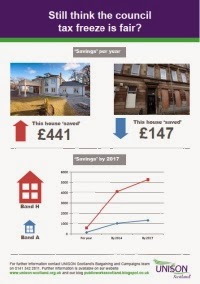
The double whammy of austerity measures and the council tax freeze has left local government in Scotland bearing the brunt of cuts.

Local councils across Scotland are setting their budgets for 2014-15. Communities across Scotland will see services being cut.

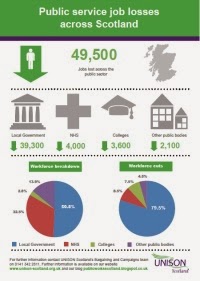
There have been 39,300 job losses in local government in Scotland out of a total of 49,500 job losses across the public sector in Scotland. Local government is the only major Scottish spending portfolio to take a cash cut since the crash.

The union says cutting any vital services – which is a direct result of UK coalition government’s unnecessary austerity measures and the Scottish government’s council tax freeze – is not the way forward. Local people should have a say in their local services and should not feel powerless in the process. It is also the most vulnerable who will be most affected.

Mark Ferguson, Chair of UNISON’s Local Government Committee, said:

Tuesday, 11 February 2014

Council budget campaign resources

As councils set their budgets for 2014, UNISON Scotland has produced three new communication materials (in pdf format) to help branches with local campaigns.

St Valentines Day Massacre. A general leaflet highlighting our key messages and actions.

An infographic on the Council Tax freeze, highlighting the regressive nature of this measure.

Public Sector Job Losses Infographic
An infographic on public sector job losses. This highlights how councils continue to take the brunt of the cuts and the job losses, well in excess of their share of the public service workforce.

Council Tax Infographic
Job Losses Infographic
More details at http://www.unison-scotland.org.uk/localgovt/budgets2014/index.html

Friday, 7 February 2014

‘Our libraries have never been under more pressure’ - UNISON Scotland

Fri 7 Feb 2014


On National Libraries Day (Saturday 8 February) UNISON warns that our libraries have never been under more pressure because of spending cuts.  National Libraries Day rounds off a week of celebrations that recognise the key role libraries play in our communities, schools, colleges, universities and in the workplace.

UNISON warns that cuts to college, university and local authority budgets has meant libraries across Scotland being forced to make cuts to opening hours and staff – and in some cases even closures.
In a UNISON survey more than 40% members reported cuts in service and two-thirds felt staffing levels in libraries were inadequate. Nearly 90% indicated public support for the service, but nearly two-thirds felt that the service was not valued.

Gray Allan, UNISON’s Falkirk Council branch secretary (and a librarian), said: 

Thursday, 6 February 2014

More Higher Education strike photos

#fairpayinHE Photos are coming in from the Scottish picket lines as UNISON HE members are taking a third day of strike action - alongside colleagues from UCU, Unite and EIS - in the increasingly bitter dispute with the higher education employers over their offer of a 1% pay rise.

Wednesday, 5 February 2014

People's Assembly Scotland speeches now on Youtube

Thanks to Cailean MacAulay and Tom Morrison, here are links to the speeches at the People's Assembly Scotland launch on 25 January.

Phil McGarry RMT Union
http://www.youtube.com/watch?v=5IxGNv4KCSE
Andrew Murray UNITE the Union
http://www.youtube.com/watch?v=z3BHhUiuEiM
Grahame Smith General Secretary STUC
http://www.youtube.com/watch?v=5DmbcEXWS1s
Ricky Tomlison Shewsbury 24
http://www.youtube.com/watch?v=gYcWFyUQ3TU
Kevin McHugh PCS Union
http://www.youtube.com/watch?v=hsL6EcRbm7U
John Stevenson UNISON Union
http://www.youtube.com/watch?v=WmAthq00DXc
Contributions from the Floor
http://www.youtube.com/watch?v=3Cu1Bq6Dfmw

Support your local library on National Libraries Day

Saturday 8 February is National Libraries Day. It rounds off a week of celebrations that recognise the key role libraries play in our communities, schools, colleges, universities and in the workplace.

As a consequence of spending cuts our libraries have never been under more pressure. While closures in Moray grabbed the headlines, there has been a salami slicing of cuts to opening hours and staff in other local authorities. In a UNISON survey more than 40% members reported cuts in service and two-thirds felt staffing levels were inadequate. Nearly 90% indicated public support for the service, but nearly two-thirds felt that the service was not valued.

As local authority budgets are set next week, further cuts are likely as councils bear the brunt of cuts in the Scottish budget.

Scottish Labour MSP Jayne Baxter has tabled the following motion in the Scottish Parliament:

S4M-08949 Jayne Baxter: Celebrating National Libraries Day—That the Parliament considers that public library services are an essential part of communities across Scotland; welcomes what it sees as the role that they play in providing access to learning for people and in serving as community hubs; believes that the professional expertise and skills of library staff are important in delivering a quality service; considers that libraries best benefit society when they are well funded and supported through strong national leadership, and joins in celebrating the importance of the work of public libraries across the UK as part of National Libraries Day, which will be marked on 8 February 2014.

Branches should encourage members to write to their MSPs urging them to support the motion. Details on how to organise or support a local event are on the National Libraries Day website. You can also tweet your support using the hashtag #NLD14

Tuesday, 4 February 2014

UNISON Fair Pay for Scotland Council Workers: Local government day of protest

UNISON Fair Pay for Scotland Council Workers: Local government day of protest: Council workers up and down the country will be taking part in activities on Tuesday 4 February to highlight the continuing scandal of low...

Monday, 3 February 2014

Pay inequality in Scotland’s universities must end, says UNISON


UNISON Scotland is calling for urgent action to be taken to redress the pay balance in universities.

The growing inequality in pay in higher education between senior managers and the workforce as a whole has been under the spotlight in the run-up to further strike action called for February 6, 2014.

The union has criticised university bosses for taking above-inflation salary increases while low-paid staff are left to pay the price. Union members across Scotland will be embarking on a day of action on Thursday to highlight that they are worth more than the 1 per cent pay rise being offered to them.

Emma Phillips, Regional Organiser for UNISON Scotland, said: “The pay balance needs to be urgently redressed.

“If the money exists to pay whopping pay rises to university bosses, then the money exists for employer’s to improve their measly current 1 per cent pay offer.

“It is the hard work of employees in higher education that support the delivery of world-class education to students, yet staff have seen a 13 per cent decrease in the value of their pay in recent years.

“Staff are being asked to do more and take home less and it’s time for universities to reverse the wage cut.”

Thursday, 30 January 2014

UNISON demonstrates against more police cuts

Thu 30 Jan 2014

The Scottish Police Authority (SPA) will officially confirm the closure of Police Force Control Centres in a ‘restructuring’ across Scotland today (Thursday 30 January 2014).

SPA are to close down 5 control centres over 18-24 months. Dumfries and Galloway in April 2014 will be first to go, with a loss of 34 jobs; then Stirling in December 2014; Glenrothes in March 2015; Pitt Street Glasgow in March 2015; Aberdeen in December 2015.

300 jobs are at risk.

Gerry Crawley, UNISON regional officer said:
"We will keep hammering the point that these closures are not about making our communities safe. 

"They are budget driven cuts. Scottish Government is cutting £139 million from police budgets between now and 2017 and £1 billion over 12 years.

"This decision to close control centres puts 300 police staff jobs at risk. These are hard working and loyal staff that bring crucial skills to keeping communities safe and they have huge amount of local knowledge which will all be lost.

"This is just part of the longer term problem. Scottish Government are hiding behind their line that they will keep police numbers. This means police staff will bear the brunt of these cuts even where this may not be the best way forward.

"Cutting jobs does not mean cutting the workload. The tasks still need to be done. More police officers will be back in the police stations rather than on the beat. It is the most expensive option."

George McIrvine UNISON police staff Scotland branch secretary said:
"If these cuts go through, the public need to understand that when they phone 101 they could be speaking to a central control centre hundreds of miles from where they are. This is on the back of the decision to shut or reducing the hours of about 60 of the 214 local police counters. There already is a lot of anger in local communities.

"We will be holding a small demonstration at the board meeting today.

"Police staff will be coming to Glasgow from as far afield as Dumfries and Galloway and Aberdeen to show how angry they are that local people feel less safe and many police families will be in hardship."

ENDS

Notes to editors

1. Police Board Scotland will make the official decision today to close down 5 control centres over 18-24 months - Dumfries and Galloway in April 2014; Stirling in December 2014; Glenrothes in March 2015; Pitt Street Glasgow in March 2015; Aberdeen in December 2015

2. UNISON Scotland police staff will listen to the debate in the public gallery and they will be holding a small demonstration outside Trades Hall, 85 Glassford Street, Glasgow, G1 1UH. UNISON members will be available for interview.

3. Police Scotland have 10 Police Control Centres in Inverness, Stirling, Dundee, Aberdeen, Glenrothers, Edinburgh, Govan, Motherwell, Glasgow Pitt Street, Dumfries and Galloway.

4. Five centres that will remain open are Dundee, Edinburgh, Motherwell, Inverness and Govan Glasgow.

5. Police control and command centres deal with 999 calls and 101 calls, some like Inverness deal with major incidents.

Tuesday, 28 January 2014

The NHS alone can't solve health inequality

UNISON Scotland Convenor, Lilian Macer, reminds us that the NHS alone cannot solve health inequality. 

In an article in the Morning Star she outlines the challenge saying, “The good news is that Scots are living longer. What has not changed is that Scots from better-off areas are living much longer while those from poorer areas are only living a little longer, and not always in good health. The gap between rich and poor in life expectancy is getting wider. The same trend is apparent in other areas of health.”

Then the solution, “A progressive tax system, increases in wages for the majority of workers, access to decent affordable housing and leisure, a system of universal benefits and services are all needed.
Only then will the multi-agency approach, beloved by governments, of bringing together policy, planning, practitioners and integrated finances, focusing on health outcome measures, be able to make inroads on health performance statistics.”


The full article can be read here.

Monday, 27 January 2014

Fair demands for a fair society – Launch of the People’s Assembly Scotland

There was standing room only as Shrewsbury 24 campaigner Ricky Tomlinson joined trade unionists and community activists in Glasgow on Saturday to launch The People’s Assembly Scotland. Building on the National People’s assembly, launched in London in 2010, the People’s Assembly Scotland will bring together unions, trade union councils and local and national campaigning groups to fight the austerity driven policies of the UK Government.

Speaking at the launch, UNISON’s John Stevenson said that the purpose of the People’s Assembly Scotland was to involve and engage, inform and educate, but most of all to organise to build justified anger, then the will and the confidence to do something about it. See full story and pics at http://unisonactive.blogspot.co.uk/2014/01/fair-demands-for-fair-society-launch-of.html

Glasgow's residential care workers embark on further strike action

Monday 27 January 2014

Care workers in Glasgow City Council’s residential homes are embarking on two further days of strike action from today (Monday).

This is the second strike action taken by the city’s care workers in response to the council’s decision to enforce new job roles, longer shift patterns and pay cuts of up to seven per cent.

UNISON Scotland, the union representing care workers, said its members had no option but to take further action.

Brian Smith, UNISON City of Glasgow Branch Secretary, said:

“UNISON members have been forced to take further strike action as the Social Work Management has made no attempt to resolve the dispute.

“The fact is that care homes would not function without the hard work and dedication of our members and to force them into this difficult position is completely unfair and unnecessary.

“Our members are only asking for what is fair: no cuts in pay, properly identified roles and responsibilities of staff and agreement on any new shift arrangements.”

ENDS

Notes to editors 


  • Further information on the strike action can be found in our press release of 13 January 'Residential home care workers strike to protect services' here http://www.unison-scotland.org.uk/news/2014/janfeb/0113.htm
     
  • Glasgow City Council plans to cut wages of residential home care workers by up to 7 per cent through the introduction of longer shift patterns. The move would affect 182 workers, out of a workforce of just over 500, with 122 full time workers on salaries of £20,000-£28,000 facing a loss of £1495 per year, while 60 part timers face a loss of £794 per year. The Council is also refusing to maintain the wages of any worker who has been in a temporary higher graded post for less than four years. UNISON views this four year criteria as unacceptably long.
     
  • Glasgow City Council wants to alter the job roles of the lowest paid workers to include the administration of medicines. This is not in their pay grade. UNISON is calling for properly identified roles and responsibilities of staff, recognition of the risks associated with any new roles staff are being asked to undertake, fair recompense for the new tasks they are being asked to do, all underpinned by proper training and support.
     
  • The strike will take place over two days on Monday, 27 and Tuesday 28 of January 2014.

Tuesday, 21 January 2014

New film about the inside story of the battle against Skye Bridge tolls


The campaign against the tolls on the Skye Bridge is the subject of a new activist documentary – ‘The Bridge Rising’ – which will premiere at the Glasgow Film Theatre on Sunday.

This year marks the tenth anniversary of the end of the tolls on the Skye Bridge. The Bridge Rising tells the inside story of the campaign for the first time. From protesters to police to politicians, from the toll-collector to the Bridge engineer, this film takes you behind closed doors.

Tuesday, 14 January 2014

Young workers vanishing from the public sector, says UNISON

Tuesday 14 January 2014

Young people are the biggest losers of public service job cuts as figures reveal the number of young workers has fallen by a quarter.

Workforce data published by Audit Scotland shows there are 1,545 people aged under 20-years-old working in Scotland’s public services, down 25 per cent since 2009.

The cuts have led to an ageing workforce. In 2013, the average age was 44 years and four months, compared with 43 years and nine months in 2009. With nearly 40 per cent retiring in the next 10-15 years – although the reality is many will leave sooner – there is a very real concern of serious skills shortages across the public sector.

2% inflation means bad news for public service workers - UNISON

Tuesday 14 January 2014

New figures showing inflation at 2.% in December brings no relief for public sector workers hit by the Government's pay freeze and squeeze, said UNISON, the UK's largest union. A fall in inflation is only positive news if earnings are keeping pace with overall inflation warned the union.

UNISON General Secretary Dave Prentis said:

"Inflation might be 2% but across the country, the reality is families are still struggling to make ends meet. There is no feeling that day to day life is improving for the vast majority.  It is only the financial elite in  the City who are looking forward to bumper bonuses this year.  The rise in the Retail Price Index to 2.7% shows the underlying cost of living crisis is getting worse.

"With transport, energy bills and  childcare cost going up, households have seen family finances significantly reduced with average earnings rising by less than the rate of inflation for the fifth year running.

“For public service workers hit hard by the Government's freeze and squeeze on their pay, 2% inflation means more hardship. Workers continue to see a squeeze in their pay and the cost of living crisis will carry on as long as their pay does not increase. It's high time the Government did something to help the millions of working families living in poverty and stopped pretending things are getting better."

UNISON UK News release: http://www.unison.org.uk/news/2-inflation-means-bad-news-for-public-sector-workers

Monday, 13 January 2014

Residential home care workers in Glasgow strike to protect services

Mon 13 Jan 2014


Care workers in Glasgow City Council’s residential homes will go on strike for two days from tomorrow (Tuesday) to resist new job roles, longer shift patterns and pay cuts of up to 7 per cent.

Brian Smith, UNISON City of Glasgow Branch Secretary, said:
“We have not taken action lightly but have no alternative. Again, we ask Glasgow City Council to work with us to reach an agreement.

“These changes will affect the vulnerable people our members care for. The lowest paid staff are being asked to take on new tasks like dispensing medicines – and at the same time they are being forced to work longer shifts and to accept massive pay cuts.”

Friday, 10 January 2014

Britain needs a pay rise

Britain needs a pay rise and Dave Watson sets out why in an article in today’s Scotsman newspaper.

British workers have experienced the longest real wage pay squeeze since 1870. Inflation has risen faster than wages for almost 43 months. The share of the economy going on wages continues to decline. In the 1960s and 1970s, up to 61 per cent of the economy went on wages. Since the 1980s, it has never gone above 56 per cent. These small percentages make a big difference to our living standards. It is no coincidence that, for the first time, we have more in-work poverty than out-of-work poverty.

Tuesday, 7 January 2014

Announcement of free healthy school lunches for all P1 to P3 children is "a huge boost"

Child poverty campaigners and trade unions including UNISON today welcomed news of free healthy school lunches for all P1 to P3 children.
First Minister Alex Salmond announced the £114 million package in the Scottish Parliament today.
It was described as “a huge boost” for children and families by the coalition of children’s charities, anti-poverty campaigners, churches and trade unions who have been campaigning for the Scottish Government to deliver on its longstanding pledge to do this.

Monday, 6 January 2014

Support the SCCS #wanttoseedouble campaign - double the funds for cycling and walking

New figures this week show commuters switching from public transport to driving, with fewer people walking to work.

That is absolutely not the direction of travel we want to see.

The SCCS #wanttoseedouble campaign is asking the Scottish Government to double the budget for active travel.

Please join in by signing up today to take part in the online action happening this Thursday, 9 January.

Through Thunderclap you can take action immediately - any time between now and Thursday - but your message (on Twitter, Facebook or Tumblr) will be sent out at the same time on 9 Jan.

The aim is to grab the attention of Finance Minister John Swinney just before he publishes his Budget Bill.

You can read here about why it is so important to boost funds for cycling and walking - for healthier lives and for climate justice.