The Protection of Workers (Scotland) Bill was defeated in the Scottish Parliament today by 75 votes to 42. Thanks to all those who sents emails to their MSPs to ask them to vote for the Bill, which was promoted by Hugh Henry MSP and supported by UNISON along with other unions and the STUC.
See reports on BBC News and STV News.
Also see UNISON Scotland Health & Safety campaign page on the Bill at www.unison-scotland.org.uk/safety/protectionofworkers/ for more info including briefings and press releases.
.

UNISON. Scotland's biggest and liveliest trade union, representing members delivering public and related services.
Wednesday, 22 December 2010
UNISON Scotland urges MSPs to support Protection of Workers Bill
Wednesday, 22 December 2010
UNISON Scotland has called on MSPs not to turn their backs on those who face violence at work, and to support a Bill to protect them.
MSPs will debate the Protection of Workers (Scotland) Bill at stage one in Parliament today (Wednesday, December 22) and will decide whether or not the Bill should proceed to stage two.
Violent incidents at work are a major problem in Scotland. UNISON Scotland’s annual Violence at Work survey highlighted more than 30,000 recorded incidents in the public sector last year alone. However, as not all violent incidents are reported, this is only the tip of the iceberg.
Last month, the Economy Energy and Tourism Committee recommended that Parliament should oppose the Bill, claiming it would not extend the protection currently available to workers under the common law. But, as the committee recognised, there is no statistical evidence that this approach works. UNISON believes incidents involving uniformed staff may be taken more seriously than the lower level – but just as traumatic – incidents which involve thousands of our members and fall below the radar of current criminal law provisions.
UNISON believes legislation is only part of the solution and must go hand-in-hand with public awareness campaigns, workplace measures and criminal legislation.
Dave Watson, UNISON’s Scottish Organiser, said: “Each year, thousands of dedicated staff providing vital services in our communities are being assaulted at work. These people deserve stronger legal protection and better protective measures and MSPs can not turn their backs on these workers.
“While legislation on its own is not enough, it is part of the solution and sends a clear message that violence against workers is unacceptable and will not be tolerated in our society. We therefore urge MSPs to take this matter seriously and to support this Bill to protect workers from violence.”
ends
Notes to editors
1. Click here to view UNISON’s Violence at Work Survey (PDF)
2. For further details on the Bill visit www.unison-scotland.org.uk/safety/index.html
For further information contact:
Dave Watson, Scottish Organiser, on 07958 122 409
Trisha Hamilton, Communications Officer, on 0141 342 2877 / 07939 478 461
.
UNISON Scotland has called on MSPs not to turn their backs on those who face violence at work, and to support a Bill to protect them.
MSPs will debate the Protection of Workers (Scotland) Bill at stage one in Parliament today (Wednesday, December 22) and will decide whether or not the Bill should proceed to stage two.
Violent incidents at work are a major problem in Scotland. UNISON Scotland’s annual Violence at Work survey highlighted more than 30,000 recorded incidents in the public sector last year alone. However, as not all violent incidents are reported, this is only the tip of the iceberg.
Last month, the Economy Energy and Tourism Committee recommended that Parliament should oppose the Bill, claiming it would not extend the protection currently available to workers under the common law. But, as the committee recognised, there is no statistical evidence that this approach works. UNISON believes incidents involving uniformed staff may be taken more seriously than the lower level – but just as traumatic – incidents which involve thousands of our members and fall below the radar of current criminal law provisions.
UNISON believes legislation is only part of the solution and must go hand-in-hand with public awareness campaigns, workplace measures and criminal legislation.
Dave Watson, UNISON’s Scottish Organiser, said: “Each year, thousands of dedicated staff providing vital services in our communities are being assaulted at work. These people deserve stronger legal protection and better protective measures and MSPs can not turn their backs on these workers.
“While legislation on its own is not enough, it is part of the solution and sends a clear message that violence against workers is unacceptable and will not be tolerated in our society. We therefore urge MSPs to take this matter seriously and to support this Bill to protect workers from violence.”
ends
Notes to editors
1. Click here to view UNISON’s Violence at Work Survey (PDF)
2. For further details on the Bill visit www.unison-scotland.org.uk/safety/index.html
For further information contact:
Dave Watson, Scottish Organiser, on 07958 122 409
Trisha Hamilton, Communications Officer, on 0141 342 2877 / 07939 478 461
.


Monday, 20 December 2010
Take action now! Email your MSPs to support Protection of Workers Bill
Latest: Protection of Workers (Scotland) Bill will be debated on Wed 22 Dec 2010...
Click here to take action now! Email all of your MSPs for support
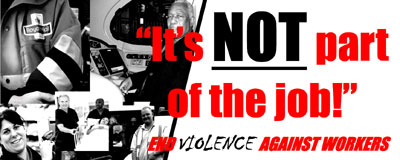
It's not part of the job - end violence against workers
UNISON Scotland wants to end violent attacks on public service workers
UNISON Scotland, along with other unions and the STUC, has supported Hugh Henry, Labour MSP for Paisley South, in promoting the Protection of Workers (Scotland) Bill. This will make it an offence for anyone to assault a public service worker carrying out their job or because of the job they do.
The Bill's first stage debate was expected to be in January 2011 but has been brought forward to Wednesday 22 December 2010 - this Wednesday - in the Scottish Parliament.
You can help by urging your MSPs (including your regional list MSPs) to support the Bill.
Send emails - click here
.
Click here to take action now! Email all of your MSPs for support
UNISON Scotland wants to end violent attacks on public service workers
UNISON Scotland, along with other unions and the STUC, has supported Hugh Henry, Labour MSP for Paisley South, in promoting the Protection of Workers (Scotland) Bill. This will make it an offence for anyone to assault a public service worker carrying out their job or because of the job they do.
The Bill's first stage debate was expected to be in January 2011 but has been brought forward to Wednesday 22 December 2010 - this Wednesday - in the Scottish Parliament.
You can help by urging your MSPs (including your regional list MSPs) to support the Bill.
Send emails - click here
.
Thursday, 9 December 2010
UNISON Scotland attacks council grant cuts
Thursday 9 December 2010
UNISON, Scotland’s largest local government trade union, today attacked the grant settlement for local government as bad for services, communities and democracy.
The settlement means a cut of 5.5% in real terms. Councils are given a classic Hobson’s choice. A cut of 2.6% if they accept the Government’s priorities, or a 6.4% cut if they don’t. If any council wanted to bridge the gap with a Council Tax rise they would need an increase of between 15% and 18%. Not a realistic political prospect for any council.
UNISON Scottish Secretary Mike Kirby said:
“This settlement will damage essential services and the local economy. It also heralds a return to ring fencing and a major attack on local democracy. Councils are being turned into the administrative arm of central government.”
The main Scottish Government priority is the Council Tax freeze. This undermines local democracy and the shortfall is increasingly being made up by charges for services. This disproportionally hits low income households who rely on council services, yet it is the wealthiest who gain most from this real terms tax cut.
Mike Kirby said:
“The Council Tax freeze is simply not viable in the current financial climate. It supports wealthy homeowners at the expense of those who rely most on local services. The Scottish Government is keen to talk up this tax cut as part of its election strategy, but less keen to identify the services that will be cut to pay for it.”
The actual financial impact on local services will be greater than this allocation implies. Councils are already planning budget cuts and job losses over and above this grant settlement due to higher inflation, reducing income, rebuilding balances and demand for services in a recession.
UNISON Scotland will be calling on councils to protect services by setting a needs budget and publishing local economic and equality impact assessments.
ends
For further information please contact:
Mike Kirby (Scottish Secretary) 07939 143355
Dave Watson (Scottish Organiser) 07958 122409
.
UNISON, Scotland’s largest local government trade union, today attacked the grant settlement for local government as bad for services, communities and democracy.
The settlement means a cut of 5.5% in real terms. Councils are given a classic Hobson’s choice. A cut of 2.6% if they accept the Government’s priorities, or a 6.4% cut if they don’t. If any council wanted to bridge the gap with a Council Tax rise they would need an increase of between 15% and 18%. Not a realistic political prospect for any council.
UNISON Scottish Secretary Mike Kirby said:
“This settlement will damage essential services and the local economy. It also heralds a return to ring fencing and a major attack on local democracy. Councils are being turned into the administrative arm of central government.”
The main Scottish Government priority is the Council Tax freeze. This undermines local democracy and the shortfall is increasingly being made up by charges for services. This disproportionally hits low income households who rely on council services, yet it is the wealthiest who gain most from this real terms tax cut.
Mike Kirby said:
“The Council Tax freeze is simply not viable in the current financial climate. It supports wealthy homeowners at the expense of those who rely most on local services. The Scottish Government is keen to talk up this tax cut as part of its election strategy, but less keen to identify the services that will be cut to pay for it.”
The actual financial impact on local services will be greater than this allocation implies. Councils are already planning budget cuts and job losses over and above this grant settlement due to higher inflation, reducing income, rebuilding balances and demand for services in a recession.
UNISON Scotland will be calling on councils to protect services by setting a needs budget and publishing local economic and equality impact assessments.
ends
For further information please contact:
Mike Kirby (Scottish Secretary) 07939 143355
Dave Watson (Scottish Organiser) 07958 122409
.
Saturday, 4 December 2010
More must be done to protect our ‘Cinderella’ services, says UNISON
UNISON’s general secretary Dave Prentis says more must be done to protect our ‘Cinderella’ services.
Dave Prentis will make the call at the meeting of UNISON’s Scottish Council – which consists of representatives from all Scottish branches covering UNISON’s 160,000 members – today (Saturday).
He will tell members: “Not everything that is valuable is popular. Not everything that transforms lives wins applause. “Will those working with young offenders be as popular as those who work in childcare? Will people supporting drug users be as voter friendly as paramedics? Who will speak up for the ‘Cinderella’ services?
“Who will champion what is right, not just what is popular? I’ll tell you who. We will. We will speak up for the vulnerable. We will stand shoulder to shoulder with those who work in public services, and those who rely on them.”
Dave Prentis will also pay tribute to Matt Smith who is stepping down as Scottish Secretary with UNISON Scotland. Matt has almost 40 years dedicated service to the trade union movement and has held the position of Scottish Secretary since UNISON was formed in 1993.
· Matt Smith, 58, has led UNISON Scotland as Scottish Secretary since it was created in 1993 and is the only one to have held the post. Over the years, Matt has worked to promote policies which advance the interests of members, particularly in relation to low pay and equal pay. He has also played a pivotal part in championing the role of trade unions and ensuring their relevance as a major stakeholder in civic society. In 2004, Matt was awarded an OBE in recognition of his contribution to trade unionism.
Dave Prentis will make the call at the meeting of UNISON’s Scottish Council – which consists of representatives from all Scottish branches covering UNISON’s 160,000 members – today (Saturday).
He will tell members: “Not everything that is valuable is popular. Not everything that transforms lives wins applause. “Will those working with young offenders be as popular as those who work in childcare? Will people supporting drug users be as voter friendly as paramedics? Who will speak up for the ‘Cinderella’ services?
“Who will champion what is right, not just what is popular? I’ll tell you who. We will. We will speak up for the vulnerable. We will stand shoulder to shoulder with those who work in public services, and those who rely on them.”
Dave Prentis will also pay tribute to Matt Smith who is stepping down as Scottish Secretary with UNISON Scotland. Matt has almost 40 years dedicated service to the trade union movement and has held the position of Scottish Secretary since UNISON was formed in 1993.
· Matt Smith, 58, has led UNISON Scotland as Scottish Secretary since it was created in 1993 and is the only one to have held the post. Over the years, Matt has worked to promote policies which advance the interests of members, particularly in relation to low pay and equal pay. He has also played a pivotal part in championing the role of trade unions and ensuring their relevance as a major stakeholder in civic society. In 2004, Matt was awarded an OBE in recognition of his contribution to trade unionism.
Friday, 3 December 2010
UNISON condemns job losses in forensic services across Scotland
UNISON Scotland has condemned the Government’s decision to cut 74 highly skilled forensic and fingerprint jobs in Scotland.
Justice Secretary Kenny MacAskill announced his plans for the future of Scotland’s forensics services yesterday (Thursday), which will mean a move away from four forensic labs – in Aberdeen, Edinburgh, Glasgow and Dundee – to two super-labs, supported by four ‘satellite’ units.
The Scottish Police Services Authority (SPSA) issued an options paper to its staff in July this year outlining possible ways of modernising forensic services in Scotland.
UNISON has consistently argued that the only viable option was to retain services in all four cities.
UNISON’s Regional Organiser Peter Veldon said: “UNISON condemns the loss of 74 highly skilled forensic and fingerprint jobs from the SPSA. The reduction will affect the quality of service in drug analysis in these areas and across Scotland. We would have preferred no job losses at present until decisions are made on the future shape of policing in Scotland and the requirements needed by the new police service on forensic services.
“We would welcome a genuine review in 18 months, but are concerned this is code for a future attempt to cut services in Edinburgh and Aberdeen.”
Justice Secretary Kenny MacAskill announced his plans for the future of Scotland’s forensics services yesterday (Thursday), which will mean a move away from four forensic labs – in Aberdeen, Edinburgh, Glasgow and Dundee – to two super-labs, supported by four ‘satellite’ units.
The Scottish Police Services Authority (SPSA) issued an options paper to its staff in July this year outlining possible ways of modernising forensic services in Scotland.
UNISON has consistently argued that the only viable option was to retain services in all four cities.
UNISON’s Regional Organiser Peter Veldon said: “UNISON condemns the loss of 74 highly skilled forensic and fingerprint jobs from the SPSA. The reduction will affect the quality of service in drug analysis in these areas and across Scotland. We would have preferred no job losses at present until decisions are made on the future shape of policing in Scotland and the requirements needed by the new police service on forensic services.
“We would welcome a genuine review in 18 months, but are concerned this is code for a future attempt to cut services in Edinburgh and Aberdeen.”
Adverse weather updates
09.10 Scottish Local Government Conference, Social night and Scottish Council are going ahead as planned.
Wednesday, 1 December 2010
False Economy website and video: why the cuts are wrong

Check out the False Economy website http://falseeconomy.org.uk/ from the people who brought you The Other Taxpayer's Alliance http://www.taxpayersalliance.org - the good one! And here's their video about Why the cuts are wrong.
Why cuts are the wrong cure from False Economy on Vimeo.
More on Scotland from STUC's There Is A Better Way
and UNISON Scotland's Public Works
.
Tuesday, 30 November 2010
UNISON Scotland attacks police budget plan
UNISON Scotland will issue a stark warning to MSPs today – cut police staff and you cut frontline services.
The union will tell Holyrood’s Justice Committee that reducing the number of police staff will result in a reduction of services, less police officers on the beat and a potential increase in crime in local communities. It has also branded the Government’s plans to recruit 1,000 additional police officers as nothing more than a “cosmetic political exercise”.
Police boards currently face a real terms cut of at least six per cent and, as police numbers have to be maintained, the cuts will fall almost entirely on police (civilian) staff. Boards have also reported that, as a consequence, they will have to backfill civilian posts with police officers.
UNISON’s Scottish Organiser Dave Watson said: “Police staff deliver a wide range of routine, complex and specialised functions that are central to modern day police forces, while allowing uniformed officers to concentrate on operational policing duties.
“Maintaining an additional 1,000 police officers in this budget is a purely cosmetic political exercise. In practice, even more police officers will be taken off the street to perform tasks they are unsuited or unqualified to do - at a huge additional cost to the taxpayer.”
Many forces in Scotland are already way behind in the efficient deployment of police staffs. In England, 39% of police personnel are civilians (32% excluding PCSOs), while in Scotland it has fallen to 26.5%. The best forces in Scotland have modernised to these levels: Dumfries & Galloway has 33% while outdated Strathclyde can only manage 25%.
He added: “This budget means that efficient forces like Dumfries & Galloway will be dragged down to the levels of the worst; like Strathclyde who have large numbers of police officers behind a desk rather than fighting crime.
“Focusing cuts on police staffs will have serious implications for policing across Scotland and it is vital that we protect the ability to deliver our frontline services.”
The union will tell Holyrood’s Justice Committee that reducing the number of police staff will result in a reduction of services, less police officers on the beat and a potential increase in crime in local communities. It has also branded the Government’s plans to recruit 1,000 additional police officers as nothing more than a “cosmetic political exercise”.
Police boards currently face a real terms cut of at least six per cent and, as police numbers have to be maintained, the cuts will fall almost entirely on police (civilian) staff. Boards have also reported that, as a consequence, they will have to backfill civilian posts with police officers.
UNISON’s Scottish Organiser Dave Watson said: “Police staff deliver a wide range of routine, complex and specialised functions that are central to modern day police forces, while allowing uniformed officers to concentrate on operational policing duties.
“Maintaining an additional 1,000 police officers in this budget is a purely cosmetic political exercise. In practice, even more police officers will be taken off the street to perform tasks they are unsuited or unqualified to do - at a huge additional cost to the taxpayer.”
Many forces in Scotland are already way behind in the efficient deployment of police staffs. In England, 39% of police personnel are civilians (32% excluding PCSOs), while in Scotland it has fallen to 26.5%. The best forces in Scotland have modernised to these levels: Dumfries & Galloway has 33% while outdated Strathclyde can only manage 25%.
He added: “This budget means that efficient forces like Dumfries & Galloway will be dragged down to the levels of the worst; like Strathclyde who have large numbers of police officers behind a desk rather than fighting crime.
“Focusing cuts on police staffs will have serious implications for policing across Scotland and it is vital that we protect the ability to deliver our frontline services.”
Monday, 29 November 2010
STUC: There is a Better Way Campaign to be debated in the Scottish Parliament
From STUC, Mon 29 Nov 2010:
"The STUC's 'There is a Better Way Campaign' will be debated in the Scottish Parliament on Thursday 2nd December at 5pm. Elaine Smith MSP has tabled a Member’s motion for debate. This has received considerable support.
"Please contact your MSPs (regional and constituency) to urge them to attend the session at Parliament. If your MSPs have not yet signed the Motion, please ask them to do so."
Scottish Parliament Resolution S3M-07227
Elaine Smith (Coatbridge and Chryston) (Scottish Labour):
There Is a Better Way
That the Parliament commends the STUC on the launch of its There is a Better Way campaign; believes that deep, savage and immediate cuts are neither unavoidable nor inevitable and that they would actually threaten economic recovery *across Scotland and in areas such as Coatbridge and Chryston*; further believes that a sensible and sustainable response to the current economic crisis is to promote growth and ensure fairness through creating jobs and protecting services, through fair taxation and a living wage, and *would welcome widespread support for the STUC campaign*.
Supported by: Bill Butler, Dr Bill Wilson, Jackie Baillie, Patrick Harvie, Pauline McNeill, John Park, Patricia Ferguson, Marlyn Glen, Rt Hon George Foulkes, Rhona Brankin, Bill Kidd, Cathy Jamieson, Mary Mulligan, Mr Frank McAveety, Ken Macintosh, Michael McMahon, Bob Doris, Sandra White, Sarah Boyack, Karen Whitefield, Dr Elaine Murray, Charlie Gordon, Rhoda Grant, Des McNulty, David Whitton, James Kelly, Cathy Peattie, Malcolm Chisholm, Brian Adam, Jamie Hepburn, Maureen Watt, Hugh Henry, Linda Fabiani, Stuart McMillan, Joe FitzPatrick, Marilyn Livingstone, Dave Thompson, Robin Harper
You can find your MSPs here:
http://www.scottish.parliament.uk/msp/membersPages/MSPAddressPostcodeFinder.htm
You could also supply your MSPs with additional information about the impact of public spending cuts locally and in your industry, and encourage them to raise particular points in the debate on Thursday in the Parliament.
In the Member’s parliamentary debate there is no vote taken, but a Scottish Government Minister will respond to points raised in the discussion.
ATTEND THE DEBATE 5pm THURSDAY 2nd DECEMBER
Please also encourage your members to come along and fill the public gallery. This will help raise the profile of the campaign and highlight the concerns of many groups and trade unions in Scotland.
Details for Visitor tickets to the Parliament :
http://www.scottish.parliament.uk/vli/visitingHolyrood/chamberTickets.htm#chambertickets
PLEASE PASS THIS INFORMATION ON, THANK YOU
Ann Henderson
Assistant Secretary
STUC
Mobile: 07875 208167
Email: ahenderson@stuc.org.uk
.
"The STUC's 'There is a Better Way Campaign' will be debated in the Scottish Parliament on Thursday 2nd December at 5pm. Elaine Smith MSP has tabled a Member’s motion for debate. This has received considerable support.
"Please contact your MSPs (regional and constituency) to urge them to attend the session at Parliament. If your MSPs have not yet signed the Motion, please ask them to do so."
Scottish Parliament Resolution S3M-07227
Elaine Smith (Coatbridge and Chryston) (Scottish Labour):
There Is a Better Way
That the Parliament commends the STUC on the launch of its There is a Better Way campaign; believes that deep, savage and immediate cuts are neither unavoidable nor inevitable and that they would actually threaten economic recovery *across Scotland and in areas such as Coatbridge and Chryston*; further believes that a sensible and sustainable response to the current economic crisis is to promote growth and ensure fairness through creating jobs and protecting services, through fair taxation and a living wage, and *would welcome widespread support for the STUC campaign*.
Supported by: Bill Butler, Dr Bill Wilson, Jackie Baillie, Patrick Harvie, Pauline McNeill, John Park, Patricia Ferguson, Marlyn Glen, Rt Hon George Foulkes, Rhona Brankin, Bill Kidd, Cathy Jamieson, Mary Mulligan, Mr Frank McAveety, Ken Macintosh, Michael McMahon, Bob Doris, Sandra White, Sarah Boyack, Karen Whitefield, Dr Elaine Murray, Charlie Gordon, Rhoda Grant, Des McNulty, David Whitton, James Kelly, Cathy Peattie, Malcolm Chisholm, Brian Adam, Jamie Hepburn, Maureen Watt, Hugh Henry, Linda Fabiani, Stuart McMillan, Joe FitzPatrick, Marilyn Livingstone, Dave Thompson, Robin Harper
You can find your MSPs here:
http://www.scottish.parliament.uk/msp/membersPages/MSPAddressPostcodeFinder.htm
You could also supply your MSPs with additional information about the impact of public spending cuts locally and in your industry, and encourage them to raise particular points in the debate on Thursday in the Parliament.
In the Member’s parliamentary debate there is no vote taken, but a Scottish Government Minister will respond to points raised in the discussion.
ATTEND THE DEBATE 5pm THURSDAY 2nd DECEMBER
Please also encourage your members to come along and fill the public gallery. This will help raise the profile of the campaign and highlight the concerns of many groups and trade unions in Scotland.
Details for Visitor tickets to the Parliament :
http://www.scottish.parliament.uk/vli/visitingHolyrood/chamberTickets.htm#chambertickets
PLEASE PASS THIS INFORMATION ON, THANK YOU
Ann Henderson
Assistant Secretary
STUC
Mobile: 07875 208167
Email: ahenderson@stuc.org.uk
.
UNISON welcomes ‘living wage’ announcement by council
UNISON Scotland has warmly welcomed an announcement by West Dunbartonshire Council to introduce a Living Wage for its staff.
West Dunbartonshire Council is only the second local authority in Scotland to introduce the Living Wage, following Glasgow City Council who introduced it in 2009. The move means that none if its employees will be paid less than £7.15 per hour and will result in a pay-rise for around 400 low-paid workers.
The Scottish Living Wage Campaign (SLWC) is supported by a range of community, trade union and campaigning organisations including UNISON, the Scottish Trade Union Congress (STUC), the Poverty Alliance, the Scottish Churches Social Inclusion Network and the Scottish Interfaith Council. Since the establishment of the SLWC, UNISON Scotland has been represented in the campaign as well as campaigning politically for the adoption of the campaign objectives with political parties and the Scottish Government.
Denise McLafferty, from UNISON’s West Dunbartonshire branch, said: “We are pleased to see that West Dunbartonshire Council has decided to introduce a Living Wage for its employees. Low pay is a very real problem for hundreds of thousands of workers across the country and it’s only right that workers get paid a fair day’s pay for a fair day's work.
“The existence of so many low paid jobs traps individuals and families in poverty, denying them opportunities and choices that should be for everyone in a country as wealthy as Scotland. We hope this move will help persuade other employers in the public, private and voluntary sectors to raise the salaries of low-paid staff.”
West Dunbartonshire Council is only the second local authority in Scotland to introduce the Living Wage, following Glasgow City Council who introduced it in 2009. The move means that none if its employees will be paid less than £7.15 per hour and will result in a pay-rise for around 400 low-paid workers.
The Scottish Living Wage Campaign (SLWC) is supported by a range of community, trade union and campaigning organisations including UNISON, the Scottish Trade Union Congress (STUC), the Poverty Alliance, the Scottish Churches Social Inclusion Network and the Scottish Interfaith Council. Since the establishment of the SLWC, UNISON Scotland has been represented in the campaign as well as campaigning politically for the adoption of the campaign objectives with political parties and the Scottish Government.
Denise McLafferty, from UNISON’s West Dunbartonshire branch, said: “We are pleased to see that West Dunbartonshire Council has decided to introduce a Living Wage for its employees. Low pay is a very real problem for hundreds of thousands of workers across the country and it’s only right that workers get paid a fair day’s pay for a fair day's work.
“The existence of so many low paid jobs traps individuals and families in poverty, denying them opportunities and choices that should be for everyone in a country as wealthy as Scotland. We hope this move will help persuade other employers in the public, private and voluntary sectors to raise the salaries of low-paid staff.”
Sunday, 28 November 2010
UNISON branches on STUC St Andrew's Day march against racism and fascism

UNISON Scotland Kinneil Brass Band on the St Andrew's Day March
UNISON Scotland's Edinburgh and Glasgow branches and the Kinneil Brass band were to the fore once again at this year's STUC March and Rally against racism and fascism in Glasgow.
The event took place on Saturday 27 November, in a combination of sunshine, snow and freezing temperatures. Around two thousand people joined the march to demonstrate value of unity amongst races and cultures in Scotland and to protest against the fascist and racist BNP, and their unwelcome acolytes the Scottish and English Defence Leagues.


More pics of the march at UNISON Scotland Picasa gallery
.
Friday, 26 November 2010
Suicide bids stopped by award-winning council scheme
UNISON members at City of Edinburgh Council, who have successfully prevented potential suicides at a social housing block, have been recognised at the Guardian Public Services Awards 2010.
Staff on one of the council’s high-rise estates had been struggling to cope with at-risk tenants until a suicide prevention initiative was set up. More than 200 people in the frontline team have now been trained to spot signs of mental illness and a multi-agency mental health awareness group, including police, social services and NHS members, has been formed.
The initiative was launched after the Edinburgh Tenants Federation raised serious concerns with council landlords about the risk of suicides and the scheme has prevented at least four deaths since.
Personal information on residents and their support needs is now available to staff and information leaflets on mental health services have been delivered to all the council’s high-rise blocks.
The City of Edinburgh Council received the award for Skills Development in the Innovation and Progress category.
UNISON member Michael McCrossan, senior officer for services for communities, said:
“We are over the moon to have received the Guardian award and believe that the initiative has had a huge effect on the lives of council tenants.
“Mental health awareness is extremely important, especially for those living in high-rise buildings, which can be very isolating and lonely.
“It is vital to keep talking to local people, who can raise concerns and help develop the scheme.
“We hope to continue with the good work and prevent many more tragedies.”
Dave Prentis, UNISON’s General Secretary, said:
“It is a huge honour for the team to win this award, as it is such a ground-breaking initiative.
“Training staff to identify problems and have the confidence to deal with them, can clearly help save lives.
“This scheme shows how important it is to empower workers through training.”
Staff on one of the council’s high-rise estates had been struggling to cope with at-risk tenants until a suicide prevention initiative was set up. More than 200 people in the frontline team have now been trained to spot signs of mental illness and a multi-agency mental health awareness group, including police, social services and NHS members, has been formed.
The initiative was launched after the Edinburgh Tenants Federation raised serious concerns with council landlords about the risk of suicides and the scheme has prevented at least four deaths since.
Personal information on residents and their support needs is now available to staff and information leaflets on mental health services have been delivered to all the council’s high-rise blocks.
The City of Edinburgh Council received the award for Skills Development in the Innovation and Progress category.
UNISON member Michael McCrossan, senior officer for services for communities, said:
“We are over the moon to have received the Guardian award and believe that the initiative has had a huge effect on the lives of council tenants.
“Mental health awareness is extremely important, especially for those living in high-rise buildings, which can be very isolating and lonely.
“It is vital to keep talking to local people, who can raise concerns and help develop the scheme.
“We hope to continue with the good work and prevent many more tragedies.”
Dave Prentis, UNISON’s General Secretary, said:
“It is a huge honour for the team to win this award, as it is such a ground-breaking initiative.
“Training staff to identify problems and have the confidence to deal with them, can clearly help save lives.
“This scheme shows how important it is to empower workers through training.”
MSPs Failing to protect workers from violence says UNISON
UNISON Scotland today responded angrily to the announcement by the Economy, Energy and Tourism Committee (EET) that they will recommend to the Parliament that the general principles of the Protection of Workers Bill are not agreed to.
UNISON Scottish Organiser Dave Watson said:
“The nearly 30,000 public service workers subjected to recorded violent incidents last year will today feel badly let down by the majority of MSPs on the committee who reached this decision. They will be joined by many thousands of other workers subjected to violence in the workplace who need Parliament to take action to protect them.”
“UNISON has always accepted that legislation is only part of the solution. But to argue that the current criminal law is adequate, when the prosecution authorities don’t even keep statistics, is a less than adequate response.”
UNISON Scotland welcomes the recommendations urging the prosecution authorities to take this issue more seriously, introduce new guidelines and to collect proper data. However, this has been identified as an issue over many years and little has happened. Meanwhile every year more workers are assaulted.
UNISON Scotland will be calling on MSP’s to reject this recommendation and approve the general principles of the Bill when it is debated in the chamber early next year.
.
UNISON Scottish Organiser Dave Watson said:
“The nearly 30,000 public service workers subjected to recorded violent incidents last year will today feel badly let down by the majority of MSPs on the committee who reached this decision. They will be joined by many thousands of other workers subjected to violence in the workplace who need Parliament to take action to protect them.”
“UNISON has always accepted that legislation is only part of the solution. But to argue that the current criminal law is adequate, when the prosecution authorities don’t even keep statistics, is a less than adequate response.”
UNISON Scotland welcomes the recommendations urging the prosecution authorities to take this issue more seriously, introduce new guidelines and to collect proper data. However, this has been identified as an issue over many years and little has happened. Meanwhile every year more workers are assaulted.
UNISON Scotland will be calling on MSP’s to reject this recommendation and approve the general principles of the Bill when it is debated in the chamber early next year.
.
Saturday, 20 November 2010
Organising to speak up for public services
 |
| Mobilise! New Media module |
Focussing on organisation, the event is pulling together a range of campaigning and bargaining tools, including media skills, ‘know your rights’, strategic campaigning, public speaking, involving members, equality issues, new media, economic briefings and myth-busting – along with more esoteric sessions on comedy skills and political song.
An exhibition on trade union history provided the backdrop last night to an evening of ‘inspirational dance’ and tonight’s entertainment includes Carol Laula (who is also doing a music workshop) and one of the masters of political song, Arthur Johnstone.
Opening the event, UNISON Scottish Convener Mike Kirby stressed the need to engage with members and get the arguments across that there is an alternative to the cuts.
The cuts were ideological, not based on financial need. It was a concerted attack on public services and the welfare state that was designed to be ‘irreversible’.
“I don’t like to get personal in political arguments”, said Mike, “But it is hard not to when you see the attacks from a cabinet that thinks poverty is another country”.
It was unlikely that the cabinet millionaires would ever have to worry about the electricity bill or about whether their children could ever afford to go to university or whether they can afford to pay for care for their relatives or themselves.
And the cuts were disproportionately affecting women. Women as public service workers, as service users and as carers, added Mike.
Trade unions and communities had to equip themselves with the arguments to challenge the cuts. But there will come a time – when people are ready, when they see the full force of the cuts – that the “force of argument” will have to move to the “argument of force” through action.
Mike stressed this had to be united action. It must not be seen as public versus private – a problem in the initial stages of the campaign in Ireland. For every public service job lost, another is lost in the private sector. This needed to be a united campaign of all workers and communities acting together.
The event continues through today, finishing at lunchtime on Sunday.
Thursday, 18 November 2010
Budget statement - UNISON Scotland initial response
The Scottish Government's commitment to a Living Wage is welcome. But they show little understanding of the reality of life for those on modest incomes. Low paid workers providing public services face increased pension contributions, housing benefit cuts and increasing inflation on essentials such as food and heating costs. That all adds up, not to a pay freeze, but a very real cut in living standards.
Any commitment to avoid compulsory redundancies is welcome, but is far from clear whether this can be delivered. Areas such as local Government are outwith direct Scottish Government control - and the budget document itself discusses lowering staff numbers as a way of implementing cuts. We are appalled at the retention of the Council Tax Freeze - a policy that has already Scottish Local Authorities in excess of £150million. Councils will - as they have been doing already - attempt to plug the gap left by reducing services and increasing charges. This has a disproportionate impact on the low paid - who are also the people who save least from freezing Council Tax.
Local authorities are being offered Hobson's Choice by The Scottish Government. They can accept a cut of 2.6% by signing up to a whole range of Scottish government priorities - or assert their independence and take a reduction of 6.4% - which would mean either decimating services or a Council Tax rise in double figures.
The Scottish Government announce that police numbers will be maintained but neglects to mention that increasing numbers of uniformed officers will be employed on administrative and specialist tasks as Police (civilian) staffs are cut. It is a waste of public money and a cosmetic political exercise to keep police numbers up this way when the public rightly expect them to be visible on the streets.
Mr Swinney should be more honest with the public. When he says efficiency savings of 3% what he means is 'cut'. There is a difference between reducing the budget and being more efficient. Where is the efficiency in a smaller number of people delivering a poorer service?
Despite protesting otherwise Mr Swinney has announced the return of PFI - via his non profit distributing model. This is essentially PFI lite. What he failed to make clear today is the long term impact on revenue budgets by using this model.
Funding capital projects through revenue budgets means long term pain for short term gain.
Women come off badly in this budget. In the equality statement accompanying the budget the issue of unequal pay is largely avoided. There are observations about segregation in the workforce and overall pay gaps but it seems to contains nothing on equal pay litigation in public services other than a commitment to conduct pay reviews for government staff. There appear to be no funds, no capitalisation and no action on the audits that have shown the scale of the problem.
Speaking after the announcement UNISON Scotland Convener Mike Kirby said "John Swinney spoke about choices today - and he made the wrong ones. His pay freeze amounts to a real terms wage cut for many modestly paid people in Scotland. Public Service workers in Scotland face a double whammy, as workers many will see a pay cut. And as service users they will find they are paying more for services that will become ever more threadbare"
ENDS
Notes for editors UNISON Scotland will publish analysis of the Budget Statement in the coming days
Any commitment to avoid compulsory redundancies is welcome, but is far from clear whether this can be delivered. Areas such as local Government are outwith direct Scottish Government control - and the budget document itself discusses lowering staff numbers as a way of implementing cuts. We are appalled at the retention of the Council Tax Freeze - a policy that has already Scottish Local Authorities in excess of £150million. Councils will - as they have been doing already - attempt to plug the gap left by reducing services and increasing charges. This has a disproportionate impact on the low paid - who are also the people who save least from freezing Council Tax.
Local authorities are being offered Hobson's Choice by The Scottish Government. They can accept a cut of 2.6% by signing up to a whole range of Scottish government priorities - or assert their independence and take a reduction of 6.4% - which would mean either decimating services or a Council Tax rise in double figures.
The Scottish Government announce that police numbers will be maintained but neglects to mention that increasing numbers of uniformed officers will be employed on administrative and specialist tasks as Police (civilian) staffs are cut. It is a waste of public money and a cosmetic political exercise to keep police numbers up this way when the public rightly expect them to be visible on the streets.
Mr Swinney should be more honest with the public. When he says efficiency savings of 3% what he means is 'cut'. There is a difference between reducing the budget and being more efficient. Where is the efficiency in a smaller number of people delivering a poorer service?
Despite protesting otherwise Mr Swinney has announced the return of PFI - via his non profit distributing model. This is essentially PFI lite. What he failed to make clear today is the long term impact on revenue budgets by using this model.
Funding capital projects through revenue budgets means long term pain for short term gain.
Women come off badly in this budget. In the equality statement accompanying the budget the issue of unequal pay is largely avoided. There are observations about segregation in the workforce and overall pay gaps but it seems to contains nothing on equal pay litigation in public services other than a commitment to conduct pay reviews for government staff. There appear to be no funds, no capitalisation and no action on the audits that have shown the scale of the problem.
Speaking after the announcement UNISON Scotland Convener Mike Kirby said "John Swinney spoke about choices today - and he made the wrong ones. His pay freeze amounts to a real terms wage cut for many modestly paid people in Scotland. Public Service workers in Scotland face a double whammy, as workers many will see a pay cut. And as service users they will find they are paying more for services that will become ever more threadbare"
ENDS
Notes for editors UNISON Scotland will publish analysis of the Budget Statement in the coming days
Tuesday, 16 November 2010
UNISON calls on Scottish government to protect public services
Date: Tuesday 16 November 2010
UNISON Scotland has called on the Scottish Government to issue a budget that protects public services and avoids the ideological cuts imposed by the UK Government.
While precise figures will not be known until the Government publishes its spending review and draft budget tomorrow (Wednesday), UNISON Scotland’s analysis of planned local budgets shows that councils and health boards are planning much greater cuts than the Scottish budget would indicate.
UNISON’s Scottish organiser Dave Watson said: "There’s a real lack of understanding about the deficit and many believe that cuts in public spending are both essential and inevitable – they’re not.
“The cuts are already impacting on service delivery while demand is increasing. Some 60,000 public sector and 65,000 private sector jobs could go in Scotland because of these cuts, costing the Treasury around £500m in lost tax revenue and £640m in increased benefit payments. This not only adds to the annual deficit, it almost entirely cancels out the saving to the public sector pay-bill. And these cuts don’t just mean job losses, they mean the loss of vital public services that we all rely on.”
The cuts will put further pressure on public bodies which are already facing increased demands on services due to the recession, reductions in income, the council tax freeze and cuts in business rates.
Dave Watson added: “We expect the Scottish Government to articulate an alternative economic approach based on the Better Way promoted by the trade unions in Scotland. This approach, based on fair taxation and cutting real waste, is more in tune with Scottish opinion than the ideological cuts imposed by the Tories and their Liberal partners.”
ends
Notes to editors
1. For more information on UNISON’s alternative to the cuts visit www.unison-scotland.org.uk/publicworks
2. Trade unionists and service users from across the country will lobby their MSPs at the Scottish Parliament tomorrow (Wednesday) ahead of the Scottish Spending Review. The STUC-organised lobby is part of the There Is A Better Way campaign. For more information visit www.thereisabetterway.org
.
UNISON Scotland has called on the Scottish Government to issue a budget that protects public services and avoids the ideological cuts imposed by the UK Government.
While precise figures will not be known until the Government publishes its spending review and draft budget tomorrow (Wednesday), UNISON Scotland’s analysis of planned local budgets shows that councils and health boards are planning much greater cuts than the Scottish budget would indicate.
UNISON’s Scottish organiser Dave Watson said: "There’s a real lack of understanding about the deficit and many believe that cuts in public spending are both essential and inevitable – they’re not.
“The cuts are already impacting on service delivery while demand is increasing. Some 60,000 public sector and 65,000 private sector jobs could go in Scotland because of these cuts, costing the Treasury around £500m in lost tax revenue and £640m in increased benefit payments. This not only adds to the annual deficit, it almost entirely cancels out the saving to the public sector pay-bill. And these cuts don’t just mean job losses, they mean the loss of vital public services that we all rely on.”
The cuts will put further pressure on public bodies which are already facing increased demands on services due to the recession, reductions in income, the council tax freeze and cuts in business rates.
Dave Watson added: “We expect the Scottish Government to articulate an alternative economic approach based on the Better Way promoted by the trade unions in Scotland. This approach, based on fair taxation and cutting real waste, is more in tune with Scottish opinion than the ideological cuts imposed by the Tories and their Liberal partners.”
ends
Notes to editors
1. For more information on UNISON’s alternative to the cuts visit www.unison-scotland.org.uk/publicworks
2. Trade unionists and service users from across the country will lobby their MSPs at the Scottish Parliament tomorrow (Wednesday) ahead of the Scottish Spending Review. The STUC-organised lobby is part of the There Is A Better Way campaign. For more information visit www.thereisabetterway.org
.
Thursday, 11 November 2010
UNISON welcomes Water Bill consultation
UNISON Scotland today welcomed the announcement of a consultation over the proposed Scottish Water Bill. The aim of the Bill remains to keep Scottish Water in public ownership, but to allow the utility to expand its operations and engage in wider activities such as renewable energy projects.
It also provides an opportunity to promote a wider vision of water resources. UNISON particularly welcomes the Minister’s commitment to retain the control of Scottish Water in public ownership.
UNISON’s Scottish Organiser Dave Watson said: “UNISON Scotland shares the long term vision that Scotland’s water is much more than the provision of a utility. It is a vital economic asset that will become even more important in the years to come. If the 20th Century was dominated by oil, then the 21st Century will be dominated by water provision. Wet countries like Scotland are well placed to exploit the economic and environmental opportunities.”
UNISON expects that the usual vested interests will use the Bill consultation to yet again argue the case for privatisation. This would involve selling off assets paid for by the taxpayer over many years at a fraction of its true value.
We would be selling off huge swathes of Scotland, almost certainly to foreign interests, together with the opportunity to exploit Scotland’s water potential for the benefit of big business rather than the people. Charge payers would face higher bills to pay for the purchase debt, fees and directors salaries.
Dave Watson added: “Those arguing for privatisation, or the Trojan horse that is mutualisation, have no vision beyond a quick profit for their companies. They are tied to a narrow privatisation ideology that Scotland rightly rejects. When communities across the world are reclaiming their water, it would be crazy for Scotland to abandon our greatest asset.”
UNISON Scotland regards the Bill consultation as an important step towards a broader approach to water in Scotland. The current approach of the Scottish Water Board and the regulatory framework can act as barrier to this larger vision for Scotland’s water.
Scotland needs a democratically accountable, strategic approach to water that is broader than simply providing a utility, important though that is. On Scottish Water much emphasis is placed on the £140m of government financing for capital in the current financial difficulties. Less well known is the fact that £90m is returned through loan repayment.
None of this would be necessary if Scottish Water had prudential borrowing powers and UNISON would argue for the early adoption of this approach. The implementation of the Calman recommendations or the relaxation of HMRC budget guidance could achieve this.
This would also enable a public service solution to the exploitation of the renewable energy opportunities, rather than another expensive ‘partnership’. We need to develop Scotland’s capacity to exploit renewable energy.
For further information please see UNISON Scotland’s Defend Scotland’s Water briefing at http://www.unison-scotland.org.uk/water/index.html
It also provides an opportunity to promote a wider vision of water resources. UNISON particularly welcomes the Minister’s commitment to retain the control of Scottish Water in public ownership.
UNISON’s Scottish Organiser Dave Watson said: “UNISON Scotland shares the long term vision that Scotland’s water is much more than the provision of a utility. It is a vital economic asset that will become even more important in the years to come. If the 20th Century was dominated by oil, then the 21st Century will be dominated by water provision. Wet countries like Scotland are well placed to exploit the economic and environmental opportunities.”
UNISON expects that the usual vested interests will use the Bill consultation to yet again argue the case for privatisation. This would involve selling off assets paid for by the taxpayer over many years at a fraction of its true value.
We would be selling off huge swathes of Scotland, almost certainly to foreign interests, together with the opportunity to exploit Scotland’s water potential for the benefit of big business rather than the people. Charge payers would face higher bills to pay for the purchase debt, fees and directors salaries.
Dave Watson added: “Those arguing for privatisation, or the Trojan horse that is mutualisation, have no vision beyond a quick profit for their companies. They are tied to a narrow privatisation ideology that Scotland rightly rejects. When communities across the world are reclaiming their water, it would be crazy for Scotland to abandon our greatest asset.”
UNISON Scotland regards the Bill consultation as an important step towards a broader approach to water in Scotland. The current approach of the Scottish Water Board and the regulatory framework can act as barrier to this larger vision for Scotland’s water.
Scotland needs a democratically accountable, strategic approach to water that is broader than simply providing a utility, important though that is. On Scottish Water much emphasis is placed on the £140m of government financing for capital in the current financial difficulties. Less well known is the fact that £90m is returned through loan repayment.
None of this would be necessary if Scottish Water had prudential borrowing powers and UNISON would argue for the early adoption of this approach. The implementation of the Calman recommendations or the relaxation of HMRC budget guidance could achieve this.
This would also enable a public service solution to the exploitation of the renewable energy opportunities, rather than another expensive ‘partnership’. We need to develop Scotland’s capacity to exploit renewable energy.
For further information please see UNISON Scotland’s Defend Scotland’s Water briefing at http://www.unison-scotland.org.uk/water/index.html
Wednesday, 3 November 2010
UNISON welcomes withdrawal of Accenture jobs threat
UNISON has today welcomed the announcement by Accenture of its withdrawal of redundancy proposals from employees working on its ScottishPower contract.
This outcome means that hundreds of employees – based in East Kilbride (South Lanarkshire) and Queensferry (North Wales) – who were facing redundancy and the insecurity of unemployment as Christmas approached can now look forward to a more stable flow of work and job security for the foreseeable future.
The announcement by Accenture follows months of detailed negations and discussions between trade unions, Accenture, ScottishPower and parent company Iberdrola.
Accenture told staff this week it had secured significant new project work and had therefore extended the scope of its support contract with ScottishPower.
Gerry Crawley, regional organiser for UNISON, said: “This is great news for our members who have gone through a difficult time and suffered a lengthy period of uncertainty about their jobs.
“This decision is testament to the hard work of all those involved, together with the support of local politicians, in preventing job losses at a time of great economic uncertainty.”
In a statement to its ScottishPower workforce, Accenture said: “We consider this to be a very positive outcome. It is a position that saves jobs for the foreseeable future and will result in a stable demand position for additional project work to at least the end of 2011 and hopefully beyond.”
This outcome means that hundreds of employees – based in East Kilbride (South Lanarkshire) and Queensferry (North Wales) – who were facing redundancy and the insecurity of unemployment as Christmas approached can now look forward to a more stable flow of work and job security for the foreseeable future.
The announcement by Accenture follows months of detailed negations and discussions between trade unions, Accenture, ScottishPower and parent company Iberdrola.
Accenture told staff this week it had secured significant new project work and had therefore extended the scope of its support contract with ScottishPower.
Gerry Crawley, regional organiser for UNISON, said: “This is great news for our members who have gone through a difficult time and suffered a lengthy period of uncertainty about their jobs.
“This decision is testament to the hard work of all those involved, together with the support of local politicians, in preventing job losses at a time of great economic uncertainty.”
In a statement to its ScottishPower workforce, Accenture said: “We consider this to be a very positive outcome. It is a position that saves jobs for the foreseeable future and will result in a stable demand position for additional project work to at least the end of 2011 and hopefully beyond.”
Tuesday, 2 November 2010
‘Now we can concentrate on defending services’ says Aberdeen’s largest public sector union
Date: 2 November 2010
UNISON, Scotland’s largest public sector trade union, says it is relieved that the long running increments row with Aberdeen City Council is now resolved, and wants to get on with defending public services in the city in the face of crippling budget proposals.
Aberdeen city councillors voted to approve the deal brokered by ACAS which means that all council staff due a pay increment in April 2010 will now receive it. The unions and the council are hopeful that all payments, including back pay, can be made before Christmas. The unions and the council have agreed to enter into immediate and meaningful talks on a range of issues connected to the Council’s budget proposals.
Karen Davidson, Branch Secretary of Aberdeen City UNISON, said: “We are relieved that council staff will now get the agreed rate of pay for their job and we are glad that this distracting issue is behind us. With-holding the increment was a breach of our contract and it affected hundreds of low paid workers who were entitled to an increment for the first time this year. Individuals will not get huge amounts of money out of this – a personal carer helping someone to stay in their own home will get £9.99 more a week after a year in the job, when she has got more skills and experience which enables her to give a better service to her clients.
“We have established a vital principle here – that employers cannot use the current tough financial climate as an excuse to break contracts of employment. Our members stood up for their rights this year and carried on doing their jobs in very difficult circumstances. Our employer now knows that they must work with their staff and the unions to achieve savings.”
Karen continued: “UNISON knows there are difficult decisions to be made in Aberdeen about the vital services that we all depend on. We want to be fully involved in the decisions about what our services should be in the future. It’s not buildings and equipment and complicated processes that ensure people get care, receive high quality education, can enjoy parks, libraries and leisure centres and have their bins emptied – all of this comes down to the commitment and effort of council workers.”
ends
.
UNISON, Scotland’s largest public sector trade union, says it is relieved that the long running increments row with Aberdeen City Council is now resolved, and wants to get on with defending public services in the city in the face of crippling budget proposals.
Aberdeen city councillors voted to approve the deal brokered by ACAS which means that all council staff due a pay increment in April 2010 will now receive it. The unions and the council are hopeful that all payments, including back pay, can be made before Christmas. The unions and the council have agreed to enter into immediate and meaningful talks on a range of issues connected to the Council’s budget proposals.
Karen Davidson, Branch Secretary of Aberdeen City UNISON, said: “We are relieved that council staff will now get the agreed rate of pay for their job and we are glad that this distracting issue is behind us. With-holding the increment was a breach of our contract and it affected hundreds of low paid workers who were entitled to an increment for the first time this year. Individuals will not get huge amounts of money out of this – a personal carer helping someone to stay in their own home will get £9.99 more a week after a year in the job, when she has got more skills and experience which enables her to give a better service to her clients.
“We have established a vital principle here – that employers cannot use the current tough financial climate as an excuse to break contracts of employment. Our members stood up for their rights this year and carried on doing their jobs in very difficult circumstances. Our employer now knows that they must work with their staff and the unions to achieve savings.”
Karen continued: “UNISON knows there are difficult decisions to be made in Aberdeen about the vital services that we all depend on. We want to be fully involved in the decisions about what our services should be in the future. It’s not buildings and equipment and complicated processes that ensure people get care, receive high quality education, can enjoy parks, libraries and leisure centres and have their bins emptied – all of this comes down to the commitment and effort of council workers.”
ends
.
Subscribe to:
Posts (Atom)