Wednesday, 14 November 2012

UNISON staff at Stow College call for openness, transparency - and union representation

Wed 14 Nov 2012

Commenting after the resignation of the Stow College chair, Chris Greenshields, UNISON steward at Stow College said:

"This row over the use of a recording device at a meeting to discuss matters of vital importance to students and staff at Scotland's FE colleges was unfortunate, but it highlights wider issues of openness, transparency - and union representation.

"Cuts, mergers and regionalisation are going ahead without full involvement of FE staff and their representatives in the process.
There is a lack of representation of unions at board level - despite the Minister saying that he wished the unions to be 'fully involved in the process of change' in colleges.

"As FE colleges head into mergers, we must reiterate our call for democratically elected local officials of our recognised trade unions to be given places on the new Boards.  Such representation would ensure the transparency and accountability of government ministers in their dealings with the FE colleges - including Stow College.

"Over 1300 jobs have been lost in Scotland’s colleges last year alone. The prospect of further damaging budget cuts means the sector is facing a difficult future.

"The number of jobs which have been lost in our colleges is unsustainable and damaging to the chances of our students successfully completing their course of study.

"All of our efforts should be on the disastrous implications of the current cuts to budgets, courses and jobs on our current and future students. Unions need to be able to represent college staff in the places where the decisions are being taken."

Chris Greenshields, chair of UNISON Scotland FE Committee and steward at Stow College
Wed 14 Nov 2012

ends

.

Energy profits cold comfort for customers - UNISON

Wed 14 Nov
 The £400 million half-year profits announced by energy company SSE have been branded obscene as thousands of families struggle in the face of a 9% bill increase.

The UK’s largest union has accused energy companies of exploiting the basic human need for warmth to line the pockets of shareholders, and called ‘price cap promises’ an empty gesture that sounds the alarm bell to further increases next winter.

Mike Jeram, UNISON head of business and environment, said:

“It is chilling that companies such as SEE should announce these enormous half-year profits when families are being forced to take the hit for yet-another massive price hike.

“All eyes are on the energy companies, and the suggestion of price fixing will put a long-overdue spotlight on the practices of companies who line the pockets of shareholders while their customers freeze.

“SSE’s ‘commitment’ to cap energy prices until the second half of next year just means that, come Winter 2013, customers can expect more of the same shabby treatment, and yet another massive price hike.

“Where is the evidence of the government’s commitment to keeping energy prices down? As ever, it’s just more hot air being wasted in the corridors of power, when it would be better served keeping families, the vulnerable and the elderly warm.”

ENDS

.

Massive human, social and economic costs: STUC on Scottish unemployment

Wed 14 Nov 2012

Commenting on the publication today of the latest official labour market statistics for Scotland, Grahame Smith, Scottish Trades Union Congress (STUC) General Secretary said:

“Today’s figures bring yet more miserable news for Scotland. The small rise in unemployment is perhaps not as worrying as the very significant fall in employment.

“It is a particular concern that so many women in particular seem to be leaving the labour force altogether as the prospect of finding decent work becomes ever more remote. Rapidly increasing very long-term unemployment, particularly amongst young people, will saddle Scotland with massive human, social and economic costs for the foreseeable future.

“It is to be expected that the UK figures will be seized on by the Chancellor as evidence of the success of the coalition’s economic strategy. However, any fair assessment must surely conclude that a stagnant economy increasingly characterised by low wage, insecure, part-time, temporary and self-employment represents pretty poor validation of the austerity agenda.

“Therefore it is essential that the autumn statement must include substantial new measures to embed recovery and grow good jobs. However it is probably best not to hold our breaths in anticipation”.

ENDS


STUC news release:
http://www.stuc.org.uk/news/983/stuc-on-labour-market-statistics


.

Millions still cannot find a job: UNISON's Dave Prentis on UK unemployment

Wed 14 Nov 2012

Commenting on the fall in unemployment figures, Dave Prentis, UNISON General Secretary, warned the Government that that there is no room for complacency saying:

“The claimant count is still growing, as is the number of people stuck in part-time work who want to work full-time. Millions of people, including a huge number of the under 25’s, still cannot find a job.

“Christmas may bring some relief in the form of temporary work, but it will be a real struggle for those who are still searching for work. And if deeper cuts are outlined in the government’s Autumn Statement, things will only get worse in the New Year. We urge the government to give the nation the Christmas present it needs, and start 2013 with a pro-growth, pro-jobs, pro-hope economic stimulus that can get the UK on the road to real and sustainable recovery.”

ENDS

Unemployment in the regions between July and September was:

Region           Total unemployment   Change on quarter Percentage rate

North East         127,000             minus 7,000       9.8%

North West         293,000            minus 26,000       8.4%

Yorkshire/Humber   247,000            minus 20,000       9.1%

East Midlands      178,000            minus 15,000       7.7%

West Midlands      235,000               no change       8.6%

East of England    212,000              plus 8,000       6.8%

London             372,000              plus 6,000       8.7%

South East         289,000              plus 6,000       6.5%

South West         155,000             minus 2,000       5.8%

Wales              121,000             minus 5,000       8.2%

Scotland           218,000              plus 4,000       8.1%

Northern Ireland    67,000              plus 1,000       7.6%


UNISON UK press release:
http://www.unison.org.uk/asppresspack/pressrelease_view.asp?id=2878


.

Tuesday, 13 November 2012

Sam McCartney, Glasgow UNISON on council proposals to cut day care services

Tuesday 13 November 2012


Statement by Sam MacCartney, Glasgow UNISON, in response to announcement of Glasgow City Council consultation on proposals to cut day care services across Glasgow for those with Learning Disabilities

"The proposals will see current day care services removed for 320 service users. Currently there are 520 users who attend day care services across the City, this will reduce to 200. In addition three centres will close leaving just four to service the whole of Glasgow. There will be no council centre available in the North West of the city .
"This must not be seen as a done deal and UNISON will be vociferously defending these council services.

"UNISON is appalled at these proposals which will see services return to what they were like pre-1970. This is not progress.

"The report considered by the Council contained a number of inaccuracies and misleading facts about the service currently provided. Our members are deeply concerned about the impact these changes will have on some of the most vulnerable people on our communities and are stunned at the scale of loss.

"UNISON and other key stakeholders will of course make our concerns known but who will advocate for the service users in this process? Where will their voices and that of their families be heard?

"The roll out of Personalisation, whereby services users are allocated a personal budget has always been predetermined by cuts and this is now the real face of this agenda – the most vulnerable left to spend their day in a shopping centre at best, and at worst left at home isolated from friends and support within the day centre. Support  that they had known in some cases for all their adult lives."

See also article in Evening Times, Thursday 13 November 2012
Day centres threatened with closure


.

Friday, 9 November 2012

Stuart Douglas: "l have experienced the living wage"

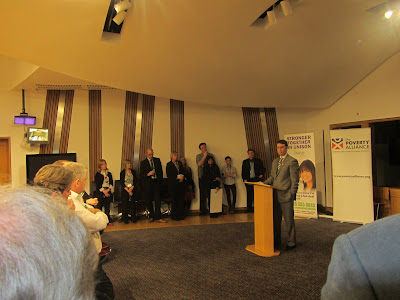
Speech by UNISON member Stuart Douglas at Living Wage event in Scottish Parliament, Thursday 8 November 2012 

Stuart Douglas speaks at Scottish Parliament 8 Thu Nov 2012
From Living Wage event Scottish Parliament 8 Nov 2012

Stuart Douglas and Deputy First Minister Nicola Sturgeon MSP at Scottish Parliament
From Living Wage event Scottish Parliament 8 Nov 2012

Thank you for opportunity to speak tonight - it's my first visit to the Scottish parliament.

I am from Clydebank currently working for the NHS at The Beardmore Hotel in Dalmuir. I am a UNISON member and steward in my workplace.

I benefit from a living wage because my union fought for a living wage in the NHS in Scotland. From 2005 till 2012 I worked on minimum wage, and it was only since May that brought me out of minimum wage employment.

So I have experienced the living wage from both sides.

I know what it like not going on holiday for 3 years, not being able to afford a car, having to spend 5 hours a week walking to work. Even though you work very hard, you don't earn enough to live just to exist, enough to get by but not to progress in life.

So you don't get to plan the next stage in your life.

And I am a single person but people that I worked alongside had children and often worried how difficult it was for them, because at an early age a child will learn that money comes before them.

The areas in and around my community like Clydebank, Drumchapel, Garscadden display shocking high levels of child poverty. In Drumchapel and Anniesland over 40% of children live in poverty.

That £30 or £40 pounds a week extra could make a real difference to the food you buy, time you have to spend with your kids and the experience they have at an early age.

As a young person living West Dunbartonshire I am upset and angry to hear that I live in the top UK unemployment black spot. Businesses are well aware they can pay the minimum wage for almost any job and that erodes wages for everyone. Unemployment is so high and wages are low, is doesn't inspire you, your not rewarded, not encouraged to work, it encourages worklessness.

Since I started to receive a living wage in May this year, it fundamentally alters the way you go about your job, because you feel valued, more loyal to your employer, carrying out your tasks maybe not more efficiently but to a higher standard. Accountable to the business because you feel a valued part of it rather than someone carrying out a mundane task, for as little as they can get away with paying you.

Companies don’t just gain loyal employees, a living wage is a social barometer that demonstrate an ability to act ethically.

The public sector should lead the way but other businesses should be required, expected to pay the living wage.

At the moment there are many people who may not work directly for the public sector but serve the public in their work. A patient in our hospital can be fed, treated and helped home by someone earning a living wage, but the home help that provides the aftercare, the chemist that provides medicine may be on poverty pay.

It divides society into a race to the bottom for everyone.

I'd like to thank the first minister, for my pay rise he announced this week, because the living wage increase will mean an extra £6.00 a week, that's £312 a year.

It’s amazing how much a few pence adds up.

I look forward to this parliament delivering a living wage nation for us all.

.

Thursday, 8 November 2012

UNISON welcomes Living Wage in Edinburgh

8 Nov 2012
News release from City of Edinburgh UNISON Branch
UNISON WELCOMES EDINBURGH LIVING WAGE

UNISON has welcomed Edinburgh council’s intention to pay a minimum ‘living wage’ of £7.50 an hour to its lowest paid council workers from January.

The union estimates 2,000 mainly low paid women will benefit.

Andy Barnett, Edinburgh UNISON Branch Secretary, said:
“This welcome announcement in Living Wage Week comes just after UNISON and the council agreed equal pay settlements for 3,000 low paid staff – another example of how much it benefits workers to be in their union.

“Edinburgh’s Labour and SNP ‘capital coalition’ have been as good as their word and have taken on board the argument UNISON made for the higher £7.50 minimum rate and early implementation.”

John Stevenson, Edinburgh UNISON Branch President, added:
“We have long campaigned for a Living Wage and made detailed submissions to the council on the benefits it would bring not just for staff, but for Edinburgh’s local economy. All the research shows that workers spend any extra money locally giving a boost to the local shops and businesses that are so badly affected by the government’s austerity measures.

“The next step is to campaign for the Edinburgh Living Wage to apply to all contractors and to convince businesses across the city of the benefits of paying their staff a living wage.”


See also News Release from City of Edinburgh Council 8 Nov 2012
Edinburgh set to introduce the living wage

http://www.edinburgh.gov.uk/news/article/1049/edinburgh_set_to_introduce_the_living_wage

.

Make minimum wage the Living Wage - UNISON

Thu 8 Nov 2012

Karen Jennings, Assistant General Secretary of UNISON, the UK's largest union, will today call for the Living Wage to become the minimum wage for all UK workers, as she gives evidence to the Low Pay Commission (LPC) in London.

The union is calling for the minimum wage to be raised in stages towards the Living Wage from 2013, and for it to be increased substantially this year to reflect the high cost of living.

The Living Wage is the minimum that workers need in order to provide themselves and their families with the essentials of life. Earlier this week (Tuesday 5 Nov) the new rates were set at £8.55 per hour in London and £7.45 outside of the capital.

UNISON has waged a long campaign for employers in both public and private sectors to make the Living Wage their bottom rate. A growing number of local authorities, Higher Education Institutions and Further Education colleges have signed up*.

In its submission to the Low Pay Commission, which sets the minimum wage rates each year, the union warns that high living costs and stagnant wages are making life a misery for many hardworking families. Research** has also shown that recent cost of living hikes have hit those on the lowest wages hardest.

Austerity for low paid workers is also self-defeating for the government warns the union. Boosting incomes for low paid workers, who are likely to spend their money in local shops and businesses, would provide much needed fuel for our struggling economy.

It would also help to cut the benefits bill. It is estimated that the government currently pays between £6 and £7 billion a year for in-work benefits to support workers paid below the Living Wage.

Karen Jennings, Assistant General Secretary, said:

"The minimum wage is an important floor; but it is sadly not high enough to give workers and their families a  decent standard of living.

"Poverty pay and high prices mean daily misery for hardworking families; the choice between heating and eating, and a struggle to afford even basic essentials. Meanwhile, pay for those at the top is spiralling ever upwards.

"Making the Living Wage the Minimum Wage would not only help families, but would help us all by cutting welfare spending and inequality. It is time for the government to take a bold step towards fairness and make the Living Wage the UK's minimum wage.

In its submission to the Low Pay Commission the union is also calling for:

-       Better enforcement of the National Minimum Wage, especially in agencies or industries with large numbers of migrant workers, and for employers to be named if they do not pay the minimum wage.
-       For the Low Pay Commission to be responsible for setting Living Wage rates.
-       Further guidance and enforcement action to prevent employers using interns as unpaid labour.
-       For the Low Pay Commission to investigate payment systems in home care - including travel time payments for workers.
-       The development rate for 18 to 20 year olds to be brought into line with the full national minimum wage rates, and for 16 to 17 year olds to be entitled to the development rate, with a view to harmonising it with the full adult rate over time.
-       For the rate for apprentices to rise to match existing youth rates.

*Public bodies already paying the Living Wage.

Councils outside of London that pay the Living Wage include Glasgow, Preston, Oxford City and North Lanarkshire.

Councils in London that have a full commitment to paying the London Living Wage include Southwark, Lewisham, Islington and Tower Hamlets. Hounslow, Ealing, Camden and City of London have also signed up but are yet to fully finalise their commitment to paying the London Living Wage.

The following education institutions pay the Living Wage - Queen Mary University of London, London School of Economics, School of Oriental and African Studies, Birkbeck College, University of London Union, School of Hygiene, Institute of Education, Goldsmiths College, London business School, London Met University, University College London, University of East London, Kings College, City and Islington College, Norlington Boys School, ARK Academy, St Charles 6th Form College.

Devolved Administrations - The Scottish Government's pay policy commits employers covered by it to pay a Scottish Living Wage of £7.20 per hour for 2012/13.


According to UNISON Scotland, 11 local authorities have adopted the Living Wage for directly employed staff and 8 others are in the process of implementing it.

UNISON has negotiated a Living Wage across NHS Scotland, and the bottom rate of pay in the NHS England is £7.24 per hour, 4p per hour above the current Living Wage rate.

In May 2012 the Welsh government announced that it has achieved the UK Living Wage rate of £7.20 per hour for directly employed staff in the Welsh Government Civil Service and the NHS.

Other public sector institutions: Greater London Authority, Olympic Delivery Authority, the House of Commons, the House of Lords, Scottish Enterprise and the London Fire Brigade.

**Research by the TUC as a part of its Living Standards Tracker has shown that rising food prices and soaring gas and electricity bills has meant that the cost of living has gone up faster for the poorest households. For example, in February 2012 the official CPI figure was 3.4% but for the poorest 10% of households it was 4.1%. The poorest households spend 17% of their income on food and non-alcoholic beverages, whilst the richest 10% spend just 10%.

ENDS


News release from UNISON UK
http://www.unison.org.uk/asppresspack/pressrelease_view.asp?id=2868
.

UNISON responds to report on nursery education around staff qualifications

Thu 7 Nov: Carol Ball, education spokeswoman for public service union Unison, said: "Child development officers plan and provide for the curriculum and educate children in nurseries to the same level as qualified teachers and, in some cases, our qualifications are more appropriate."

From Herald article:
Wide variations in childrens' access to teachers at nursery Thu 7 November by Andrew Denholm
http://www.heraldscotland.com/news/education/wide-variations-in-childrens-access-to-teachers-at-nursery.19361411


.

Tuesday, 6 November 2012

#StrongerTogether in @unisonscot - more branches working hard - #joinUNISON


Lanarkshire Health branch stewards recruiting in Motherwell Health Centre


New stewards from three colleges that are merging - Reid Kerr, James Watt and Clydebank.
Great discussions on the training course about recruitment and the Stronger Together campaign.

Ayr Station

And the ad on the 4A bus in Prestwick

Glasgow City Council branch's street stall in Argyle Street.

Argyll & Bute branch are sponsoring football strips in Oban, Dunoon and Campbelltown.

And Forth Valley Health reps training course, with a focus on Stronger Together.

The phone box in Garshake Road, near West Dunbartonshire Council HQ in Dumbarton.


#StrongerTogether in @unisonscot - more recruitment campaign pictures from branches

Our ad on a bus in Motherwell town centre
And below...pictures from the Adtrailer's recent visits to support branch campaigning activity in Lanarkshire...

At Carluke Leisure Centre

At Hairmyres Hospital, East Kilbride

At the main station in Hamilton

And at South Lanarkshire council HQ in Hamilton

Hamilton Palace Towers retail park

Monklands Hospital, Airdrie

Monklands Hospital again

Motherwell Civic Centre

Wishaw General Hospital

And Aquatec Leisure Centre in Motherwell


Ravenscraig Regional Sports Facility

Antonine Shopping Centre, Cumbernauld

Cumbernauld Shopping Centre

And at the Time Capsule in Coatbridge


.


Monday, 5 November 2012

A Living Wage must be guaranteed on public sector contracts - UNISON

Date: Monday 5 November 2012

UNISON Scotland today urged the Scottish government to use its new procurement law to ensure that public money is only spent with contractors who pay a Living Wage.

Scotland’s largest public services union – along with the Scottish Living Wage Campaign and the Scottish TUC – has made the call as part of Living Wage Week which kicks off today.

Stephen Smellie, Vice Convener of UNISON Scotland said:
“We have made good progress in achieving the Scottish Living Wage so far. Almost all the public sector in Scotland is now committed to paying the Scottish Living Wage - currently at £7.20 per hour, although the new rate will be £7.45. That is good for workers, employers and the wider community.

“But it is a scandal that nearly one in four Scots are still earning below the current Living Wage level. This includes many UNISON members in the community and private sectors.”

“The next step is for the Scottish government to take action to ensure that public money is only spent with contractors who pay a Living Wage.”

Dave Watson, UNISON Scotland’s Head of Bargaining and Campaigns said:

“We believe there are four ways in which the Scottish government can make a real difference on extending the Living Wage to those not yet covered. They can use their new procurement law to require firms bidding for public sector contracts to pay the Living Wage. They can use their influence with the European Commission to remove barriers to the Living Wage. They can establish a Living Wage Unit to promote and oversee the policy. And they can produce a Code of Practice on promoting the living wage in procurement.

UNISON is also supporting the One Fair Wage campaign by the Scottish Youth Parliament, and a private members’ bill proposed by Scottish Labour MSP John Park which is currently out for consultation and which also seeks to achieve these objectives.


ENDS

Notes for editors

1. The Scottish Living Wage – UNISON Scotland Briefing 29

Please see the latest UNISON Scotland briefing on The Scottish Living Wage (released today 5 November 2012) at our website here
http://www.unison-scotland.org.uk/briefings/b029_BargainingBrief_ScottishLivingWage_Nov2012.pdf

The Scottish Living Wage - currently at £7.20 per hour, although the new rate will be £7.45 - is good news for workers as they get higher wages that also improves health and job motivation. It’s good for employers because it reduces turnover, improves productivity and attracts better staff through reputational gain. The wider community benefits through lower benefit cost, less stress on the NHS and cash into the local economy.

The Institute of Fiscal studies has calculated sub-living wage employers cost the taxpayer £6bn a year in in-work benefits alone. The indirect cost on poverty is around £25bn a year.

In contrast the cost to employers is minimal at around 1% of wage bill. Even in the retail sector it is only 5%. As a recent study of the London Living Wage shows, even that can be recouped through decreased turnover and better productivity. Even Boris Johnson, the Tory Mayor of London said, “I believe that paying decent wages reduces staff turnover and produces a more motivated and productive workforce”.


2. Four key actions the Scottish government can take to promote the Scottish Living Wage:
  • Use the Procurement Reform Bill to amend the Public Contracts (Scotland) Regulations 2006 to require that the living wage is a part of any contracting authorities bid for a public sector contract.
  • Seek to influence the European Commission to remove any perceived barriers in EU Directives that prevent the inclusion of the living wage in procurement.
  • Establish a Living Wage Unit to advise on, promote and oversee the living wage in the public sector and in procurement.
  • In partnership with stakeholders, develop and produce a Code of Practice on promoting the living wage in procurement.

The Scottish Parliament Local Government Committee has produced a detailed report on the Scottish Living Wage that covers many of the key issues and broadly supported its introduction.

UNISON believes that payment of the living wage can be included as a contract performance clause that sets out how the contract is to be performed and must be accepted by the successful tenderer. The Local Government Committee report (Para 98) covers this in more detail and includes a positive Counsel opinion that branches can refer to. The legal risk is largely theoretical as there have been no successful challenges to the policy in the UK.

The EU is also reviewing the Directives that are perceived to be a barrier to procurement clauses. UNISON is working closely with Scottish MEPs to ensure there are no European procurement barriers.


3. Useful links

UNISON response to Procurement Bill consultation
http://www.unison-scotland.org.uk/response/ProcurementReformBill_Response_Nov2012.pdf

John Park MSP’s Bill
http://www.scottish.parliament.uk/parliamentarybusiness/Bills/53618.aspx

London Living wage evaluation report
http://www.geog.qmul.ac.uk/livingwage/

Scottish Youth Parliament – Fair Wage Campaign
http://www.syp.org.uk/one-fair-wage-W21page-345-

Dave Prentis and David Miliband on the living wage
http://www.guardian.co.uk/commentisfree/2012/nov/03/miliband-prentis-living-wage

.

#StrongerTogether in @unisonscot - Stirling shopping centre ads & Orkney campaigning

Here's our Stronger Together ads in the Thistles shopping centre in Stirling - and, below that, a Halloween recruitment stall, part of the campaign activities organised by the Orkney health branch.


Friday, 2 November 2012

Occupational Health and Safety


As early as 2009, David Cameron called for an end to the ‘over-the-top’ health and safety culture in Great Britain. In January 2012, he pledged that, ‘one of the coalition’s new year resolutions is this: 'kill off the health and safety culture for good.’

In Scotland, the lethal combination of weak regulation and heavy industry caused endemic levels of occupational illness and disability. Through images, film and oral testimony this event highlights the lived experiences of Scots whose health has been affected by their occupation and illustrates both the risks of trivialising occupational health and safety and the complexities surrounding responsibility.

Understanding Occupational Health and Safety in Scotland since 1800
Saturday 10 November 2012
Summerlee Museum of Scottish Industrial life, Coatbridge
1.00pm to 4.00pm

Scotland should ban companies involved in tax dodging from public contracts

Friday 2 November 2012


UNISON Scotland today urged the Scottish Government to ban companies involved in tax dodging from being eligible for public contracts.

The public services union said that Ministers should use their forthcoming Procurement Reform Bill to take innovative action against companies using tax havens and other forms of tax dodging.

Scottish Organiser Dave Watson said: "It is entirely wrong that companies seeking to avoid paying their fair share of tax should be awarded public contracts.

"Public bodies in Scotland spend nearly £11 billion annually through procurement. This Bill offers ways to use that spending to deliver local social, economic and environmental benefits.

"We think this is an important opportunity to do what some European cities such as Helsinki and Paris are already doing, in acting against companies using tax havens.

"Our message to the Scottish Government is that they should adopt a tax justice approach, finding ways, with appropriate legal advice, to bar companies involved in tax dodging from being eligible to bid."

Recently public outrage has focused on big-name companies like Google, Amazon and Starbucks paying miniscule amounts of tax. Many companies investing in PPP/PFI projects are registered in tax havens.

UNISON believes that community benefit clauses could be used to argue that the community will benefit from companies paying proper levels of taxes.

Dave added: "This Bill also offers opportunities to strengthen labour rights and workforce protections, to extend the Living Wage to private sector employees on public contracts and to exclude companies involved in blacklisting trade unionists from bidding for public contracts.

"And, of course, public procurement policies must contribute properly to Scotland’s climate change targets and must support a ‘Just Transition’ to a low carbon economy."

Ends
 
Notes for Editors:
1. UNISON’s Procurement Reform Bill Consultation response is online at 
www.unison-scotland.org.uk/response/ProcurementReformBill_Response_Nov2012.pdf
2. A number of European cities/regions are already acting against companies that use tax havens.
www.ipsnews.net/2012/10/helsinki-boycotts-tax-havens/
3. Richard Murphy, of Tax Research UK, and adviser to the Tax Justice Network, says that legislation in England, the Public Services (Social Value) Act 2012, provides councils there with ways to argue for this that would not breach EU procurement rules. This would include councils being able to demonstrate that a large company paying tax would benefit the community through funding for better education, roads etc. This would allow them to choose a tender on the basis of which company pays tax or not.
www.taxresearch.org.uk/Blog/2012/10/23/the-october-taxcast-from-the-tax-justice-network/  UNISON believes the Procurement Reform Bill could use a similar approach.
4.There has been considerable success in winning the Living Wage for public service workers in Scotland – directly employed Scottish Government and NDPB staff, the NHS, a growing number of councils -  but UNISON wants to see it extended to staff employed by contractors and this Bill offers the chance to do this. We also support John Park MSP’s Living Wage (Scotland) Bill.
www.scottish.parliament.uk/S4_MembersBills/Living_Wage_Consultation_Final.pdf
5. Living Wage week takes place next week, from 4-10 November. The Scottish Living Wage Campaign website is at
http://slw.povertyalliance.org/index.php  

.

Ministers must act now to protect FOI rights - UNISON welcomes Finance Ctte Report


2 Nov 2012 

UNISON welcomes the fact that the Scottish Parliament's Finance Committee has today called on Ministers to act on lost Freedom of Information rights.

The Committee’s Stage 1 Report on the Freedom of Information (Amendment) (Scotland) Bill asks the Scottish Government to consider amendments on extending coverage to protect the public’s right to know.

The Campaign for Freedom of Information in Scotland also welcomed the report. (news release below)

We urge the Scottish Government to now amend the Bill to ensure that the public has full rights to information on PPP/PFI contracts, leisure trusts, housing associations and other bodies currently not covered.

Last month Scottish Information Commissioner Rosemary Agnew, who in September gave evidence to the Committee, stressed again that extending the Act is necessary to protect rights.

She said in her Oct 12 newsletter:

“It is now ten years since the FOI provision to designate additional bodies was enacted, yet in that decade no orders have been made, despite radical changes to the public sector landscape.
“It is easy to think of designation principally in terms of an extension of the right to information. However, a failure to designate is increasingly representative of a failure to protect rights.

“By not designating new authorities rights to information are being lost through the outsourcing of public service delivery - whether it be to PFI contractors, external "arms-length" organisations, or other third parties.

“Since the FOI Act came into force in 2005, for example, 15,000 Scottish households have lost FOI rights as a result of the transfer of local authority housing stock to housing associations.”


CFoIS news release today...

Time for Scottish Government to act on Freedom of Information


The Campaign for Freedom of Information in Scotland (CFoIS) today endorsed the Scottish Parliament Finance Committee’s conclusions on the Freedom of Information (Amendment) (Scotland) Bill. The Committee, in its Stage One report called on the government to bring forward proposals to protect the public’s right to know.  

CFoIS is pleased the Committee has listened to its evidence that legal reform must address the increasing number of public services that are being moved outwith the scope of Freedom of Information legislation via private contractors, housing associations, arms-length organisations and voluntary bodies.

The Committee requested that the Scottish Government come forward with fresh proposals at Stage 2.  CFoIS believes a ‘purpose’ clause should be added to the Bill and Section 5 of the Freedom of Information (Scotland) Act 2002 amended ensuring all public services are covered by FoI.  These two reforms will ensure the public have an enforceable right to access information when public services or services of a public nature are delivered.   

CFoIS also called for the proposed absolute exemption for Royal Communications to be dropped and is relieved that the Committee agrees.  We believe there is no case to change the current arrangement whereby the existing exemption is subjected to a ‘public interest’ test.

The Committee states:

“... in relation to the Royal exemption the Committee invites the Scottish Government to remove the Bill’s section 1 provision at Stage 2.63 The Committee also invites the Cabinet Secretary to provide details and timings of how the Scottish Government intends to take forward the issue of extension of coverage and clarify what the options are which she is ‘actively considering’, including the possibility of Stage 2 amendments to section 5 of the 2002 Act. In the light of this response, the Committee will reconsider its position on this issue at Stage 2.” (Para 93 http://www.scottish.parliament.uk/parliamentarybusiness/CurrentCommittees/56170.aspx)

Carole Ewart, Co-convener of the CFoIS said “We are delighted that the Finance Committee has identified that people’s right to know is not as effective in 2012, as it was in 2002 when the law was passed, and 2005 when it came into force.

“It is now time for the Scottish Government to accept the Committee’s conclusions and the evidence provided and introduce the necessary amendments so Scottish FoI law is once more pre-eminent in the UK.”

UNISON Scotland’s submission to the Finance Committee on the Bill is here 


.


Thursday, 1 November 2012

#StrongerTogether in @unisonscot - branch action and pictures from Edinburgh


Lothian Health branch were busy at the Royal Infirmary Edinburgh yesterday.


And on Tuesday the Adtrailer was outside Chesser House, in Gorgie Road, an Edinburgh council contact centre.


Keep putting your pictures on Facebook and Twitter - hashtags #StrongerTogether #joinUNISON

Wednesday, 31 October 2012

#StrongerTogether in @unisonscot - Pictures from recruitment events around the country

 Branches around Scotland have been busy organising Stronger Together recruitment events


Argyll and Bute stewards, with UNISON Scotland Regional Organiser Bridget Hunter,
Lead Officer for Nurses and Midwives 

Ayrshire and Arran health branch held a student nurse
event on the Stronger Together campaign
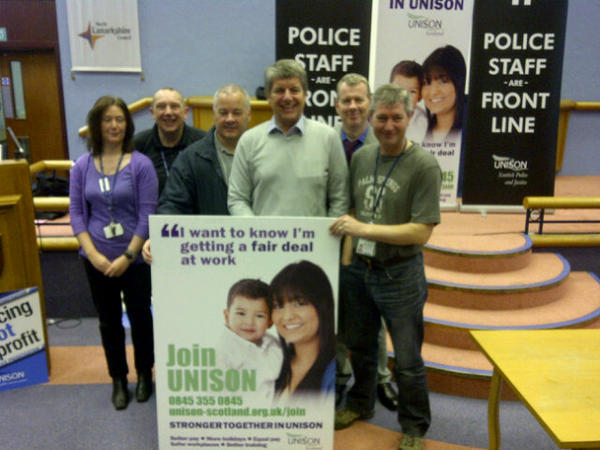
Strathclyde Police branch is holding meetings on the move to a single police service in Scotland – and so many people turned up they ran out of membership forms.


Area Organiser Deborah Dyer said: “We started our series of reform meetings yesterday at Pitt street under the Stronger Together banner.  

“More than 400 police staff attended with 11 Stewards assisting.  Deputy Chief Constable Ruaraidh Nicholson also attended the second meeting to show his support for police staff.

“The turnout was amazing and staff were saying they felt supported and had a better understand of the challenges they face.  Both sessions had a robust Q&A session at the end with people agreeing to recruit colleagues to UNISON to protect their terms and conditions.”


Above and right - the recruitment stall at an information day at Forth Valley Royal hospital in Larbert

Above and right - Grampian Health branch recruiting - and an entrant to their 'Spot the Ad' competition.
And the Stronger Together advert on a Lothian Bus. Have you spotted any? Send in the pictures!